
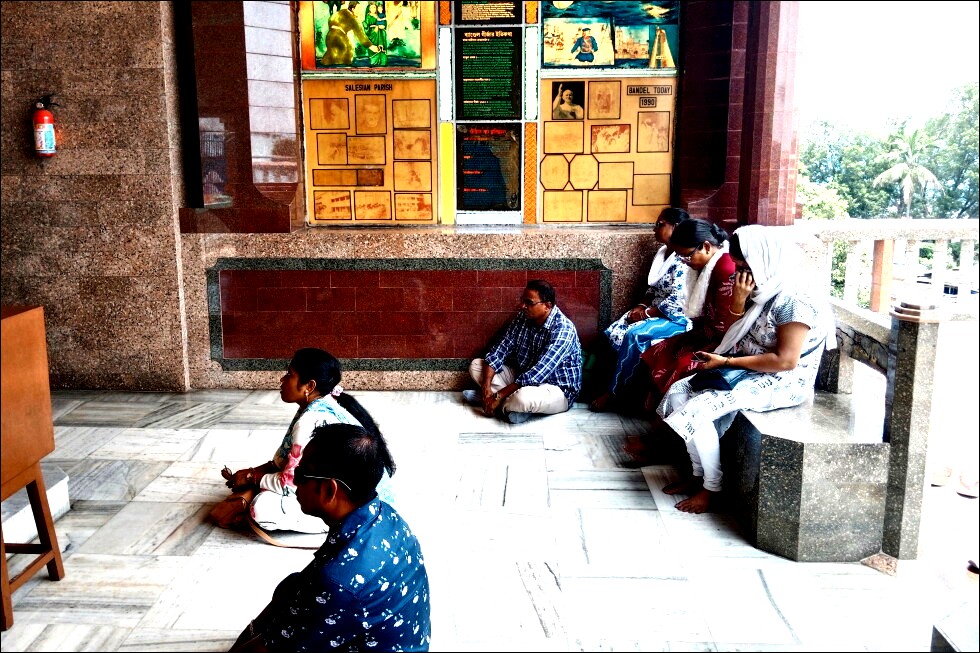
Bandel, India — For over 13 years, 28-year-old Rimpa Chowdhury, a devoted Hindu, has made it a weekly ritual to visit the Basilica of the Holy Rosary, a historic Catholic church dating back to the 16th century. Located on the banks of the Hooghly River, this church features a shrine dedicated to the Virgin Mary, which has become a source of comfort and community for many, including Chowdhury.
Situated about 50 miles north of Kolkata, the capital of West Bengal, the Bandel Church is not just a place of worship for Chowdhury; it’s a sanctuary where she finds peace and support. “There’s something special about this place,” she shared, dressed in a flowing green tunic. “A shrine takes on new meaning when a woman has authority over it.”
Every year, thousands of pilgrims, mainly Hindus and Muslims, flock to the basilica during special feast days, drawing on what they call the “power of the divine feminine.” They believe in the strength of Mary, the mother of Jesus, and many travelers come to pray for protection at the church’s prominent statue of “Our Lady of Happy Voyage.” In 1988, Pope John Paul II recognized its significance by declaring the church a minor basilica.
The history of this site dates back to the late 1500s when Catholic Augustinian friars and Portuguese traders settled in Bengal. The original church was built in 1599 but faced destruction from invasions and natural disasters. However, the legend of Mary’s statue being saved from the river helped mark her as a divine protector of the community. Father John Chalil, the church’s lead priest, notes that “devotees from across India come here looking for shelter,” emphasizing the area’s rich spiritual connection.
Since the 1950s, various groups of nuns have contributed to the shrine’s mission, fostering social harmony amid the region’s diverse religious landscape, which includes terracotta temples, mosques, and churches. The local community embraces collaborative efforts beyond their religious differences, with outreach programs focusing on women’s rights and tribal welfare. “Our mission is to educate and assist,” said Sister Nirmala, who has served at the Bandel shrine for over 15 years. “People have not allowed their faith in Mary to be affected by religious differences.”
Nuns assist pilgrims in spiritual nurturing and community support, even as tensions across India rise. Organizations like Mother Teresa’s Missionaries of Charity provide crucial health services, while other orders offer counseling, retreats, and educational support for underprivileged girls.
Sister Philomena Mathew expressed concern over growing anti-Christian sentiment in India, stating, “We’re ready to stand up against any disruptions to peace in our community.” Since the rise of the Bharatiya Janata Party (BJP) in 2014, incidents of violence targeting Christians have surged, raising alarm among minority groups. Reporting an uptick in attacks, AC Michael from the United Christian Forum noted, “What began as isolated incidents has turned systemic.”
Though West Bengal traditionally offered a safer environment, recent political changes have sparked fear of rising intolerance. Mother Teresa’s Missionaries of Charity have faced scrutiny from extremist groups, which claim their charitable efforts aim to convert Hindus. Despite a significant backlash, they managed to regain operational licenses after a brief suspension.
Sister Jesline Rose, serving at the church, emphasized their commitment to harmony, saying, “Even if the political climate is shifting, we will continue to maintain our diverse spirit.” Nuns frequently visit nearby Hindu and Muslim households, providing spiritual care to those facing challenges. They help pilgrims express their prayers by inviting them to write intentions on paper slips, which are placed near Mary’s statue.
During festivals, the nuns welcome thousands of attendees from different faiths, creating a space for unity and thanksgiving. The church symbolizes shared cultural heritage, with the nuns acting as guardians of this faith. The local community sees the divine feminine as an essential strength against rising extremism.
“We find hope in the nuns,” said Chowdhury, who lives in the nearby alleyways filled with households of diverse beliefs. She remains apprehensive about the growing intolerance in India but believes in the protective power of Mother Mary. “She is a guardian for all of us who visit this church,” she affirmed.
