
India’s Crude Oil Imports Steady in First Half of 2026
India’s crude oil imports have remained fairly stable in the first half of this year, according to a report from shipbroker Banchero Costa. They noted that after a small drop in 2024, the sea-borne crude oil market began to recover in 2025, with an increase of 1.8% year-on-year. However, in the first half of 2026, global crude loadings saw a decline of 6.1% year-on-year, totaling 1,016.4 million tonnes, excluding cabotage trade. Exports from the Arabian Gulf suffered a significant drop of 30.7% year-on-year, reaching 299.7 million tonnes, which is a stark decrease from the usual 40% of global maritime crude trade, influenced by ongoing conflicts in the region. Meanwhile, exports from Russian ports, including oil originating from Kazakhstan, rose by 3.5% year-on-year to 117.1 million tonnes, while South American exports surged by 31.5% to 137.6 million tonnes, and U.S. exports grew by 20.5% to 107.3 million tonnes.
Banchero Costa also highlighted that Mainland China remained the leading importer of crude oil, accounting for 20.5% of global trade. However, imports into China dipped by 14.2% year-on-year to 209.5 million tonnes. The European Union saw a slight increase of 1.7% in crude oil imports, totaling 227.6 million tonnes, while South Korea and Japan experienced declines of 18.5% and 22.5%, respectively. On the other hand, U.S. imports increased by 8.9% to 62.8 million tonnes during this period.
As for India, it fell into the fourth position among the world’s largest crude oil importers, trailing behind the EU, China, and ASEAN nations, contributing to 11.7% of global crude trade. Seaborne imports to India increased by 2.4% year-on-year in 2023, 2.5% in 2024, and another 2.5% in 2025. However, in the first half of 2026, crude imports saw a slight drop of 0.3% to 119.4 million tonnes compared to the same period last year. Notably, around 48% of the crude oil received in India was transported by Very Large Crude Carriers (VLCCs), with Suezmaxes and Aframaxes accounting for 30% and 22%, respectively.
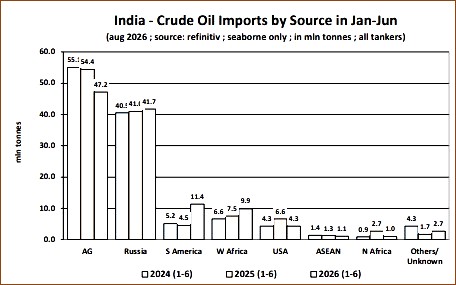
The main ports for crude oil discharge in India during January to June 2026 were Jamnagar, Vadinar, Paradip, Mundra, and Mumbai, leading the rankings with substantial volumes. The shipbroker also noted a politically driven reshuffling in sources of imports. Seaborne imports from Russia climbed from just 4.1 million tonnes in 2021 to a peak of 82 million tonnes in 2024 but slightly decreased to 79.5 million tonnes in 2025. In the first half of 2026, imports from Russia edged up by 1.8% year-on-year to 41.7 million tonnes.
Additionally, Russian ports stood as the second-largest source of crude for India, supplying 35.0% of the volumes, closely following the Arabian Gulf at 39.5%. The report revealed that shipments from the Arabian Gulf dropped by 13.3% year-on-year to 47.2 million tonnes. Interestingly, Saudi Arabia remained India’s top supplier in this region, while imports from the UAE increased significantly, overtaking Iraq as the second-largest supplier.
In summary, while India’s crude oil imports have seen minor fluctuations, the global market dynamics have shifted considerably, influenced by geopolitical factors and changes in demand.
