
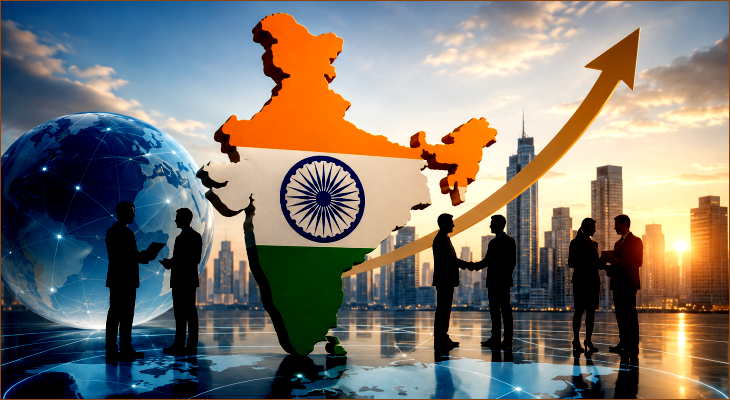
India Rises as a Top Business Hub for Multinationals
India has been recognized as the second-most appealing business environment for multinational companies, according to a recent report from the World Economic Forum. This news comes amid increasing geopolitical tensions and economic uncertainties around the globe, showcasing India’s growing attractiveness as a destination for international businesses.
The report, part of the Chief Economists’ Outlook for May 2026, highlights the hurdles facing the global economy, such as conflicts and supply-chain disruptions. Despite these challenges, India stands out as a preferred choice, trailing only the United States and surpassing regions like Europe and China.
India’s Allure for Global Investors
A survey involving 38 chief economists from prominent global organizations revealed that 56% regard India as one of the top three business-friendly environments for the next year. The United States topped the list with 65% support, while Southeast Asia came in at 50%, followed by Europe and China at 44% and 35%, respectively.
The report attributes India’s strong position to its large market size, economic growth, and favorable policies. It noted India’s efforts to expand trade, maintain active economic policies, and enhance market accessibility.
The World Economic Forum emphasized India’s commitment to free trade and the pursuit of new trade agreements, which have played a significant role in boosting investor confidence.
Changing Global Business Landscape
The report indicates that multinational companies are reevaluating where to invest due to shifting geopolitical risks. It points out that businesses are increasingly focused on markets that display resilience and adaptability to global uncertainties.
While the United States maintains its top spot due to robust capital markets and a large consumer base, India is recognized for its mix of growth prospects and supportive policies.
Southeast Asia’s Role in Supply Chain Diversification
Southeast Asia is becoming increasingly relevant as global supply chains adapt and diversify. Almost half of the chief economists surveyed anticipate moderate growth in this region in the coming year, with 21% expecting strong growth, thanks to its growing manufacturing and logistics capabilities.
However, experts warn that factors like weaker demand from abroad and rising imports of cheaper goods from China could dampen growth in Southeast Asia.
Global Challenges Amidst Conflict and Inflation
The broader global outlook, as described by the WEF, remains bleak. Ongoing conflicts and disruptions in trade routes are raising economic risks worldwide. Notably, the outlook for the Middle East and North Africa has worsened, with 88% of economists predicting weak growth. Additionally, inflation concerns are rising in several emerging regions, particularly Sub-Saharan Africa.
Japan also faces a grim outlook, with many economists expecting slow growth due to high energy costs and external uncertainties.
India: A Bright Spot in the Economic Landscape
In this challenging context, India’s strong positioning is notable. The report suggests that multinational companies are increasingly seeing India as a strategic market that can offer both growth opportunities and resilience in supply chains.
As businesses adapt to geopolitical changes, India seems primed to capture a larger share of global investments and expansions in the years to come.
