
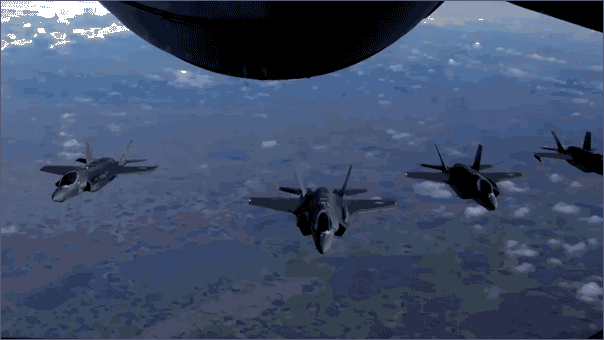
Military Exercises Highlight U.S. Readiness in Alaska Amid Rising Tensions
In one of the coldest and most remote areas of the United States, American troops are enhancing their skills for land, air, and sea operations. In western Alaska, forces are swiftly deploying rocket systems, sending F-35s and F-16s into the skies to simulate responses to threats, and coordinating naval movements with Canadian warships in the Bering Sea.
These activities are part of Tundra Merlin, a long-term military initiative aimed at demonstrating the ability of U.S. and allied forces to quickly mobilize combat capabilities in Alaska’s harsh Arctic conditions to protect the nation’s northern borders.
The urgency behind these exercises is rooted in a shifting global security landscape, increasingly influenced by the actions of Russia and China.
Highlighting Operations in Alaska
Lt. Gen. Robert Davis, leader of Alaskan Command, shared that two primary factors are driving these changes—melting sea ice in the Arctic has made the area more accessible, inviting increased commercial and military activities, especially during the summer months. Additionally, countries like China and Russia are advancing their military capabilities, intent on showcasing their strength in the Arctic.
In 2024, the Pentagon reinforced these concerns in its Arctic Strategy, warning that growing cooperation between Russia and China could destabilize the region. It emphasized the need for a greater U.S. military presence and preparedness to respond to potential threats in this newly opened frontier.
Alaska: A Strategic Military Hub
Alaska is strategically located at the junction of the Arctic and Pacific, serving as a vital base for national defense and extending U.S. military power into the Indo-Pacific. The Russian and U.S. landmasses are only about 55 miles apart in some areas, while the Big and Little Diomede Islands are just 2.5 miles apart. This proximity underscores Alaska’s significance in military strategy.
The state hosts critical military infrastructure, including air bases and missile-defense systems, with over 22,000 active-duty personnel stationed there. U.S. Air Force officials describe Alaska as the “crossroads of the Arctic and Pacific.”
Davis explained that military forces based in Alaska could respond quickly to any threats throughout the Northern Hemisphere, making the region essential for defense and power projection.
Demonstrating Capability Through Tundra Merlin
The Tundra Merlin exercises are designed to showcase Alaska’s geographic advantages in military readiness. As Davis put it, the operations feature a series of strategic “plays” that can be activated to deter aggressors or respond to threats if they occur.
A recent demonstration highlighted this capacity, as U.S. and Canadian forces quickly deployed a mobile rocket system and radar equipment to western Alaska. This operation saw ground forces coordinate with U.S. air power, including F-35s and F-16s, to simulate an integrated response to a potential attack.
Davis remarked that the objective was not only to showcase the individual systems but also to demonstrate how fast forces could be mobilized and interconnected in Alaska’s remote settings, thus establishing a robust defense network.
Challenges in Arctic Operations
Despite these promising capabilities, Alaska’s unique challenges cannot be ignored. Harsh weather conditions can hinder military operations, while the vast distances and limited infrastructure complicate logistics and resupply efforts. The Pentagon acknowledges these obstacles and has identified maintaining infrastructure in Alaska as crucial for effective military operations.
To operate safely and effectively in such cold environments, military equipment must be specially adapted, and personnel need proper training to avoid cold-related injuries.
Conclusion: Preparing for Future Threats
The increasing military activities by China and Russia near North America highlight the importance of U.S. readiness. In July 2024, the North American Aerospace Defense Command (NORAD) intercepted a joint flight of Russian and Chinese bombers in the Alaskan airspace, showcasing the cooperation between these nations.
Presently, Davis believes that Alaska is well-prepared to address foreseeable military threats, but he indicated that any major escalation would lead to requests for additional military resources.
Ultimately, Tundra Merlin seeks to affirm that, despite formidable challenges, the U.S. can mobilize forces effectively across Alaska, ensuring combat readiness against potential aggressors on the nation’s northern front.
