
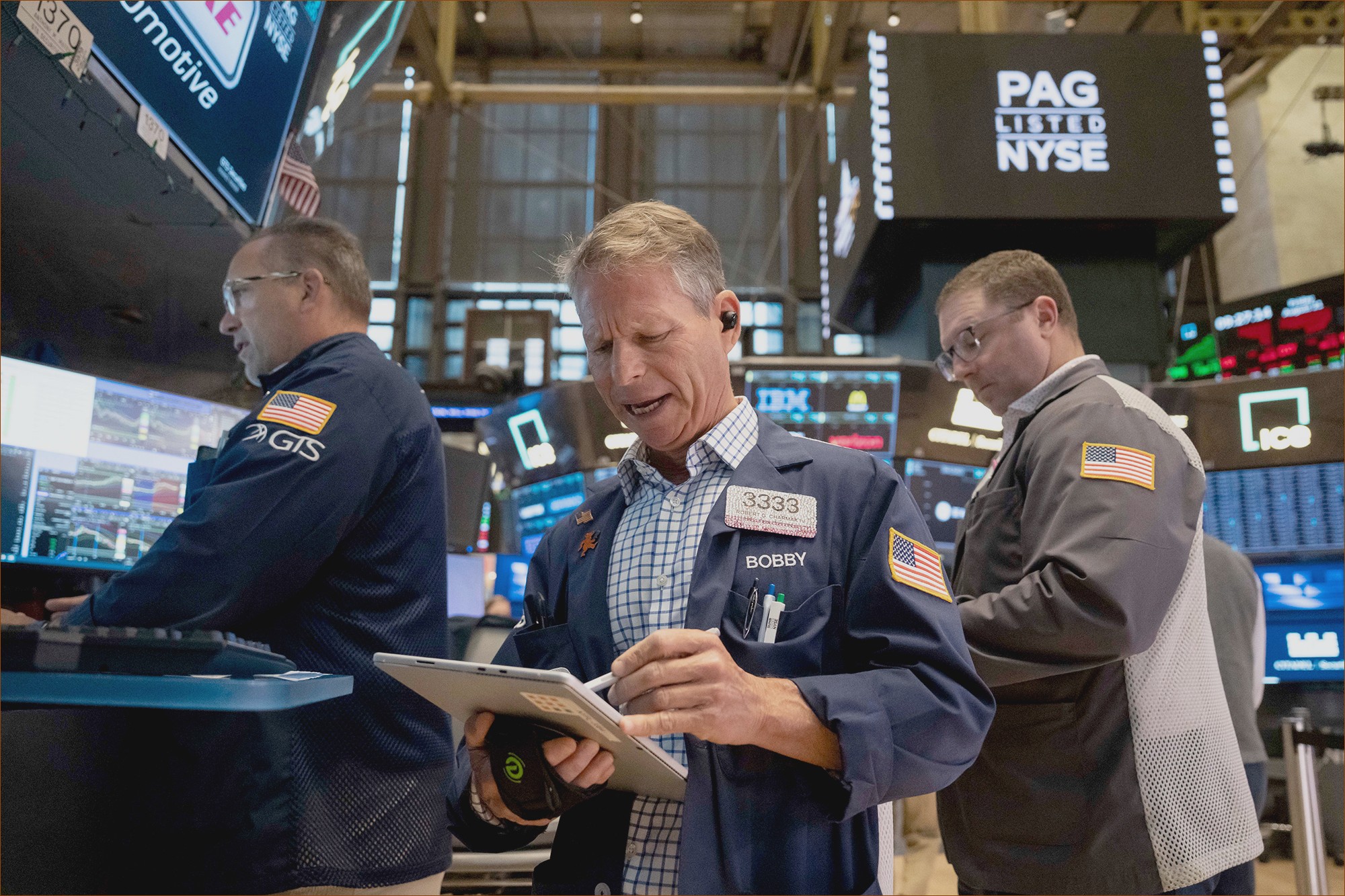
Tech Stocks Push Wall Street Higher
NEW YORK – Wall Street saw a positive day on Thursday, largely thanks to strong performances from technology companies. Major players like Nvidia and Salesforce reported profits that exceeded expectations for the spring quarter, boosting investor confidence.
The S&P 500 index gained 0.7%, inching closer to its record high achieved earlier this month. The Dow Jones Industrial Average rose by 105 points, or 0.2%, while the Nasdaq composite surged by 1.6%.
Nvidia played a pivotal role in lifting the market, with its shares climbing 8.7% after the company reported stronger-than-expected profits and revenue. More significantly, Nvidia provided optimistic revenue forecasts, indicating that demand for chips—a key component in driving artificial intelligence projects—remains robust. Nvidia’s CEO, Jensen Huang, remarked, “AI has reached its inflection point. It’s now doing useful and profitable work.”
This news helped ease some concerns about AI stocks, which had experienced a downturn previously. After enjoying a surge due to excitement over AI, these stocks faced skepticism over whether their high valuations could be sustained, especially if demand for AI chips doesn’t generate the anticipated profits.
Salesforce also celebrated a remarkable day, with its stock jumping 22.6%. The company credited AI with helping to achieve one of its most successful quarters ever. CEO Marc Benioff highlighted “incredible demand for our AI and data products,” resulting in a raised revenue forecast for the year ahead. Additionally, Salesforce announced an expanded partnership with Anthropic to integrate its Claude chatbot, marking a significant move since fears of competition had previously weighed on Salesforce’s stock. This was the company’s best day in six years.
However, the day was not uniformly positive across the stock market. Several companies within the S&P 500 saw their share prices dip. HP saw a decrease of 2.9% despite beating profit and revenue estimates. Analysts expressed concerns over its personal computer sales and higher costs for computer parts, which are squeezing profit margins.
Retailers like Best Buy also faced challenges amid ongoing concerns about how inflation may be affecting consumer spending. Best Buy dropped 4.4%, despite surpassing expectations for its quarterly performance.
On a more positive note, dollar stores could benefit from high inflation as more shoppers look for budget-friendly options. Dollar General’s shares rose 2.5% after reporting stronger profits. However, rival Dollar Tree saw a 3.9% decline despite exceeding profit expectations due to a disappointing forecast for key revenue metrics.
In summary, the S&P 500 climbed 55.29 points to settle at 7,730.99. The Dow added 105.56 points to reach 53,569.44, and the Nasdaq rose 411.16 points, closing at 26,541.35.
In the bond market, Treasury yields experienced a modest increase following a report illustrating a resilient job market. Fewer Americans applied for unemployment benefits last week, pointing to stable employment levels. As a result, the yield on the 10-year Treasury rose slightly to 4.67%.
Concerns about persistent inflation and growing national debt have kept yields on the rise throughout the summer, prompting the Treasury Department to intervene last week in the bond market, though the potential impact of this move is debated among analysts.
Looking ahead, all eyes will be on the Federal Reserve, particularly Chairman Kevin Warsh, who is set to address the markets. There is anticipation that he may offer clearer guidance on future interest rate decisions aimed at controlling inflation.
Oil prices remain a wildcard in the inflation equation due to uncertainty surrounding shipping conditions in the Persian Gulf. On Thursday, Brent crude oil prices rose by 1.8% to reach $88.52 a barrel.
Globally, stocks had mixed results, with markets in Europe and Asia showing varied performance. In Asia, stocks rose in Seoul and Shanghai by 1.5% and 1.1%, respectively, while Paris experienced a decline of 1.7%.
