
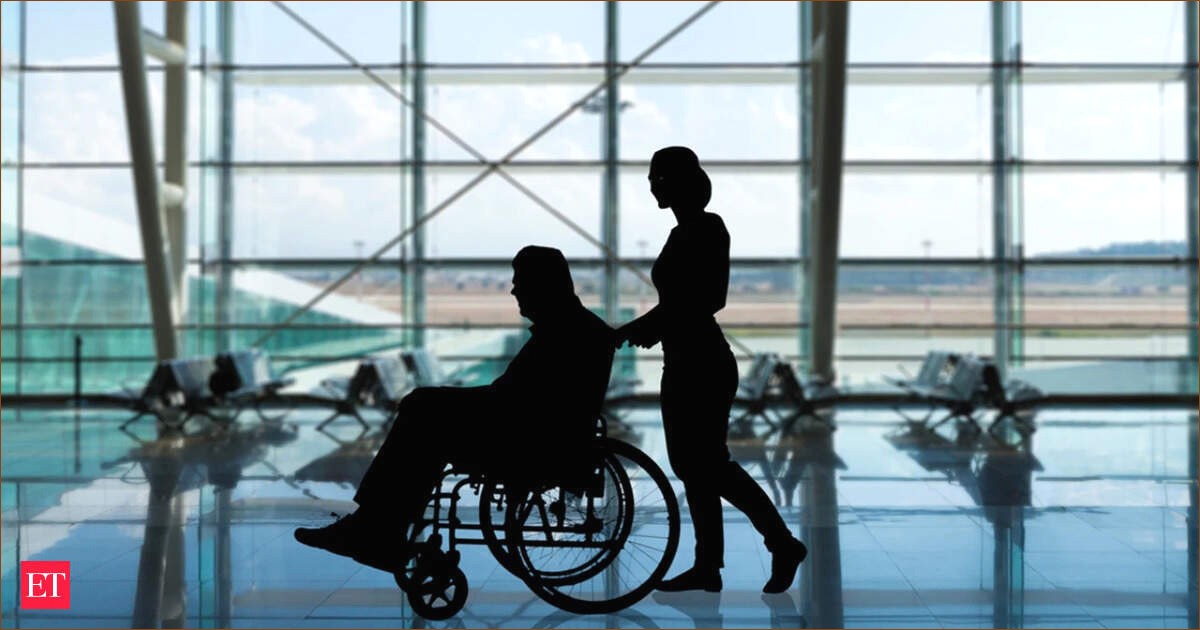
Wheelchair Use at Airports: A Growing Trend
In India, it’s becoming increasingly common to see passengers using wheelchairs at airports. Someone unfamiliar with the country might assume that there are more people unable to walk than in other places. The reality is that in India, many people can afford to avoid walking by hiring help or doing things online, which makes life a bit easier.
Recently, on a flight from Kolkata to Delhi, I noticed 14 passengers in wheelchairs. Since most of them were accompanied by family members, this meant around 50 people were given priority boarding. Observing them closely, it was clear that a number of these passengers might struggle to walk long distances at the busy Delhi airport.
Among the crowd were a Union minister and a retired judge, both of whom faced the challenge of navigating the airport after the flight landed at the far-off Gate 52. An electric golf cart conveniently arrived just as the former judge stepped off the aerobridge, whisking him away, while the minister opted to walk. Sadly, for the rest of us, no additional carts appeared.
It’s easy to see why demand for wheelchairs might increase, but how can we find a solution? While many modern airports have moving walkways, they still require a fair amount of walking. Those who choose to stand still on these walkways often face impatient requests to move aside. Clearly, we need a better way to help both passengers who genuinely require assistance and those who simply want to avoid long walks.
One possible answer is to increase the number of golf carts available. This would provide efficient group transportation without needing to push wheelchairs for passengers who are capable of walking but prefer not to. Unfortunately, these carts often seem reserved for VIPs, leaving regular passengers who could benefit from them without options.
Safety concerns are often cited as the reason for limited availability of these carts, with the fear of causing congestion on the concourse. However, designating certain lanes for carts and restricting their use to the most distant gates could alleviate these issues. It’s not uncommon to see idle carts sitting around when they could assist those in need.
When I’ve inquired about unused carts, the answer typically revolves around them needing to charge. While older battery types may take a long time to recharge, there should be enough carts available to meet passenger demands. It shouldn’t be the case that they all require charging at once, especially when travelers are arriving late at night.
In the long run, the ideal solution would be encouraging more Indians to walk and stay active, akin to habits seen in the West. However, becoming a culture where mobility is essential for daily tasks might be a tough shift. The question remains: is it worth changing our lifestyle, or is the current system—complete with wheelchair bottlenecks at airports—a small price to pay for comfort in other areas of life?
