
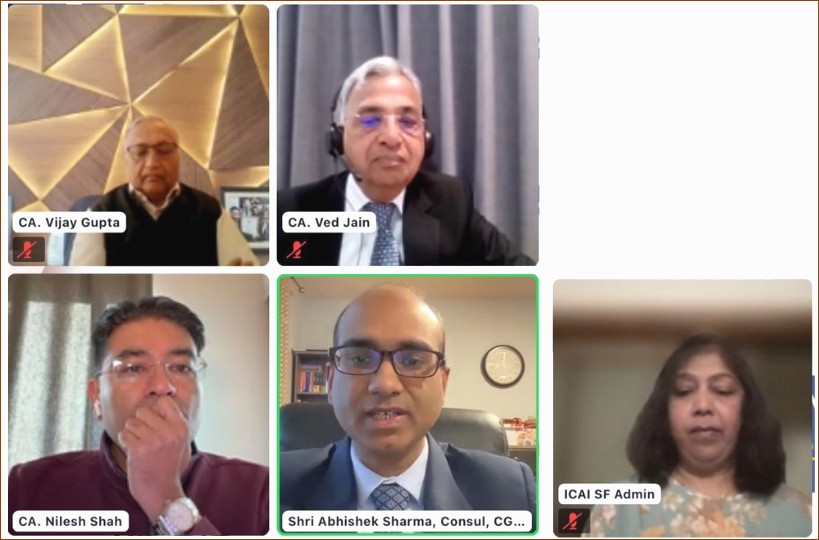
The San Francisco Chapter of the Institute of Chartered Accountants of India (ICAI) recently organized a virtual discussion to review India’s Union Budget for the fiscal year 2025-26. This event, which took place on February 9, aimed to offer valuable insights to the Indian community and professionals in the industry. It was co-hosted by the Indian Consulate in San Francisco and both the ICAI San Francisco and Vancouver chapters.
Ved Jain, a respected chartered accountant and former president of ICAI, discussed the key highlights of the budget presented by Finance Minister Nirmala Sitharaman on February 1. Jain pointed out that the budget focuses on driving economic growth, fostering inclusive development, increasing household spending, and attracting private investments. The session was moderated by Nilesh Shah from the ICAI San Francisco chapter. Abhishek Kumar Sharma from the Indian Consulate shared the government’s viewpoints, while Vijay Gupta from the ICAI Vancouver Chapter also contributed his insights. Participants from across the United States took part in the webinar, with a particularly engaging question-and-answer segment addressing the concerns of non-resident Indian (NRI) taxpayers.
One of the main goals of the budget is to enhance rural prosperity and create more jobs. Jain mentioned that the government is keen on making India a global hub for manufacturing, especially in sectors like leather, footwear, toys, and electronics. New incentives have been put in place to encourage investments in these areas, supporting the “Make in India” initiative and promoting clean energy initiatives.
For NRIs looking to invest in India’s manufacturing sector, Jain noted that earnings could be subjected to taxation. The new tax rules state that 25% of the income from goods and services used for establishing manufacturing facilities in India would be taxable at a rate of 35%.
Jain also pointed out India’s advancements in semiconductor and electronics manufacturing, which he believes could significantly strengthen the industrial sector. The budget also introduces measures to support micro, small, and medium enterprises (MSMEs) by broadening the eligibility criteria for government benefits. For instance, a medium enterprise can now have an investment of up to Rs 125 crore and a turnover of Rs 500 crore, while small enterprises can have investments up to Rs 25 crore and a turnover of Rs 100 crore.
Tourism is another area of focus, with plans to develop 50 new tourist destinations. Medical tourism is also being prioritized, offering investment avenues for establishing healthcare facilities.
On the topic of taxes, Jain highlighted changes that affect NRIs. While Indian residents can enjoy tax exemptions for incomes up to Rs 12 lakh, NRIs have a lower exemption limit of Rs 4 lakh. Nevertheless, they can still benefit from revised tax rates. Jain explained that, under the new scheme, NRIs with incomes up to Rs 12 lakh could see a tax advantage of Rs 20,800, and those earning Rs 24 lakh could save around Rs 1.14 lakh. NRIs earning above Rs 4 lakh will be required to file a tax return in India.
Abhishek Kumar Sharma from the Indian Consulate emphasized the broader goals reflected in the budget, which include poverty reduction, better education quality, expanded healthcare access, enhanced workforce skills, and increased participation of women in the economy. He expressed that these goals are essential for India to become a fully developed nation by 2047, highlighting a strong commitment towards agriculture, MSMEs, human investment, economic innovation, and exports.
Significant reforms in the financial sector were also discussed, such as increasing foreign direct investment (FDI) in the insurance sector from 74% to 100%. Additionally, new Grameen Credit Scores will be introduced to assess creditworthiness in rural regions. The budget also increases investment and turnover thresholds for MSMEs to improve their access to financial support.
To promote innovation, the budget allocates Rs 10,000 crore for a startup fund and establishes five Centers of Excellence for Skill Development, focusing on global collaboration. Moreover, there are plans to develop centers for artificial intelligence centered around education, healthcare, agriculture, and sustainable urban development.
This discussion provided attendees with valuable insights into the Indian government’s financial policies and investment opportunities, helping NRIs and industry professionals engage with the rapidly changing economic environment in India.
