
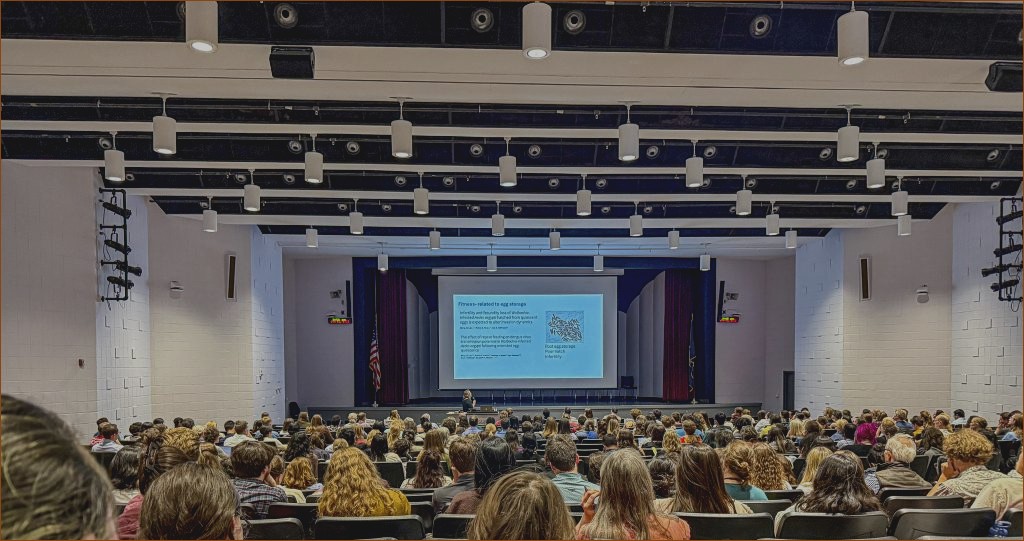
Virginia Tech Hosts Record-Breaking EEID Conference
Virginia Tech recently held its largest Environmental and Emerging Infectious Diseases (EEID) Conference to date, attracting 450 participants from across the globe. The event showcased 300 research posters, featured 14 keynote speakers, and included 29 additional speakers along with several engaging panel discussions.
Before the main presentations commenced, the first two and a half days focused on workshops specially designed for graduate students, aimed at enhancing their skills in quantitative analysis and programming. Coordinated by Lauren Childs, an associate professor of mathematics, and Kate Langwig, an associate professor in biological sciences, these workshops introduced participants to epidemiological modeling with an emphasis on spatial applications. The training covered how to create and simulate spatial models, incorporating real data.
Virginia Tech also enhanced the workshop offerings through additional sessions provided by VectorByte. This initiative, backed by a National Science Foundation grant and led by professor Leah R. Johnson along with three colleagues, aims to develop a global platform for open access data on disease vectors. As VectorByte enters its final year, it focuses on making crucial research readily available.
One of the standout aspects of the conference, as noted by attendee Hudson, was the welcoming atmosphere for sharing ongoing research and collaborating across various disciplines. “This conference is unique. We concentrate on diseases that jump from wildlife to humans and the factors that spark outbreaks,” Hudson expressed. “It’s simply wonderful to connect face-to-face with other scientists and foster teamwork.”
Hopkins, a professor in fish and wildlife conservation, collaborated with five colleges at Virginia Tech, the Fralin Life Sciences Institute, and the Center for the Mathematics of Biosystems to secure the necessary funds for this major event. The conference marked a significant partnership involving the Global Change Center and the Center for Emerging Zoonotic and Arthropod-borne Pathogens, led by Kylene Kehn-Hall.
The planning committee was made up of seasoned EEID conference participants, including Dana Hawley, Joseph Hoyt, and Langwig, all from biological sciences. They worked diligently with a scientific planning committee, comprising faculty from eight departments at Virginia Tech, to curate the extensive scientific agenda and recruit keynote speakers.
Hopkins reflected on the collaborative effort behind the conference, saying, “It was a massive team initiative, and it truly paid off. The conference buzzed with open discussions, diverse viewpoints, and a sense of collegiality. It wouldn’t have been feasible without the support from our colleges, the FLSI, and our dedicated volunteers.” He further emphasized that this event showcased how Virginia Tech is an excellent hub for researchers in this vital field.
The Continuing and Professional Education (CPE) team played a crucial role as well, managing the logistical details and supporting the event’s planning to ensure a smooth experience for the hundreds of researchers who gathered in Blacksburg. This effort aligns with CPE’s mission to assist faculty in presenting conferences and professional development programs to both university and external audiences.
