
Acodyne Secures €2.5 Million for Unmanned Cargo Drones
Copenhagen-based startup Acodyne has successfully raised €2.5 million in pre-seed funding to create unmanned cargo drones tailored for defense, offshore, and remote logistics needs.
The funding round was led by Gungnir Capital, a Swedish defense venture firm, and PSV Hafnium, a Danish investment group. Other contributors included EIFO, SAP9 Group, and GreenUP IV Invest, a partnership aimed at boosting early-stage deep tech companies.
The initial prototype, known as the E100, is designed to carry up to 100 kilograms and can reach speeds of 450 km/h. Upcoming models are expected to handle payloads exceeding 500 kg within the next two years, with the first flight tests scheduled for late 2026.
Innovative Technology
Acodyne’s E100 employs ducted-fan motors—a technology commonly used in commercial jet engines—rather than traditional propellers. The aircraft’s autonomous operations are managed by eTHOR, an AI system developed in collaboration with DTU Compute, which supports both manual and autonomous flight.
Jasmina Pless, Acodyne’s co-founder and Chief Commercial Officer, commented, “For many years, the most efficient way to transport heavy goods has been with ducted fans. We believe this technology is superior to simply scaling up propellers.”
Market Potential
Currently valued at approximately $2.1 billion, the global cargo drone market is projected to soar to $103.7 billion by 2035. As military and offshore operators look for cost-effective alternatives to helicopters, which can be extremely expensive to operate, Acodyne’s drones could offer a viable solution.
Team and Background
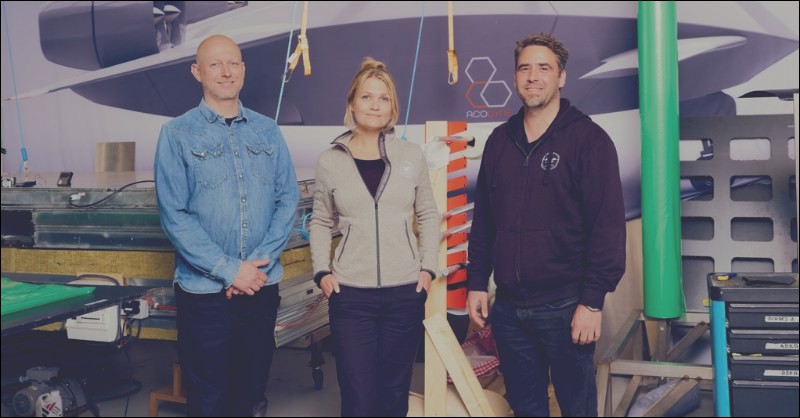
Founded in late 2023, Acodyne operates from the Technical University of Denmark in Lyngby, with a test site at Avedøre Airfield near Copenhagen. The team consists of ten members, including four co-founders with extensive backgrounds in defense and aviation. CEO Mads Schnack has experience with counter-drone systems, and CTO Claes Nicolaisen is a seasoned pilot. Chief Electronic Engineer Martin Arndt and CCO Jasmina Pless round out the leadership with their expertise in aerospace and international diplomacy, respectively.
Focused on Speed
Boasting a top speed of 450 km/h—about twice that of a standard helicopter—Acodyne’s drone also features a range of 500 kilometers, extendable to 1,000 kilometers in hybrid mode. Its detachable wings facilitate easy transport in standard shipping containers, allowing for quick deployments.
In defense scenarios, traditional resupply methods can expose personnel and machinery to danger. Acodyne’s drones aim to bridge that gap, offering faster and safer deliveries during critical missions.
Looking Ahead
The funding will allow Acodyne to further develop its prototype and start real-world flight tests. Field trials are expected in Greenland in 2027, as well as between a Danish port and a wind farm service station. Pless anticipates that the company will double its workforce within a year to support its growth.
“This funding will help us transition from concept to a tested platform,” Pless stated. “It highlights a strong interest from European investors in supporting innovative logistics solutions for defense and offshore operations.”
