
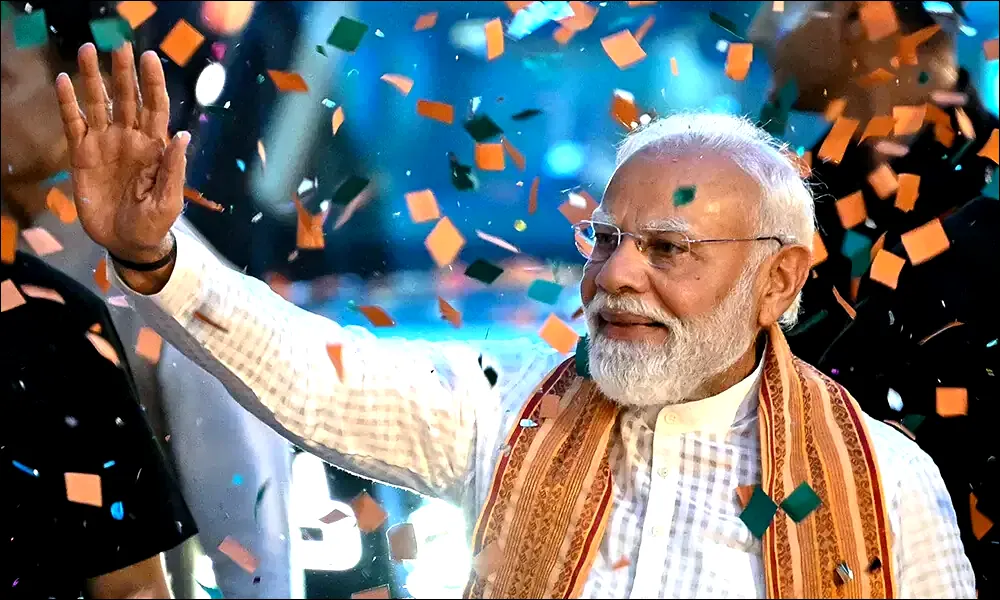
New Delhi: Shift in Voter Demographics Sparks Concerns Over Religious Polarization
India’s main opposition party, Congress, is gaining increasing support from Muslim voters, while Prime Minister Narendra Modi’s party, the Bharatiya Janata Party (BJP), continues to attract a strong majority of Hindu voters, according to recent election results from four states.
This trend underscores a growing divide in a country that prides itself on being secular, highlighting the ideological split between India’s two largest political factions, analysts say.
Since coming to power in 2014, Modi has embraced a pro-Hindu agenda through the BJP, which promotes a Hindu-centered ideology known as Hindutva. This strategy has helped the BJP maintain a strong grip on political power, especially considering that Hindus make up nearly 80% of India’s population of 1.42 billion, while Muslims represent about 14%.
Political analyst Rasheed Kidwai notes that the BJP’s rise has pushed Muslim voters to consolidate their support behind secular parties like Congress, resulting in what he describes as “reverse polarization.”
Modi’s Expanding Influence
Muslim leaders point out that their community is increasingly favoring Congress or strong regional parties, moving away from smaller groups that have struggled to be part of government.
In the recent elections held across four states and one federal territory, Congress made a modest showing, securing control of just one state. Meanwhile, a coalition led by the BJP won three states, with a new regional party capturing the remaining territory.
In Assam, a BJP-ruled northeastern state, Muslim representation was significant, with 18 out of 19 newly elected lawmakers coming from the Muslim community. The party fielded 20 Muslim candidates against approximately 80 non-Muslims for the 126-member assembly, where the BJP won 82 seats.
In contrast, the Assam-based All India United Democratic Front (AIUDF), which primarily garners Muslim support, saw its representation shrink from 16 seats to just two.
In neighboring West Bengal, where the BJP won 207 lawmakers in a 294-member assembly for the first time, the two Congress members elected were also Muslims. Notably, the BJP did not nominate any Muslim candidates in either state, with party leaders attributing their victories to solid Hindu support.
Looking Ahead: Potential for Further Polarization
Political columnist Radhika Ramaseshan warns that if Muslim voters continue to rally around Congress, Hindu voters might also further consolidate behind the BJP.
Badruddin Ajmal, head of the AIUDF, mentioned that many Muslims feel marginalized under BJP rule, leading them to seek protection from parties like Congress. He explained that there’s a perception that only Congress can effectively counter the BJP’s influence at the national level, despite differing opinions on this belief.
Congress spokesperson Pawan Khera expressed his dismay at the current political climate, stating that discussions focused on such divisions are backwards for a modern society. He emphasized that Congress remains committed to helping all marginalized communities, regardless of their religion.
While the BJP has attempted to reach out to Muslim voters, it notably did not include any Muslim candidates in the upcoming 2024 general elections. Modi denied that he uses religion as a political tool, claiming he avoids discussing Hindu-Muslim dynamics in governance.
However, Ramaseshan pointed out that communal rhetoric has become increasingly prominent under Modi’s leadership compared to previous BJP administrations. She argued that the BJP is shaping a new vision of India centered on a “Hindu rashtra” (Hindu nation), a narrative that is becoming more embedded in the public mindset.
As the political landscape in India continues to evolve, these developments may pose significant implications for the future of the nation.
