
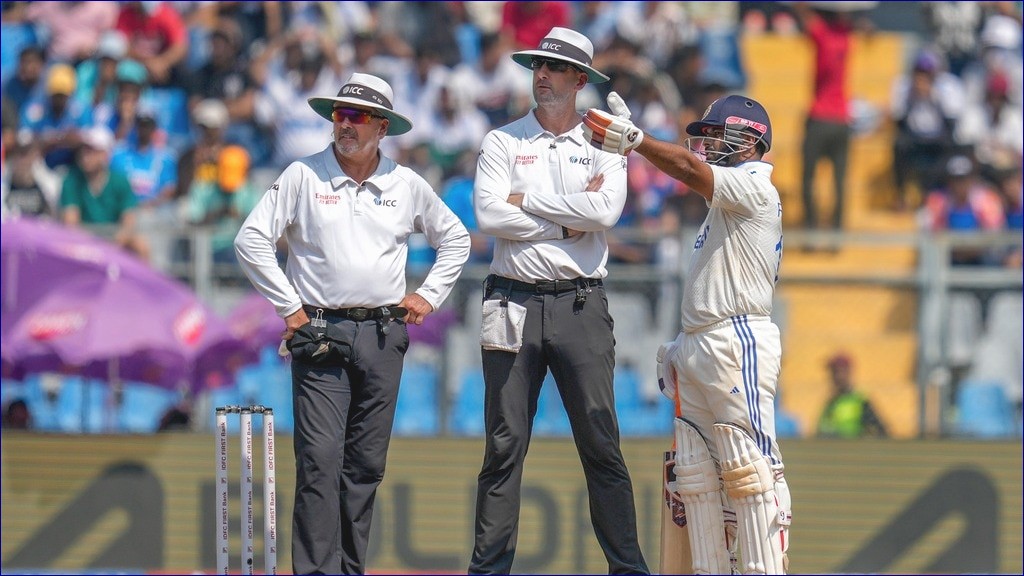
In the tense landscape of cricket, where every moment can sway the course of the game, former South Africa skipper AB de Villiers passionately reacted to the contentious dismissal of Indian wicketkeeper Rishabh Pant. “Such moments always gnaw at me,” de Villiers reflected, voicing his concerns about the potential for controversy to rear its head “at crucial junctures” in a Test match.
During a critical phase of play, Pant, brave and audacious, charged down the pitch in the 22nd over, only to have his attempt thwarted by a delivery from Ajaz Patel. The ball struck his pads, ballooning high into the air, where Tom Blundell awaited like a hawk. De Villiers, ever the keen observer, pointed out that if ambiguity lingered regarding the decision, the third umpire should have defaulted to the on-field umpire’s call.
“Controversy strikes again! Ah, the murky grey area looms. Did Pant make contact with the bat? The dilemma is quite perplexing—when the ball brushes the bat, only to connect with the pads simultaneously, snicko technology can easily mislead us into thinking there’s an edge. But can we be certain? My fears have always lingered around these pivotal moments, and now, here we are, facing it in a significant Test match,” de Villiers lamented on social media.
As he continued, he posed a crucial question: “Where’s the hotspot? If there’s doubt, isn’t it prudent to uphold the on-field call, unless the third umpire observed a definitive deviation? I’m not entirely convinced. And let me clarify: my stance is devoid of bias—what I seek is consistency in judgments and a judicious application of technology.”
Was Pant Out or Not?
In the thick of action, Pant gallantly surged down the wicket, yet his endeavor came crashing down when the on-field umpire deemed him not out, suspecting no bat contact. However, Ajaz Patel, alongside skipper Tom Latham, adamantly insisted there was an inside edge. Replays revealed a faint spike correlating with the ball’s proximity to the bat, but equally, it seemed Pant’s bat may have collided with his pad. The pendulum of decision hung precariously, swaying finally in favor of the fielding side as the third umpire weighed in. Crestfallen and visibly agitated, Pant trudged off, exchanging terse words with the umpire before retreating to the pavilion, frustration etched on his face. His spirited innings of 64 runs off 57 balls, studded with nine boundaries and a six, had seemingly set India on course, needing just 41 more runs with a mere three wickets remaining.
The test of patience and technology continues to stir debate, as clarity in cricketing decisions remains an ongoing quest.
