
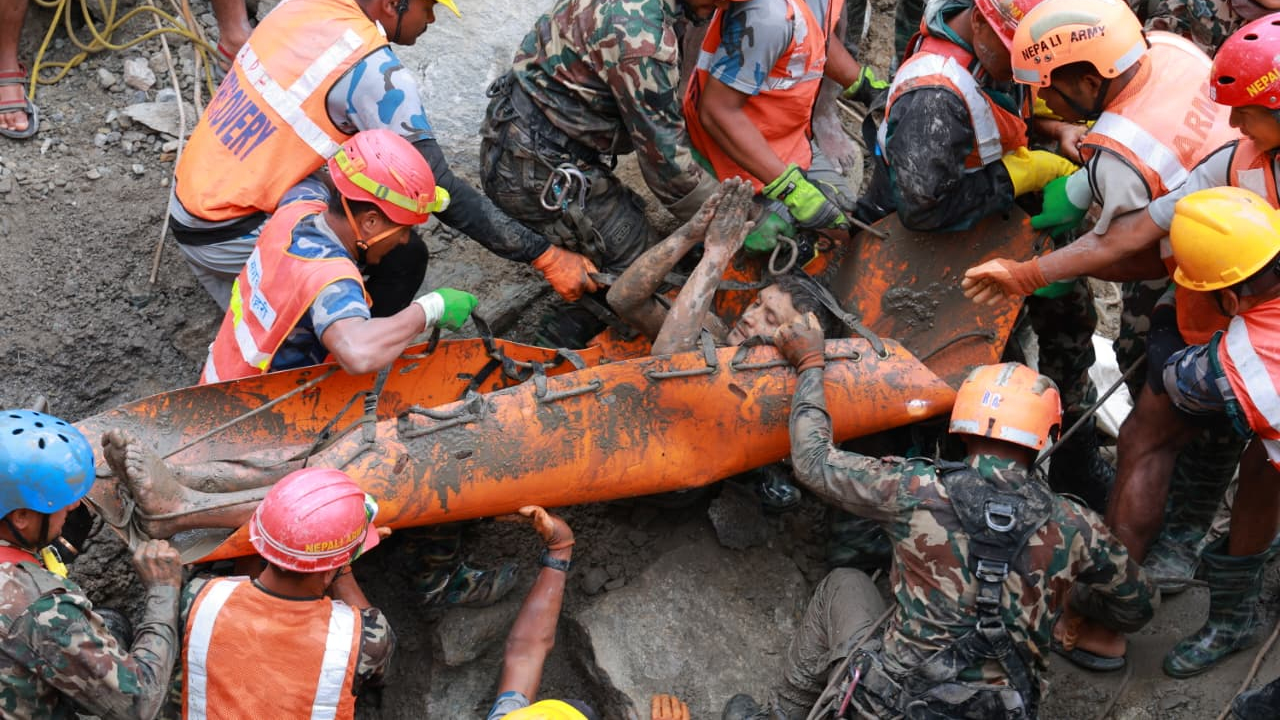
Rescue teams in Nepal have successfully pulled two workers from a hydropower tunnel nine days after severe flooding devastated the area, leaving over 1,000 people dead and thousands missing. The search teams first detected voices coming from the tunnel on Friday morning, according to local lawmaker Shri Ram Neupane. Images shared by the Nepal Army captured the moment when a rescuer carried one of the men to safety, flanked by soldiers providing assistance.
This successful rescue has sparked hope that there may be more survivors trapped inside the tunnel. One of the rescued workers mentioned that additional individuals might still be alive, prompting ongoing search efforts led by Brig. Gen. Raja Ram Basnet.
Amir Maharjan, the brother of one of the rescued men, expressed deep gratitude, stating, “I can’t explain what we are feeling at the moment. We are just grateful to God.” Both workers have been transported to a hospital in Kathmandu, and one is reported to be in critical condition, as shared by the Prime Minister’s office. The workers—identified as a mechanical foreman and a mechanical supervisor at the Trishuli 3A plant—are among many affected by the disaster.
Reports indicate that about 115 individuals may still be trapped in the Trishuli 3A tunnel alone, while approximately 900 workers are unaccounted for across 12 hydropower sites in Nepal, with around 500 believed to be trapped in tunnels.
Nepal’s Communication Minister, Bikram Timilsina, took to Facebook to express thanks to all those involved in the rescue efforts, stating, “A heartfelt thank you to everyone who worked tirelessly day and night.”
The floods, which occurred on August 26, are believed to have been caused by a glacier collapse, resulting in at least 1,287 fatalities and over 5,000 missing as reported by the Associated Press. Further, in Tibet, which borders Nepal, 21 people have been confirmed dead and 541 are reported missing.
Nepal’s disaster agency has estimated damages from the flooding to be at least 387.5 billion Nepalese rupees, equivalent to about $2.5 billion, impacting infrastructure and property across the region.
