
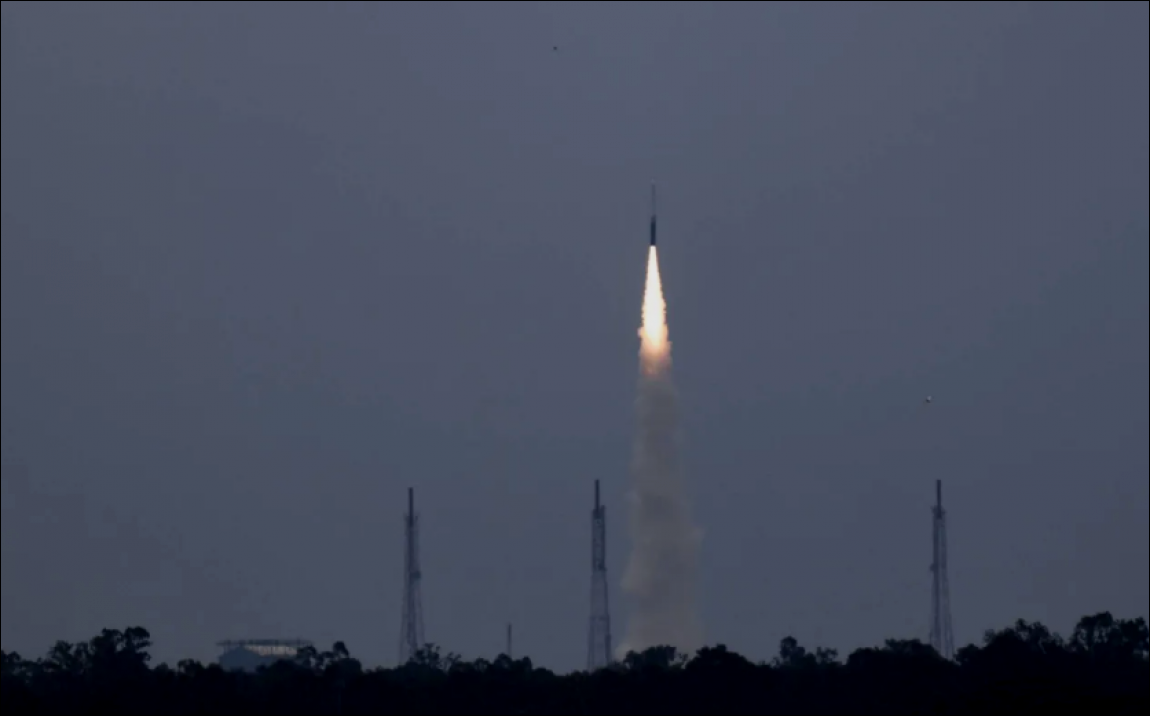
India Launches Its First Privately Built Orbital Rocket
India achieved a major milestone on Saturday with the successful maiden flight of its first privately developed orbital rocket, the Vikram-1. Skyroot Aerospace, the company behind the rocket, shared the exciting news, highlighting a significant leap for the nation as it aims to expand its role in the global space economy.
The Vikram-1 rocket, designed to transport small satellites into low-Earth orbit, took off from the Satish Dhawan Space Center in Sriharikota, drawing cheers from onlookers. In a post on X, Skyroot Aerospace triumphantly announced, “Hello space, we have arrived!” They confirmed that the first-ever launch by an Indian private company was a success.
Standing as tall as a seven-story building, the Vikram-1 can carry payloads weighing up to 350 kilograms (about 771 pounds). Pawan Goenka, chairman of the Indian National Space Promotion and Authorisation Center, praised the accomplishment, stating it exceeded all expectations for a first launch from a private firm.
Prime Minister Narendra Modi celebrated the achievement, calling it “a defining moment in India’s space journey.” He emphasized how the growing involvement of private companies is fostering innovation and encouraging young people to dream bigger.
The Vikram-1 rocket is carrying various payloads, including a lab-grown diamond and robotic arms designed to help clear space debris. Notably, it also has a miniature 18-carat gold rocket featuring small sculptures of prominent Indian scientists and engineers, such as Vikram Sarabhai and APJ Abdul Kalam, among others.
India’s aspirations in space have been growing, bolstered by years of investment from the Indian Space Research Organization (ISRO). Since the space sector opened to private companies in 2020, the industry has rapidly expanded, boasting over 400 startups and a market valued at approximately $8.4 billion.
Following the launch, Foreign Minister S. Jaishankar remarked, “India’s space ambitions soar to new heights!” Just last month, India made history by becoming the fourth country to confidently land an unmanned spacecraft on the Moon, joining the ranks of Russia, the United States, and China.
Former ISRO chairman K. Sivan commended the vital contributions of space startups and emphasized the significant advancements seen since the sector’s privatization. He noted that the Vikram-1 represents one of the most complex challenges in space technology and is sure to inspire many.
Sivan added that the launch would positively impact India’s global standing. “If an Indian startup can achieve one of the toughest feats in the space industry, it greatly enhances India’s reputation worldwide,” he concluded.
