
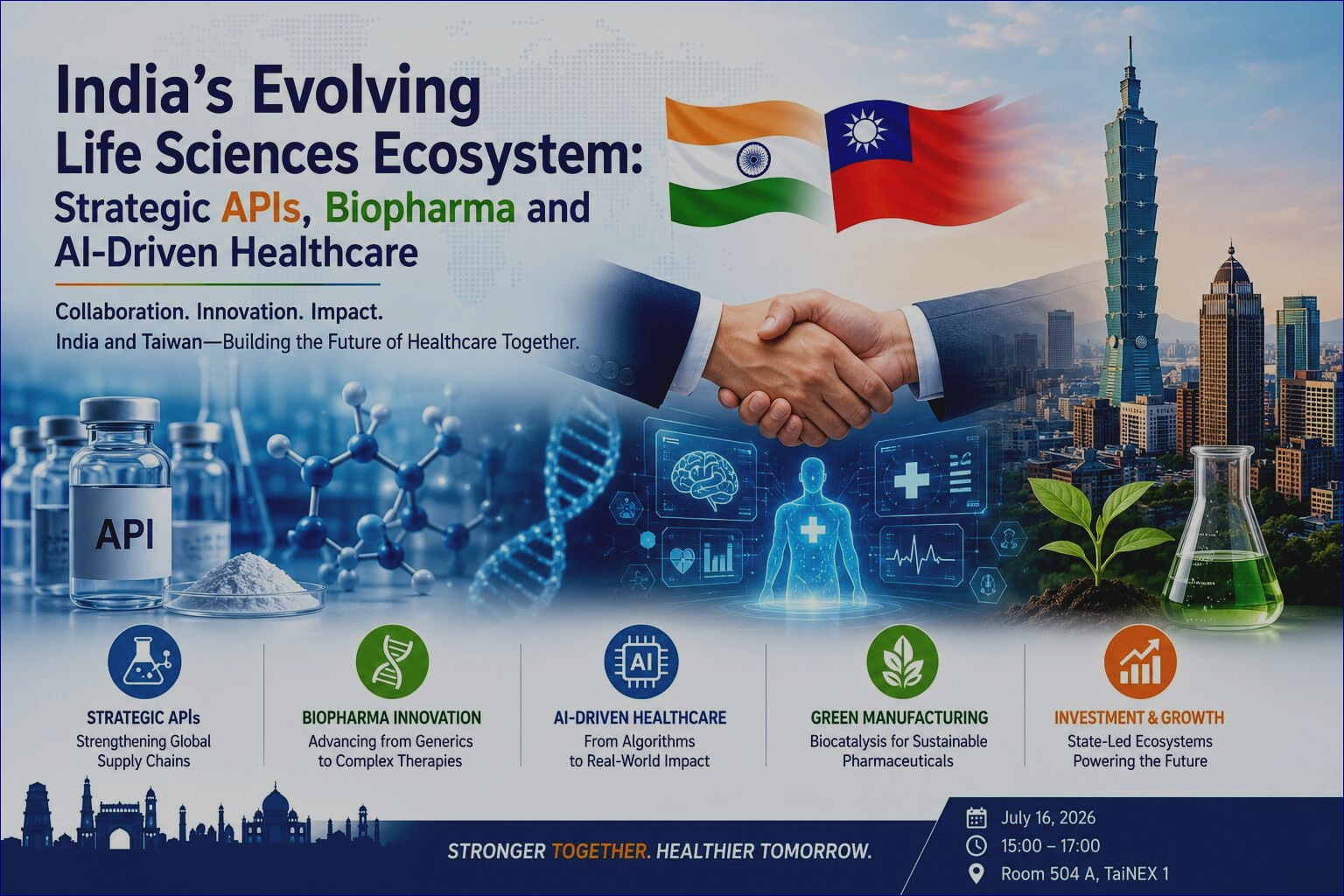
India Showcases Growth in Life Sciences at BIO Asia–Taiwan 2026
India took center stage at BIO Asia–Taiwan 2026, highlighting its dynamic life sciences sector. The country is making strides by blending its strong pharmaceutical manufacturing with innovations in biopharma, AI in healthcare, sustainable practices, and government-backed investment opportunities.
India’s role in the global life sciences scene has traditionally centered on its vast production capacity, notably in active pharmaceutical ingredients (APIs) and generic medicines. However, during the India Session at the event, the focus shifted to the country’s goal of leveraging its pharmaceutical expertise for the future of healthcare innovation.
The session titled “India’s Evolving Life Sciences Ecosystem: Strategic APIs, Biopharma and AI-Driven Healthcare” took place on July 16 at TaiNEX 1. It featured discussions among government officials, industry leaders, and tech innovators on how India’s healthcare and biotechnology fields are growing through advanced manufacturing and AI.
Setting the Stage for Collaboration
Opening the session, Vishwanjali Gaikwad, Acting Director General of the India Taipei Association, and Tsai-Kun Li, President of the Development Center for Biotechnology, encouraged deeper connections between India and Taiwan. Their discussion hinted at the potential for collaboration, combining India’s manufacturing expertise and talent with Taiwan’s biotech strengths.
A Shift in Perspective
In his keynote address, Dr. Murali Panchapagesa Muthuswamy, Chairman of Jananom Private Limited, discussed the transformation in India’s life sciences landscape. Although the country continues to excel in pharmaceutical production, a new wave of growth is driven by innovative startups, biotechnology advancements, and the use of digital technologies in healthcare.
This evolution positions India as not just a low-cost production hub but as a valuable contributor to research, technology development, and commercial success on a global stage.
Generics: A Strong Foundation
Amid discussions about innovation, India’s established capabilities in pharmaceuticals were also acknowledged. Dr. Puneeth Kumar Surupa, Country Manager of Camber Pharmaceuticals, pointed out the significant role of Indian firms in the global generics market, emphasizing their contribution to improving access to medicines.
The generics sector has provided India with a vast market reach and manufacturing expertise, serving as a strong base for future growth in complex medicines and biopharmaceuticals. The pressing challenge now is to effectively link this scale with the next wave of scientific innovation.
Bringing AI to Healthcare
One of the session’s notable themes was the role of artificial intelligence in healthcare. Rahul Singh, Founder and Managing Director of Sciverse Solutions, presented on “AI at the Point of Care: From the First Algorithm to the First Patient.” He highlighted how India’s diverse healthcare system offers unique chances for AI development that can directly address clinical needs.
However, transitioning from algorithms to real patient outcomes requires not only technological advancements but also clinical validation, integration into existing workflows, regulatory compliance, and acceptance by healthcare professionals.
Focus on Sustainable Manufacturing
The topic of sustainability also took the spotlight during discussions. Dr. Tse Yu Chung, Division Director at the Development Center for Biotechnology, spoke about the potential of biocatalytic platforms to make pharmaceutical manufacturing greener. These innovations could not only enhance efficiency but also contribute to environmental sustainability.
As global pharmaceutical companies increasingly prioritize sustainability, greener production technologies may play a pivotal role in the competitive landscape.
Strengthening Ties Between India and Taiwan
The event also featured a signing of a Memorandum of Understanding (MoU), reflecting a commitment to foster cooperation. Such partnerships may become essential as India and Taiwan explore collaborative opportunities in areas like biotech, pharmaceutical production, research, and investment.
Tamil Nadu: A Hub for Biotech Investment
The session concluded with insights from Prakash Ekambaranellore, Associate Vice President at Guidance Tamil Nadu – Taiwan Desk, who shared Tamil Nadu’s vision for attracting biotech investments. The state’s proactive approach in establishing a supportive environment for life sciences signifies a broader trend across India, where regional governments are pursuing investment through infrastructure development and policy support.
From Manufacturing to a Comprehensive Life Sciences Ecosystem
The India Session at BIO Asia–Taiwan 2026 underscored a significant transformation. While APIs and generics remain crucial, a more diverse life sciences ecosystem is emerging. Innovations in biopharma, AI-enabled healthcare, and sustainable practices are reshaping India’s future in healthcare.
For India, the challenge lies in creating an integrated value chain that connects manufacturing with cutting-edge science and global partnerships. This evolution holds the potential to position India not just as a major supplier but also as a significant player in shaping the future of life sciences in Asia.
