
Farmers Face Challenges in Ladakh’s Harsh Climate
Perched high in the Himalayas at nearly 4,000 meters (about 13,000 feet), the village of Sakti in Ladakh presents tough conditions for farmers. The landscape, characterized as a desert, sees very little rainfall and only allows for one growing season each year.
Gelak Gutme, a farmer here for over 65 years, shares how difficult it has become to cultivate crops like wheat, peas, and potatoes. “Ladakh has a harsh climate,” he explains, adding that the situation has worsened over time. Climate change has led to the disappearance of important low-altitude glaciers that farmers once depended on for irrigation.
“Last year, I lost everything. My entire field dried up due to lack of water,” Gutme recalls, highlighting the severe impact of water scarcity on farming.
Traditionally, small glaciers near the valleys acted as natural water reservoirs, melting slowly to provide moisture when the growing season began. But as these glaciers fade away, farmers find themselves in a precarious position.
“Now, there’s nothing left to melt,” notes Lobzang Fardod, a local water management committee member, pointing out the significance of a reliable water source each spring. The summer in the mountains is short, compelling farmers to plant crops by May to ensure they ripen before winter returns.
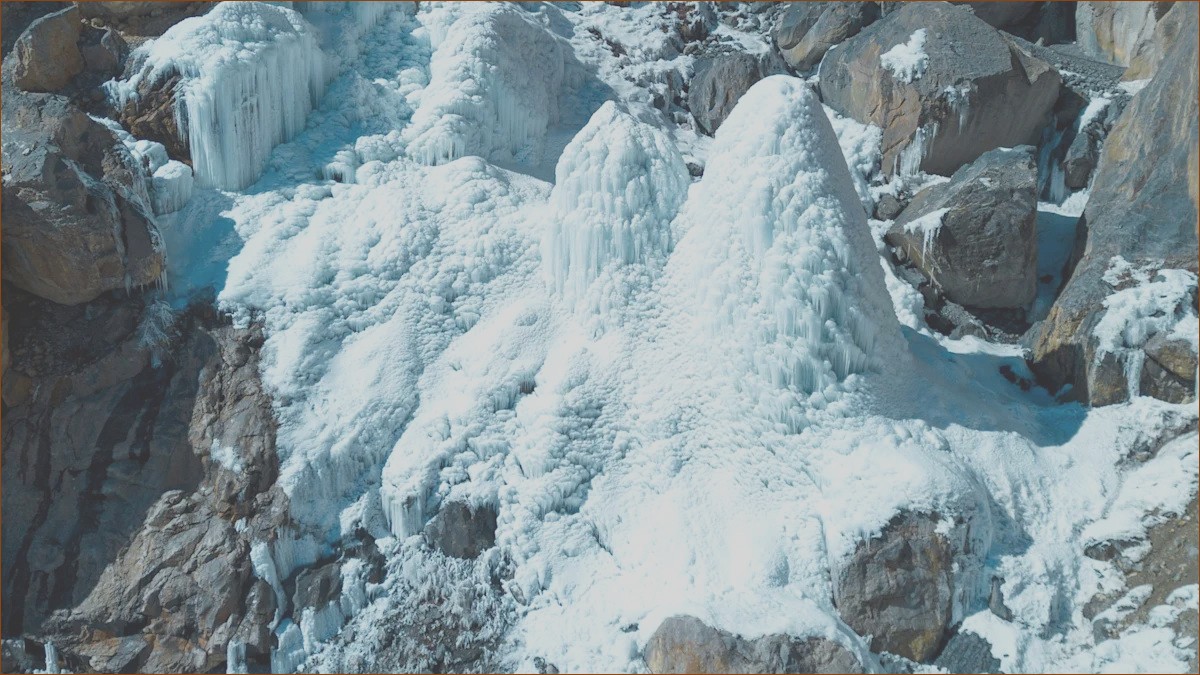
To combat water shortages, several villages in Ladakh devised a unique solution in the early 2010s: ice reservoirs. This innovative approach involved channeling water from higher altitudes and spraying it into the air during winter to create artificial glaciers, known as ice stupas. While this method did provide meltwater in spring, managing it in extreme cold was challenging, leading to cracked pipes and system failures.
Farmers would spend nights near water sources, battling the freezing temperatures to prevent pipe blockages. However, this exhausting method might soon change.
As traditional water systems falter, Ladakh has become a center for new water management technologies. Murtaza Ali, an executive engineer at the Ladakh Autonomous Hill Development Council, observes this shift, especially in Leh, the capital of Ladakh.
The older ice stupa approach was not efficient enough. Water flowing constantly sometimes melted existing ice on warmer days. Recently, a tech upgrade has enhanced this system. In collaboration with a company called Acres of Ice, a new method called the Automated Ice Reservoir (AIR) has been developed.
AIR uses a controlled process to produce ice more effectively. Water is piped under pressure from the mountains and shot out of vertical nozzles like a fountain. This flow is managed by a solar-powered control box that also monitors environmental conditions, ensuring the system operates smoothly.
In case of rapidly falling temperatures, the system automatically drains the water from the pipes to prevent freezing. Instead of continuous spraying, AIR delivers a mist that freezes quickly, forming solid layers of ice.
This innovative system has already shown positive results for villagers. “We’re hearing reports that the groundwater is being replenished, and spring water sources are reviving. The farmers are getting water when they need it,” says Ali, who is also planning a scientific study to measure the impact.
In 2025, several AIR projects were launched across Ladakh, aiming to expand this efficient ice production. “Our goal is to enhance this technology to create even more ice reservoirs,” explains Dr. Suryanarayanan Balasubramanian, founder of Acres of Ice.
Back in Sakti, Gutme feels hopeful about the future. The current AIR system has provided a more dependable water source, and he dreams of adding more artificial glaciers. “I may not understand the technology, but I know I have water for my crops now,” he says.
Living in such a challenging environment, the lack of water had pushed many young people to consider leaving the village for city jobs. “That would have been a disaster,” Gutme reflects, expressing gratitude for the changes that promise a more sustainable future for farming in their community.
