
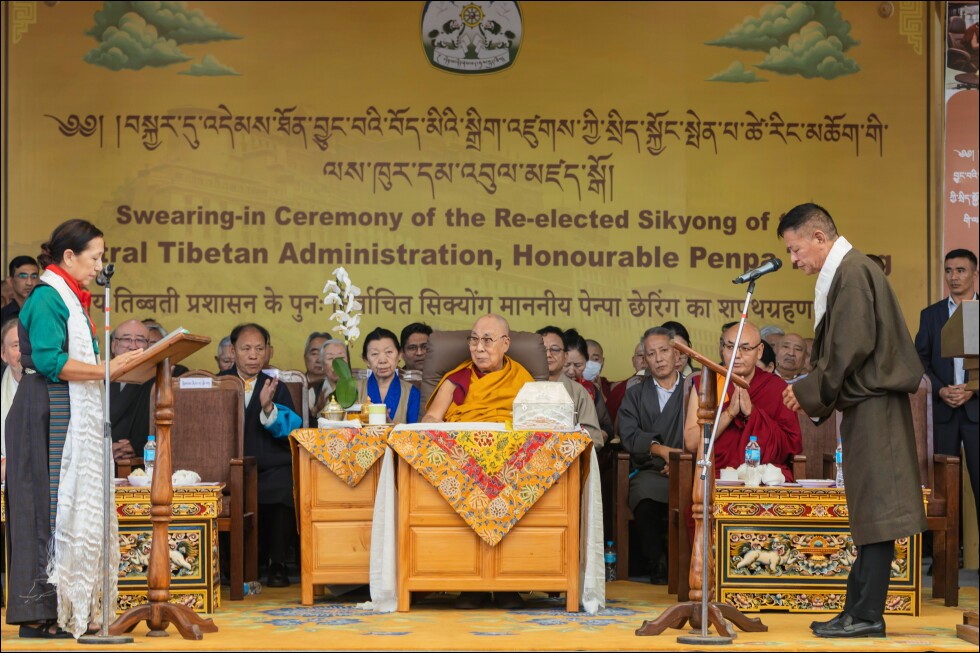
Dharamshala, India — Penpa Tsering took the oath of office on Wednesday, beginning his second term as president of Tibet’s government-in-exile. Tsering was reelected earlier this year and will serve another five years.
At 58 years old, Tsering has been leading the Tibetan government based in Dharamshala since 2021. His political journey began in 1996 when he was first elected to the Tibetan Parliament-in-Exile, later serving as speaker from 2008 to 2021.
The Central Tibetan Administration, as it is now known, was established in 1959 and includes executive, legislative, and judicial branches. During his swearing-in ceremony, held in the presence of the Dalai Lama and attended by many monks and Tibetans, Tsering emphasized the administration’s commitment to the “Middle Way Policy.” This approach, inspired by the Dalai Lama, promotes peaceful dialogue and aims for a resolution that benefits both Tibetans and Chinese authorities.
Tsering also mentioned that they will maintain cautious communication with the Chinese government until a resolution is reached. The ceremony included traditional elements, with the Dalai Lama arriving accompanied by monks, and the Chief Justice Commissioner overseeing the oath.
The recent elections mark the fourth direct vote for Tibetan leadership since the Dalai Lama stepped back from political roles in 2011. While China asserts that Tibet has been part of its territory for centuries, many Tibetans argue for their historical independence and highlight concerns about cultural suppression and resource exploitation by the Chinese government.
Currently, the Chinese government does not acknowledge the Central Tibetan Administration and has not engaged in discussions with representatives of the Dalai Lama since 2010. China has accused the Dalai Lama of attempting to separate Tibet from China, which he firmly denies. As little progress has been made in talks with China, some Tibetan supporters are calling for independence.
Yu Jing, a spokesperson for the Chinese Embassy in India, recently rejected the legitimacy of the exile government, claiming it lacks recognition from any sovereign nations. On his 90th birthday last year, the Dalai Lama asserted that Chinese authorities would not participate in choosing his successor and confirmed that the institution of the Dalai Lama would persist beyond his lifetime.
