
Transforming Lives Through Vision Care in India
Tofan Jena, a 49-year-old vegetable seller from Bhubaneswar, India, experienced a life-changing moment when he put on a pair of glasses for the first time. Instantly, the world around him came into sharp focus.
“I can see all the letters, even the tiny ones,” he exclaimed, pointing to his phone. Jena is one of over a billion people worldwide, as reported by the World Health Organization, who struggle with vision issues and lack the resources to correct them. In India alone, the International Agency for the Prevention of Blindness estimates that $30 billion in productivity is lost due to preventable vision problems.
Earlier that day, Jena underwent a free eye examination organized by GoodVision, a charity dedicated to providing eye care for underserved communities. The organization works in 12 countries, including India, where about 550 million people need glasses, and approximately 250 million are unable to access them.
For less than two dollars, Jena walked away with a pair of corrective glasses and a renewed outlook on life. “Now, I can read, write, and see things clearly,” he said, smiling in disbelief. “These glasses will change everything for me.”
Bringing Care to Those in Need
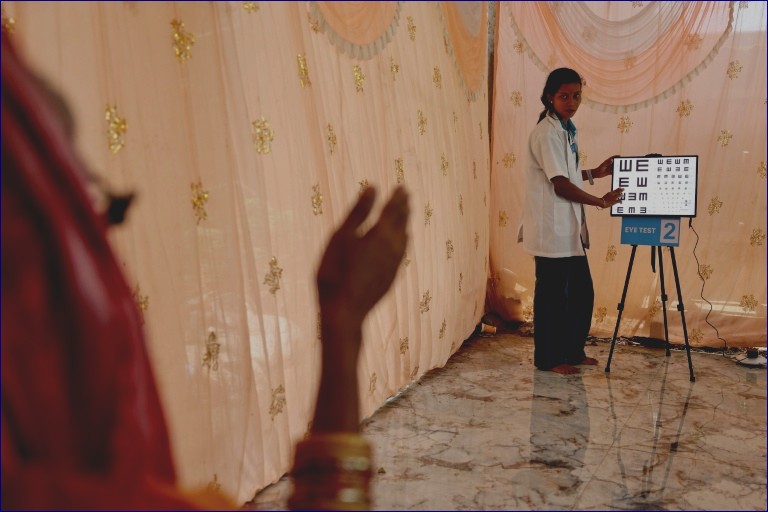
Jena’s story is just one of many in the Salia Sahi district, where volunteers from GoodVision set up a mobile eye care camp. Protecting themselves from the sun under tarpaulins, they offered vision tests and fitted glasses to local residents. As many people received glasses, they were amazed to rediscover the details in their surroundings.
Among those who benefited was 43-year-old shopkeeper Minati Rout. After receiving her glasses, she completed a final test of separating pebbles from grains of rice. “Before, I couldn’t read small letters or thread a needle; now I can do both,” she said. She encouraged her neighbors to get their eyes checked as well.
Piush Khetan, the charity’s director in India, highlighted the importance of their services, which include free eye screenings and basic glasses. The glasses themselves are made with lenses sourced from China and frames crafted from metal wire in India, ready for assembly in about ten minutes.
Patients at a nearby camp in Maniabandha, a small town two hours from Bhubaneswar, eagerly awaited their turn. “These camps are crucial because many villagers lack access to proper eye care,” said optometrist Gopinath Das. “Sometimes, they aren’t even aware they have vision problems.”
Each month, GoodVision visits over 400 underserved neighborhoods and villages, providing essential eye care where it’s most needed. “It feels good to help people, and I earn a living from it,” said 23-year-old technician Debasmita Behera.
Overcoming Challenges
In Maniabandha, some patients were taken to a hospital in Bhubaneswar for cataract surgery. Srimant Kumar Mishra, the hospital director, noted that motivating patients to undergo surgery can be difficult due to social stigma and fear. Many believe that diminishing vision is a natural part of aging.
GoodVision’s representative from France, Maryline Ehlermann, emphasized the economic benefits of treating vision problems. She pointed out that addressing the issues faced by the billion people with curable eye conditions could add $447 billion to the global economy annually.
In a country as populous and diverse as India, the challenges in providing eye care are significant. “People only take health seriously in life or death situations,” Khetan said. “We focus on raising awareness about the importance of eye care.”
Through community efforts and education, organizations like GoodVision are making strides in improving access to vision care, one pair of glasses at a time.
