
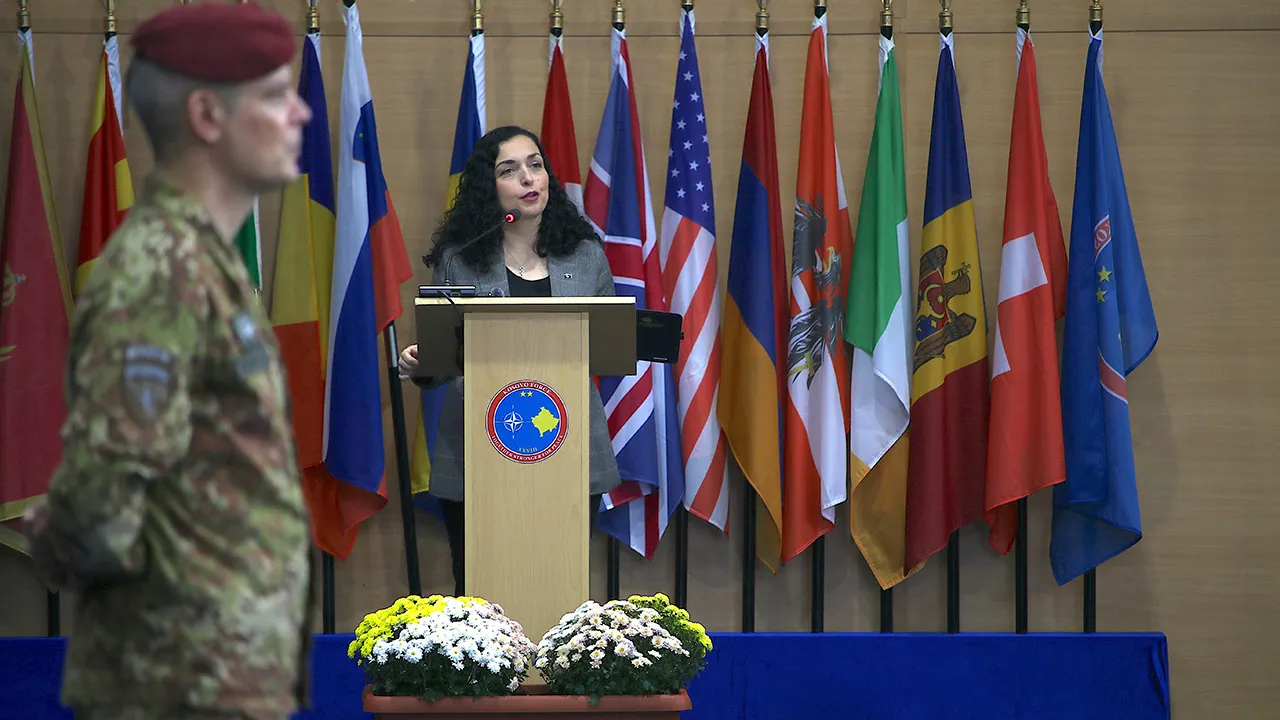
Kosovo Faces Political Uncertainty Amid Election Delays
Kosovo is currently grappling with a political crisis as the deadline for electing a new president has passed. President Vjosa Osmani, a supporter of Donald Trump, has dissolved the parliament and called for new elections.
With ongoing global conflicts and a NATO presence in the region aimed at maintaining stability, Osmani emphasized the importance of completing the electoral process during this complex geopolitical time. “I find it very hard to predict what might happen next,” she told reporters.
Recently, Trump commended Osmani for her leadership, referring to her work in Kosovo as excellent. She has also accepted an invitation from Trump to join a peace initiative and offered support to an international stabilization effort in Gaza.
The situation in Kosovo is further complicated by discussions about possible changes to the NATO peacekeeping mission, KFOR, which has been operating since 1999 following the Balkan wars. The mission’s commander stated that U.S. troop levels in Kosovo are not expected to decrease; around 600 American soldiers remain deployed there.
Tensions between Kosovo and Serbia have persisted since Kosovo declared independence in 2008. Former Albanian Prime Minister Pandeli Majko commented that Kosovo needs effective governance and cooperation to settle the president’s election issue. He expressed hope that the Constitutional Court would help find a solution.
The Kosovo parliament has been stuck in a deadlock for over a year. A recent vote to elect a new president fell short because opposition members boycotted it, opposing the prime minister’s candidate. Prime Minister Albin Kurti maintained that the parliament should only be dissolved after two failed presidential votes.
Kurti’s party has appealed to the Constitutional Court regarding the election process, hoping to clarify its legality. New elections might be scheduled as soon as April 5, according to opposition leader Ramush Haradinaj.
Majko believes that the ongoing disputes aren’t a significant issue, as the parties’ standings would likely remain the same in any new elections. He described the notion of early elections as a tiring political crisis without clear resolutions.
