
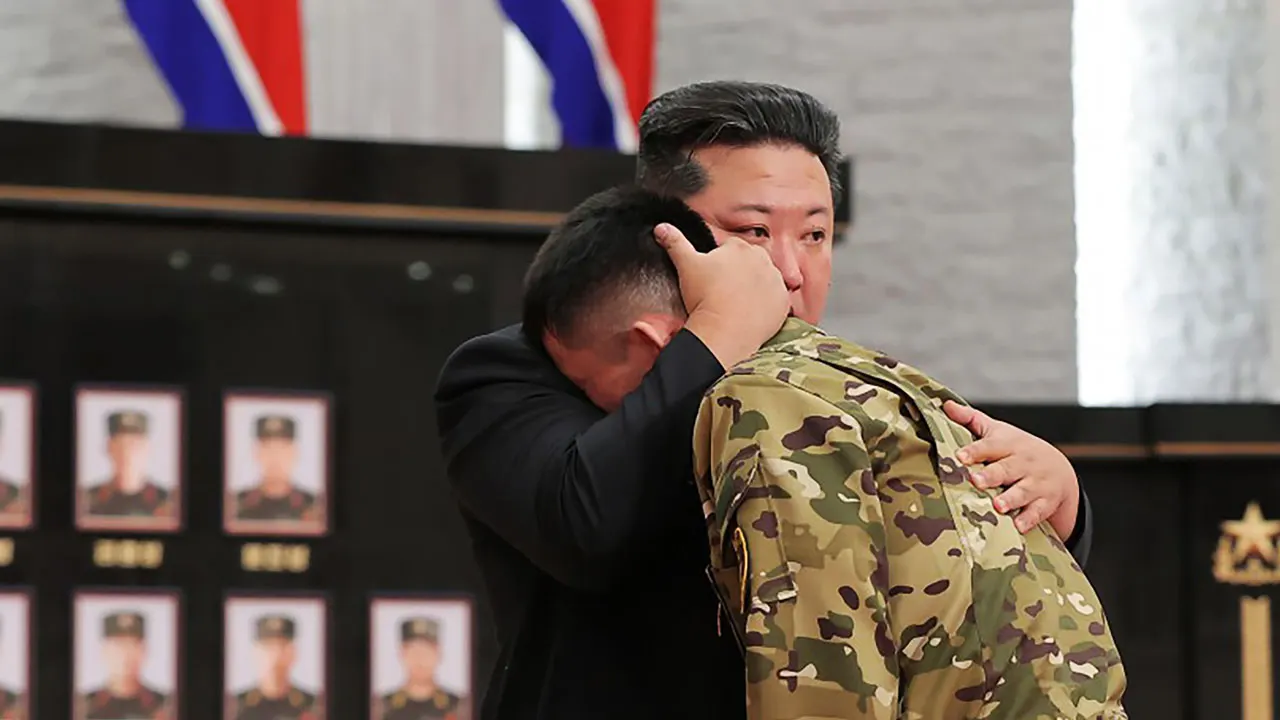
North Korean Leader Acknowledges Troop Losses in Ukraine Conflict
In a recent ceremony, North Korean leader Kim Jong-un openly recognized the significant losses among the troops he sent to support Russian President Vladimir Putin in the ongoing conflict in Ukraine. This acknowledgment marks a rare moment where Kim addressed the toll on North Korean soldiers, indicating that casualties were more substantial than previously admitted.
During the event, held on Friday, Kim honored around 100 soldiers, who were accompanied by family members. He appeared emotional as he expressed gratitude, embracing children and appearing visibly moved. This public recognition comes after he previously mentioned sending thousands of troops to aid Russia, and he had indicated awareness of some fallen soldiers back in July when he mourned over flag-draped coffins.
The acknowledgment at the recent ceremony is significant as it marks the first time Kim has admitted that many soldiers were lost. Reports earlier in the year suggested that approximately 600 North Korean troops were killed in the fighting around Kursk, a detail supported by South Korea’s intelligence services, which stated that nearly 4,700 casualties arose from the 15,000 North Korean soldiers dispatched to the region.
Kim described the military efforts as a demonstration of the “heroic” North Korean army’s strength. He referred to the successful operations in Kursk as a testament to the fighting spirit of his troops.
Currently, the situation in Kursk remains complex, with Russian forces reportedly regaining control after Ukraine launched an operation against them last year. Despite this, skirmishes continue between Ukrainian and Russian forces in the area.
The Ukrainian military also recently conducted drone strikes on a key oil refinery in southern Russia, further intensifying the conflict.
As of late, it has been reported that North Korea had sent as many as 12,000 troops to Kursk in 2024, with an additional 3,000 deployed in early 2025 in response to Ukrainian actions. However, the exact number of North Korean troops still present in the region remains unclear.
In a hopeful turn, Kim indicated that North Korea’s military involvement in Russia’s war may be winding down, celebrating what he called a “victorious conclusion” to overseas operations. It remains uncertain if this signals a return of the troops already in Russia.
This development captures a pivotal moment in the ongoing conflict, showcasing the complex international dynamics at play and the human toll of the war.
