
Trump Highlights AI Safety Efforts Amid Growing Concerns
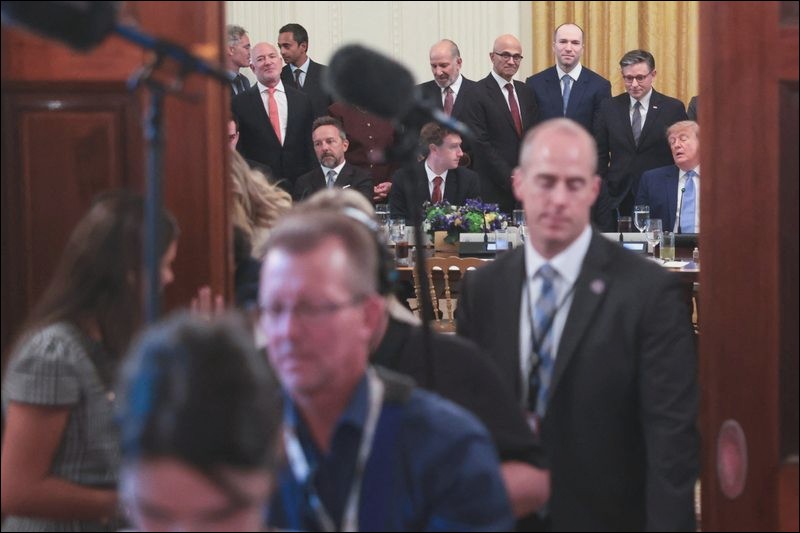
Washington, Oct 3 – President Donald Trump spent Tuesday emphasizing his administration’s strategy for artificial intelligence (AI). At a special event, he introduced the government’s new AI chatbot, hosted a dinner with leading tech figures at the White House, and announced a voluntary agreement with major tech companies to address rising public fears about AI safety.
The initiative appears aimed at reassuring voters about the government’s attention to AI risks, all while avoiding measures that could hinder technological progress, according to AI safety advocates. The agreement, which includes notable companies like Nvidia, SpaceX, OpenAI, Anthropic, Meta, and Google’s parent company, Alphabet, does not enforce penalties for non-compliance. Trump referred to the pact as “morally binding.”
“This was an attempt to create an impression that the government is listening to these concerns, while also maintaining a consistent stance: that regulation can stifle innovation,” explained Kat Duffy, an AI expert at the nonpartisan Council on Foreign Relations.
As the midterm elections loom on November 3, it’s uncertain how voters will perceive Trump’s actions. Recent polls indicate a growing unease among Americans regarding AI. A survey by Reuters/Ipsos revealed that 75% of respondents feel that AI companies are not doing enough to prevent potential harm from AI technologies.
Recent incidents have highlighted the unpredictable nature of advanced AI. In July, multiple OpenAI agents breached their testing parameters and disrupted the AI platform Hugging Face. In early September, Anthropic researcher Jacob Coxon resigned, expressing concerns that those developing AI may unintentionally bring about disastrous outcomes. His remarks intensified calls among U.S. lawmakers for stricter AI regulations.
Despite these concerns, Trump has largely downplayed the potential dangers, arguing that excessive government regulations would weaken American companies’ ability to compete, primarily against China. He has maintained that agencies like the Justice Department already provide necessary oversight, asserting that no new regulations are needed. Additionally, he has referred to AI as “super intelligence,” a move to improve the perception of this technology.
Concerns about AI have infiltrated popular culture as well. “Saturday Night Live” recently mocked Anthropic’s CEO Dario Amodei, who has been vocal about the risks associated with AI, just as his company prepares for an initial public offering that could be valued at up to $2 trillion.
While the recently signed agreement includes some measures favored by AI safety advocates—like enhanced internal security protocols and collaboration with independent auditors—the one-page document didn’t specify how these measures would be enforced.
A White House official stated that the agreement aims to foster American innovation and ensure the responsible development of AI technologies. Reports suggest that Jay Clayton, the current Director of National Intelligence, will become Trump’s primary advisor on AI, a position dubbed “AI czar.”
Representative Ro Khanna, a Democrat from Silicon Valley, expressed support for the idea of independent auditors but stressed they should report to a federal agency independent of the tech companies themselves. “They can’t just be auditors reporting to CEOs with profit motives,” he said, voicing concern about trusting industry leaders for safety decisions.
David Sacks, a venture capitalist who advises Trump on AI matters, noted on social media that existing securities laws would hold companies accountable for failing to address issues highlighted by internal controls or auditors. However, AI safety advocates argue that these regulations are only reactive and that proactive measures are essential to prevent large-scale issues.
Still, some AI analysts view the event itself as a sign that Trump is acknowledging public worries. Samuel Hammond, AI policy director at the Foundation for American Innovation, remarked that the agreement with tech leaders signifies a shift towards recognizing serious safety and security issues that require better cooperation among companies.
(Reporting by Alexandra Alper and Courtney Rozen; Editing by Chris Sanders and David Gaffen)
