
Iran’s New Supreme Leader Faces Challenges Amid Ongoing Conflict
WASHINGTON: U.S. Defense Secretary Pete Hegseth expressed concerns on Friday regarding Iran’s recently appointed Supreme Leader, Mojtaba Khamenei, suggesting he is injured and may be facing serious difficulties in leading the nation. This statement comes after ongoing attacks from the U.S. and Israel over the past two weeks.
So far, there have been no public images of Khamenei following an Israeli strike that resulted in the deaths of many of his family members, including his father and wife. His first public comments were delivered through a pre-recorded statement read on television, where he vowed to keep the Strait of Hormuz closed and urged neighboring countries to remove U.S. military bases or risk retaliation from Iran.
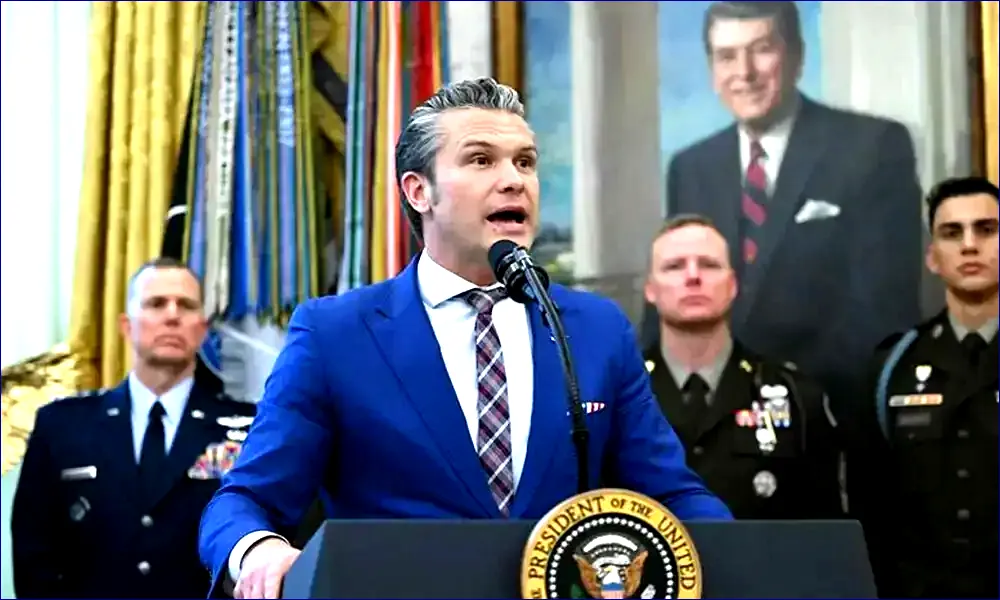
Hegseth noted the unusual nature of Khamenei’s communication. “We have not heard his voice or seen him on video. It raises questions about his condition. He seems frightened and lacks legitimacy,” Hegseth remarked during a briefing.
Meanwhile, a source in Iran reported to Reuters that Khamenei has only sustained minor injuries and is still actively involved in governance, contradicting some reports of his condition.
Hegseth, alongside General Dan Caine, highlighted the U.S. military’s commitment to dismantling Iran’s missile and drone capabilities, emphasizing a strong approach in the conflict. He declared, “We’re going to keep pushing forward, showing no mercy to our enemies.”
During the briefing, Hegseth mentioned that the U.S. has struck over 6,000 targets in Iran, resulting in significant casualties. U.S. officials also announced plans to send more military resources to the Middle East to enhance their presence in the region.
Despite these attacks, Iranian drones have reportedly continued their operations in neighboring countries, including Kuwait and Iraq, indicating that tensions remain high.
Tragically, the conflict has also claimed the lives of six U.S. service members after a military refueling aircraft crashed in western Iraq, a situation the Pentagon clarified was not due to enemy fire.
As the situation develops, the international community is closely monitoring these events, particularly the implications for regional stability.
