
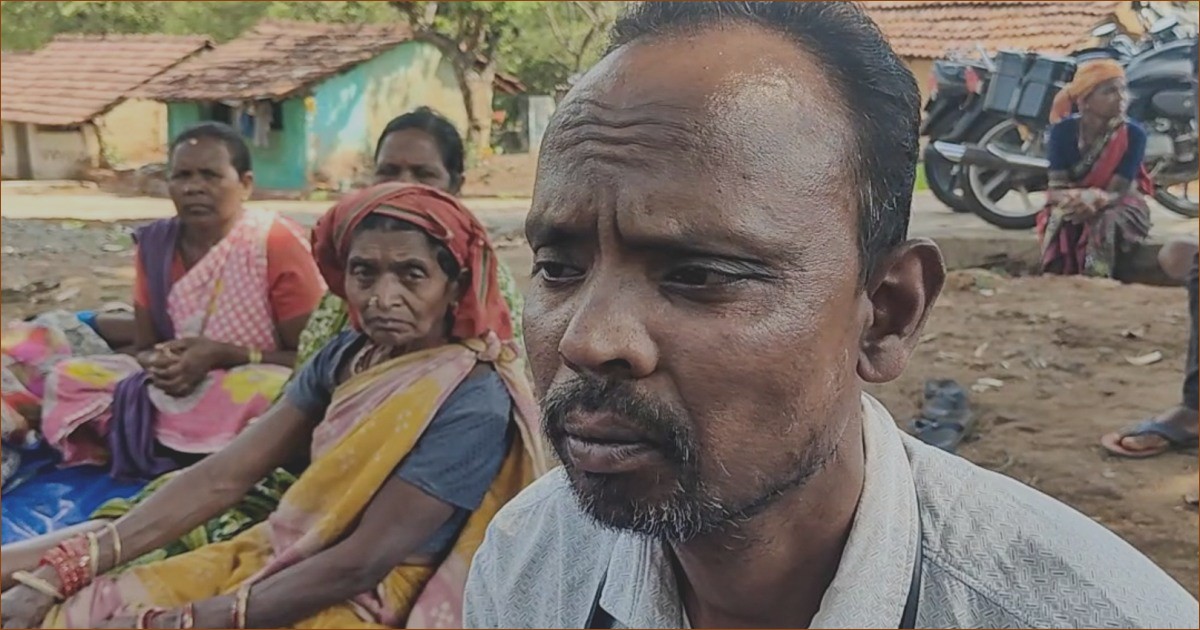
Villagers in Koraput District Protest Against Alleged Land Grab for Bauxite Mining
Koraput, India — Raghunath Khara was stunned when he saw a document with his thumbprint claiming he had agreed to allow a mining project on his village’s untouched forest land. He insists he never gave his consent.
“I only sign in English — that thumbprint isn’t mine,” said Khara, a shopkeeper in Balda village, located in the tribal-rich Koraput district of Odisha, in eastern India.
Khara is among many Indigenous people from Balda and the nearby Bannur village who are facing the loss of their ancestral land due to a new bauxite mine. This mine is being set up by Kalinga Alumina Limited, a part of Adani Enterprises Limited, owned by Gautam Adani, a close associate of Prime Minister Narendra Modi and one of India’s wealthiest individuals.
The project, estimated at $24 million, threatens to destroy significant parts of Balda Hill, which is home to forests and sacred sites for ten nearby tribal villages.
According to allegations, the signatures and thumb impressions of nearly 600 tribal members were collected during village council meetings held last October in Balda and Bannur, which is about five kilometers away. Khara claims he did not attend the meeting and was instead protesting against the mining plans with his family, located just a short distance from the village council office.
“We all protested outside that day. It was impossible for me to have participated in the meeting,” Khara explained.
India’s constitutional laws protect Indigenous people’s rights to their ancestral lands. Any proposal to change land use requires a valid resolution from the village council, where at least half of the adult population must agree in writing. However, government documents assert that all 580 adults—360 from Balda and 227 from Bannur—consented to give up their land. Yet, local leaders deny that any signatures were gathered and called the recent meetings invalid.
Photographic evidence from the meetings shows that only about 100 people attended, which does not meet the minimum requirement for a valid resolution. Villagers are also claiming that many signatures listed are either forged or belong to deceased individuals.
In one notable case, Rama Hantal’s name appeared in the documentation despite the fact that he is paralyzed and cannot move or speak. His daughter-in-law asserted that he did not attend the meeting.
“How could he have signed anything?” she questioned.
Many villagers recount how they were approached to sign documents under misleading pretenses. Madhav Kuntili, a farmer from Bannur, said he was pressured to sign a petition under the false impression that doing so would provide the village with basic infrastructure like roads and schools.
The perceived coercion has stirred unrest among those affected. Villagers from Balda and Bannur, led by Ajaya Muduli, are taking legal action to contest the legitimacy of the agreements supposedly made concerning their land.
Local officials also seem to have rushed the approval process for the mining project. In February, the Odisha government quickly designated Adani Enterprises as the preferred bidder for the mining lease, igniting protests from local tribal communities. Although many voiced their objections during a mandatory public hearing, approvals for the project were quickly granted soon after.
Adding to the community’s concerns, recent findings suggest that many consent documents were collected through deceptive means. Residents discovered that names and thumbprints were taken for documents unrelated to the mining project and later presented as support for it.
Experts have pointed out that these incidents reveal a troubling trend across India, where projects often proceed without the proper consent from local communities. Activists fear that these practices set a dangerous precedent for future resource extraction projects.
Villagers are alarmed about the possible ecological fallout that could follow mining activities. They worry about the impact on local water sources and the loss of their sacred forests, which they believe are tied to their identity and spirituality.
“The forest is everything for us,” says Raghunath Hanthal, a local priest. “Our rituals and culture are deeply connected to this land.”
Despite the formal approvals given to the Adani project, the villagers remain determined to fight against the mining operation, promising to protect their land and way of life.
“This is our ancestral land, and we will not give up without a struggle,” concluded Rajendra Khara, another local resident.
