
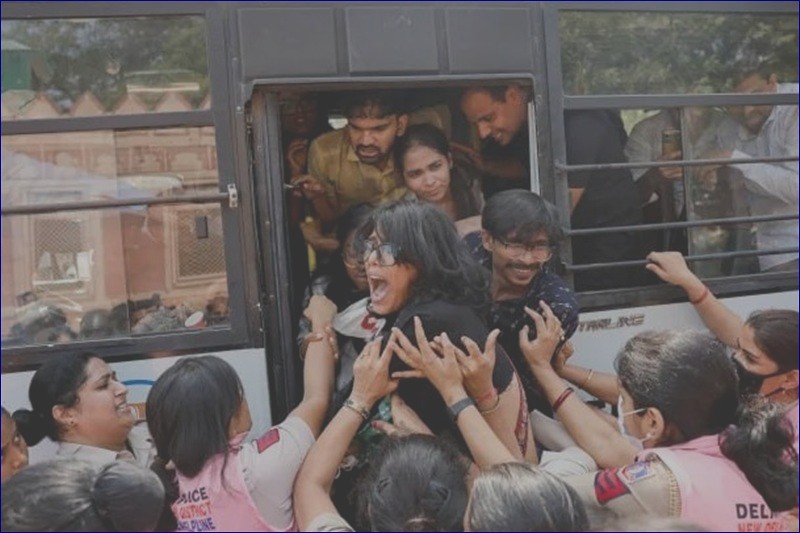
Protests Erupt in New Delhi Over Voter List Controversy
In recent days, intense protests have erupted in New Delhi, with a focus on the Cockroach Janta Party (CJP) and other youth organizations. These groups are accusing Prime Minister Narendra Modi’s Bharatiya Janata Party (BJP) of manipulating voter lists to boost its chances in upcoming state elections.
Authorities responded by sealing off Jantar Mantar, the area designated for protests in central New Delhi. In an effort to control the situation, they suspended mobile internet services in the business district and closed many metro stations and markets. Barricades, checkpoints, and anti-riot vehicles were positioned around the city, and police inspected buses and cars for protesters.
According to reports, approximately 2,000 to 2,500 individuals were detained in New Delhi, with an additional 600 arrests made in Mumbai. The protests are largely centered on the Election Commission’s Special Intensive Revision (SIR) of voter lists, which critics claim unfairly benefits the BJP. Tensions escalated after a newspaper report revealed that two election commissioners had raised concerns about changes that removed around 130 million names from the voter lists.
Both the Election Commission and the BJP have denied any wrongdoing, and the chief election commissioner has not publicly addressed the issue. Among those detained were CJP founder Abhijeet Dipke and his associates, who were arrested while arriving on an Air India flight from Mumbai. Dipke shared a video of the police entering the aircraft on Instagram, declaring that he was unafraid of arrest and accusing the government of acting like a dictatorship.
The arrests included well-known figures such as YouTuber Dhruv Rathee, All India Students’ Association president Neha Bora, Communist Party of India (Marxist-Leninist) leader Dipankar Bhattacharya, and lawyer Prashant Bhushan. Television footage also captured the detention of opposition lawmakers, including former chief ministers Mamata Banerjee, Arvind Kejriwal, and Pinarayi Vijayan.
Despite the crackdown, smaller protests continued across the city. A member of the Students’ Federation of India, Shranaya, expressed concerns about the government’s threat to democracy and promised that protesters would not back down.
Internationally, the detentions have drawn criticism, with the United Nations Human Rights Office urging Indian authorities to uphold the right to peaceful assembly and engage in constructive dialogue. Amnesty International has cautioned against any attempts to stifle dissenting voices, while the Committee to Protect Journalists has demanded that police respect media personnel after several reporters were briefly held.
In response, India’s mission to the United Nations in Geneva defended the government, stating that while peaceful assembly is constitutionally protected, it can be subject to reasonable restrictions for public order.
Domestically, BJP spokesman Sambit Patra dismissed the protests as insignificant, claiming that India remains stable under current leadership. Conversely, Congress president Mallikarjun Kharge criticized Modi’s government, labeling it a “Muzzled Democracy.”
This wave of unrest comes as India approaches a series of significant state elections starting in early 2027, heightening the stakes for the Modi administration. Political analyst Sanjay Kapoor shared with Al Jazeera that the government appears to be fearful of growing dissent, suggesting that the BJP may be losing public trust.
