
Protests Erupt Across France as Students Demand Better Conditions
In France, more than 625 individuals, predominantly students, have been arrested during two days of intense protests near educational institutions. The demonstrations, which escalated from Paris to various regions, were sparked by students’ complaints regarding inadequate staffing, aging school infrastructure, overcrowded classrooms, government budget cuts, and long school hours.
Prime Minister Sébastien Lecornu held an emergency meeting on Thursday, calling off ministerial engagements to focus on the growing unrest that has unfolded in schools across the Paris area since last week.
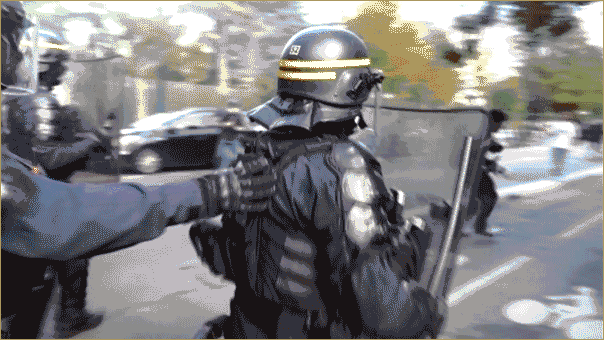
On Thursday alone, over 350 high schools and approximately 30 universities reported disruptions due to the protests. Reports state that 83 police officers and gendarmes were injured during the clashes, with a total of 119 people, including students and school staff, hurt since the beginning of the protests.
In a troubling incident, the principal of Marseille’s Victor Hugo high school was attacked with gasoline. Additionally, two more school principals were injured in separate incidents in Rouen and Petit-Quevilly. As tensions rose, police resorted to using tear gas in several locations, drawing accusations from students of excessive force. Authorities have raised alarms about potential “urban violence” and attempted arson incidents at different schools.
The protests have gained momentum following the government’s recent announcement of budget cuts in the proposed 2027 budget, becoming a focal point in the political climate as the French government faces scrutiny.
Growing Political Tensions Over Protests
As these protests gain traction, they are rapidly becoming a significant issue in the upcoming presidential election, set for next May. Far-left candidate Jean-Luc Mélenchon criticized the government’s handling of the protests, describing it as repressive. Critics allege that his party, La France Insoumise (LFI), may be leveraging the unrest to further its political agenda, potentially inciting violence in the process.
Interior Minister Laurent Nunez noted that some individuals are instigating violence among students, moving from school to school and encouraging disturbances. Education Minister Edouard Geffray suggested that schools should consider online classes if protesters block their entrances, emphasizing that “violence will not take away students’ right to education.”
Simone Rodan-Benzaquen from the Foundation for Defense of Democracies has pointed out that while the students’ issues concerning teacher shortages and unsafe facilities were valid at first, the extreme violence, including attacks on school leaders and firefighters, is concerning. She believes this situation reflects a broader challenge to the government, especially amid significant political and economic uncertainties.
The protests, originating in the Ile-de-France region, have now spread nationwide, juxtaposing real student grievances with an emerging political drama. With significant challenges lying ahead for the French government, the current unrest represents a complex and potentially dangerous scenario for the nation.
As President Emmanuel Macron remarked recently, “High schools are meant to be open and share knowledge, not be blockaded or subjected to vandalism.”
This series of protests highlights the urgent need for addressing education issues in France while questioning the role of political factions in shaping the narrative around such demonstrations.
