
India is making great strides in developing sustainable aviation fuel (SAF), turning this initiative into a significant opportunity for industry, agriculture, and energy security. As the country establishes blending mandates for SAF, the focus is shifting toward increasing production. However, this challenge involves much more than just enhancing refining capabilities. It calls for a well-coordinated system that includes gathering feedstock, building infrastructure, managing logistics, and ensuring proper certification, alongside commitments from airlines to purchase the fuel.
The green transition for aviation in India hinges on this collaborative effort. SAF development cannot happen in isolation; it requires a united front involving policymakers, energy firms, airlines, farmers, technology providers, investors, logistics experts, and global partners.
The India SAFA Conclave and Awards served as a vital gathering for those involved in the global SAF value chain, fostering discussions, partnerships, and actionable steps. WriteCanvas was honored to participate in this collaboration.
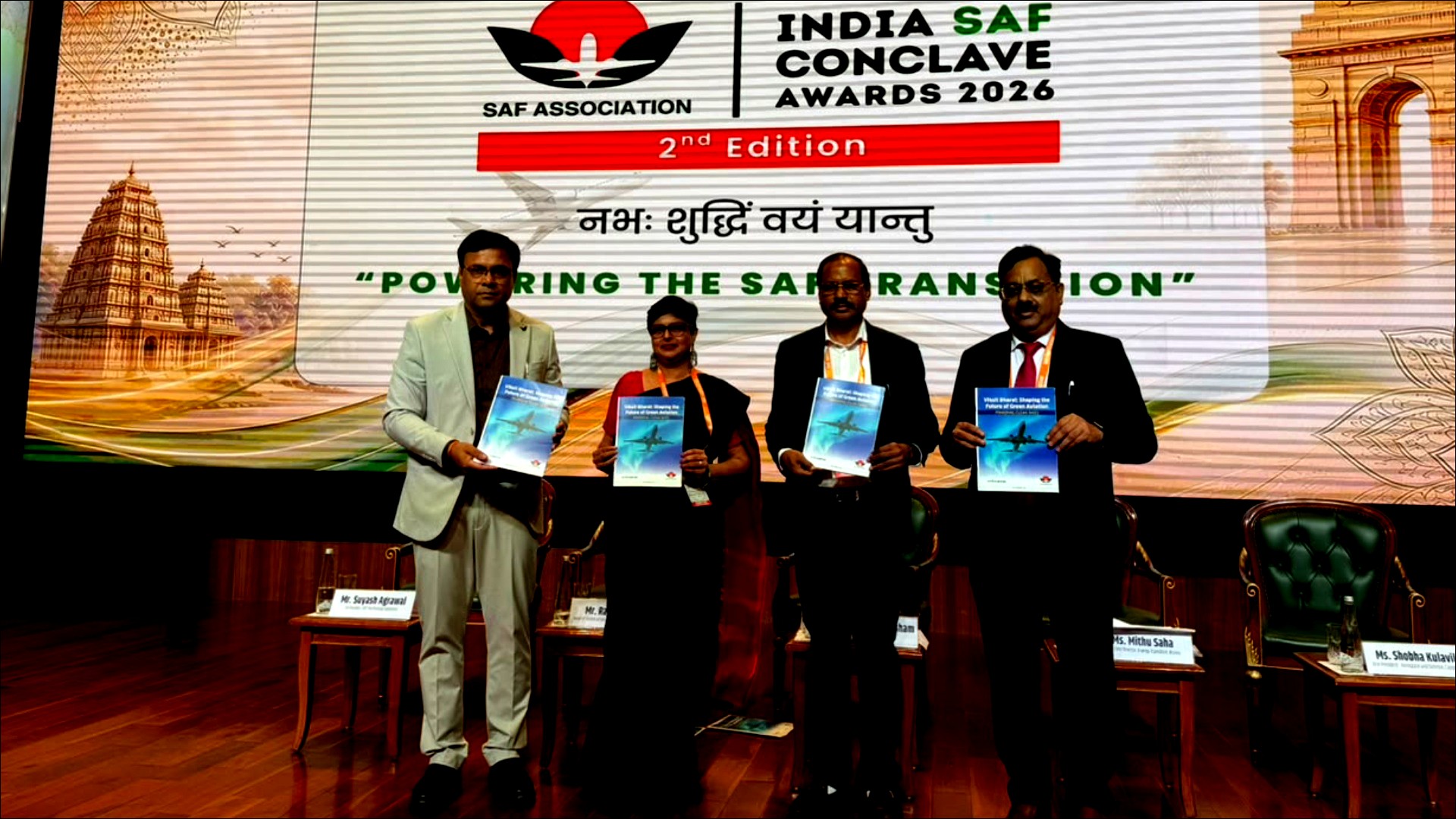
At the start of the conference, the SAF Association and WriteCanvas presented a report titled “Visit Bharat: Shaping the Future of Green Aviation.” The report was released by notable figures such as Alok Sharma, former Director of R&D at IndianOil, J V V Satyanarayana, Senior Vice President of the SAF Association, Renjini Liza Varghese, CEO of WriteCanvas, and Rohit Kumar, Secretary General of the SAF Association.
The potential of SAF goes beyond cutting emissions from aviation. It can boost India’s bioeconomy, provide additional income for rural communities, attract industrial investment, and lessen reliance on foreign energy sources. Rohit Kumar emphasized that this sector can deliver significant economic benefits along with its environmental advantages.
SAF also introduces a dual-income model for India. By generating demand for agricultural residues and waste oils, farmers can earn more while a strong domestic SAF industry could enhance exports and decrease energy imports.
Speakers at the conclave stressed that India’s strategy must focus on long-term resource management and sustainability, rather than just rushing to meet immediate decarbonization goals. Alok Sharma pointed out that SAF should not be seen as a single technology or feedstock. Instead, a careful evaluation of technology and resource availability alongside sustainability is essential for a country as vast as India. Different regions have varying levels of feedstock availability, and factors like transportation costs and competing biomass uses can impact economic feasibility. Therefore, creating a flexible strategy with various feedstock options and conversion methods is necessary.
The urgency of addressing aviation’s climate impact was underscored during the discussions. While aviation is responsible for about 2.5% of global CO2 emissions, its actual warming effect is larger when considering non-CO2 emissions. Upendra Tripathi, the former Secretary of the Ministry of New and Renewable Energy, pointed out that when heat contributions are included, aviation emissions contribute approximately 3.5%.
Aviation is part of India’s broader challenge of addressing hard-to-abate emissions, which make up nearly 40% of the country’s total emissions. Sanjay Kumar Singh, president of the Carbon Markets Association of India, highlighted India’s commitments under the Paris Agreement aimed at reducing carbon intensity relative to GDP by 47% by 2035 while also establishing carbon sinks during that time. SAF will be crucial in transforming a rapidly growing aviation sector to become more environmentally friendly.
The conclave also emphasized the value of sharing knowledge internationally as India builds its SAF framework. The Omani Ambassador, Issa Saleh Abdulla Saleh Al Shibani, noted that Oman is creating a renewable energy ecosystem in line with its Vision 2040 and aims for net-zero emissions by 2050. Similarly, Benedikt Hoskuldsson, Iceland’s Ambassador to India, remarked that for Iceland, SAF represents not just sustainable aviation but also the potential of carbon capture, utilization, and storage, and that Iceland is eager to share its experiences with India.
These discussions reflect SAF’s growing connection with clean energy solutions, from green hydrogen and e-fuels to carbon capture strategies. India has the chance to tap into global knowledge while tailoring approaches to its domestic needs.
The transition toward SAF in India will depend on building a comprehensive, sustainable, and economically viable value chain that spans from feedstock sources to delivery at airports. The India SAFA Conclave and Awards brought together global representatives to enhance this value chain. Moving forward, it is crucial that conversations lead to action: clear policies, reliable feedstock supplies, investment-ready projects, strong logistics, supportive market mechanisms, and engaged end-users are all necessary.
The launch of the report “Visit Bharat: Shaping the Future of Green Aviation” is a step forward in this ongoing discussion. As India gears up to increase SAF production, the focus must remain on uniting the ecosystem, maintaining momentum, and effectively transitioning to a greener aviation future crafted in India.
