
A Dream Drive: Racing in Simulators at Monza
It was a sunny morning on July 26 when an unexpected phone call changed everything. Mumbai Falcons Racing Limited (MFRL) reached out with a tempting question: “Would you like to drive your favorite Formula One car on the track of your dreams?”
Caught off guard, my childhood dream instantly rushed back—a chance to race a Ferrari at Monza, known as the Temple of Speed. Without hesitating, I shared my wish, and MFRL was ready to make it a reality, with one condition: I had to clock my fastest lap by July 30.
The next four days were filled with preparation. I took inspiration from the F1 movie and started doing neck exercises and reflex drills. As the race day approached, I felt more tired than ever, even though I hadn’t yet figured out how to reach Italy.
Just a day before I was set to race, I was told to head to Bharat Mandapam in Delhi for my drive at Monza. Monza… in Delhi? I was puzzled but excited for July 30 to finally arrive.
I managed some last-minute neck exercises before hailing an Uber to the “racetrack.” Although it wasn’t the glamorous F1 driver experience I pictured, I cranked up the F1 movie soundtrack to enhance the mood.
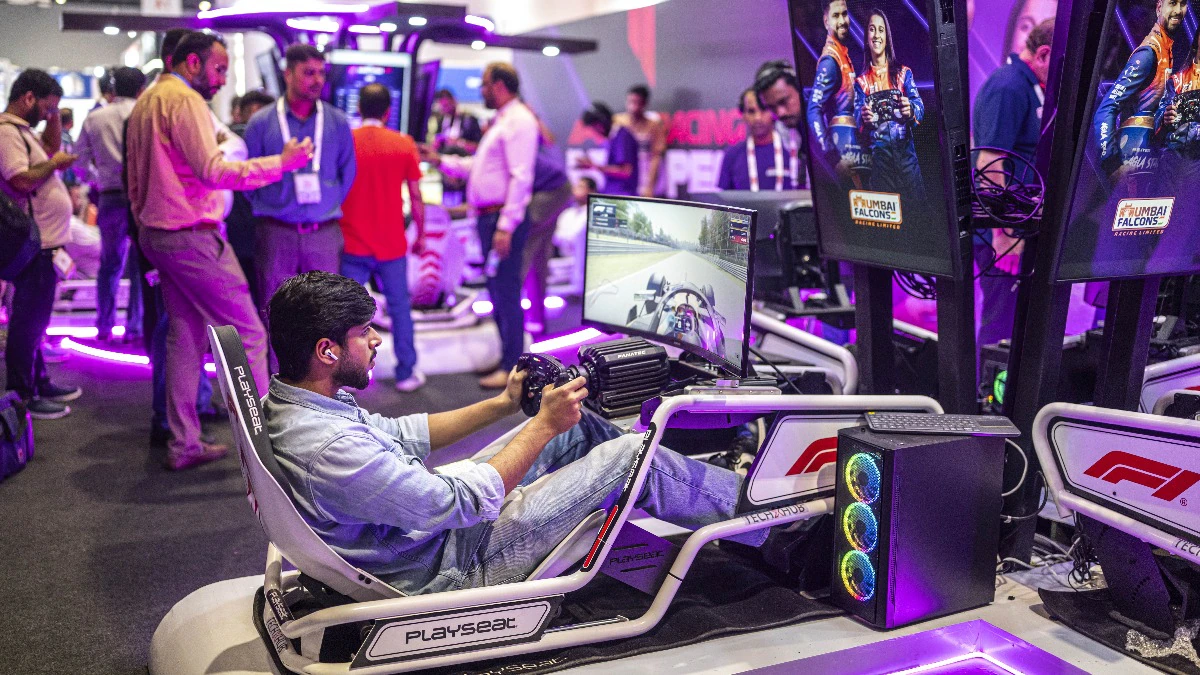
Arriving at Bharat Mandapam, I saw a sign that read: F1 Sim Racing India Open 2026. This event aims to find India’s next racing talent, providing a platform to showcase skills on professional-grade simulators, with a total prize pool of ₹2 crore. The overall winner will also secure a spot in MFRL’s One in a Billion Hunt, which includes a ₹3 crore Driver Development Fund to support their motorsport journey.
MFRL has been instrumental in launching careers of several drivers, including Kimi Antonelli, the current championship leader.
As I walked toward Hall 14, the sound of roaring engines filled the air. People were getting behind the wheels of cars resembling those of racing stars like Lando Norris and Max Verstappen. Everyone aimed for the top of the leaderboard, trying to prove they had what it takes to become the next Formula One driver for India.
With discussions about bringing Formula One back to India gaining traction, the search for a new Indian talent feels more pressing than ever.
Finally, it was my turn to hop into a simulator rig. It resembled something every F1 fan has dreamt of having but this felt genuinely different. While I was waiting, I watched other drivers struggle. Some ended up in the gravel, others veered off course too often, and a few collided with walls.
The Monza Experience
When my chance came, I settled into the simulator, feeling as though I was stepping into a real F1 car. With the settings loaded, my Ferrari—well, Lewis Hamilton’s Ferrari—was ready to hit Monza.
As the lights went out, I concentrated on controlling the car through the first corner. Immediately, I felt the forces at play. The simulator tested my precision like nothing else.
I managed to post a lap time of 1:28.131, a moment of pride for me. But then I got a bit too ambitious on my second lap and ended up in the gravel, making the same mistake repeatedly. By the fifth lap, I finally grasped the rhythm, clocking a time of 1:26.187—only to have it invalidated because I grazed the gravel.
This experience taught me that perfection is essential in racing. Dewansh Mahesh Sadi, a fellow participant and aspiring racer, echoed similar sentiments after his experience. He had come in first place despite some initial stumbles.
MFRL aims to give aspiring racers in India the feel of a real F1 cockpit while discovering potential talents in the process. “Why don’t we find an Indian driver? That’s what we’re doing,” said Phiroze Jhaveri, director of Race Operations at MFRL.
Why Sim Racing?
Max Verstappen, the reigning F1 world champion, is also a strong supporter of sim racing. He dreams of seeing a sim racer transition to the real world of Formula One.
Simulators play a critical role for drivers preparing for new F1 circuits, allowing them to learn every corner, every braking point, before facing the actual track.
Though go-karting has been a traditional starting point for many racers, simulator technology doesn’t replace it; it complements it by reducing costs and making motorsport accessible to more young talents.
“MFRL sees these simulators as an introduction to motorsport, helping to create a pathway for aspiring drivers,” explained Ishaan Bhataiya, another MFRL official.
Looking Ahead
Winning the F1 Sim Racing India Open is only the beginning. MFRL has plans to continue this journey, with further opportunities leading to go-karting, and eventually, the path to Formula 4, 3, and beyond.
The recent event demonstrated that the enthusiasm is there, with nearly 3,000 participants eager to race. Union Sports Minister Mansukh Mandaviya even showed up to witness the action.
As I packed up and left Bharat Mandapam, I humorously asked an official if there was still a chance for me to switch careers into Formula One—only to be told I’d need to clock a time of 1:20 to qualify.
Though my F1 dreams may have ended in that moment, I realized that among many eager racers, there could be hidden talent waiting to be discovered. And with MFRL’s vision, perhaps the next star in Indian motorsport won’t start with a go-kart, but rather on a simulator, chasing their dreams.
