
Kashmir Protests: Local Leaders Deny Indian Links Amid Escalating Tensions
Amid rising unrest in Pakistan-administered Kashmir, the protest group at the center of the violence firmly rejected claims of receiving support from India. They challenged the Pakistani government to provide proof for these allegations, emphasizing that their movement is rooted in demands for democratic rights rather than foreign influence.
In a recent conversation, SA Khan, a key member of the Jammu Kashmir Joint Awami Action Committee (JKJAAC), stated that their coalition of civil society and political groups is “not answerable to India.” He dismissed accusations that they are funded or directed by the Indian government.
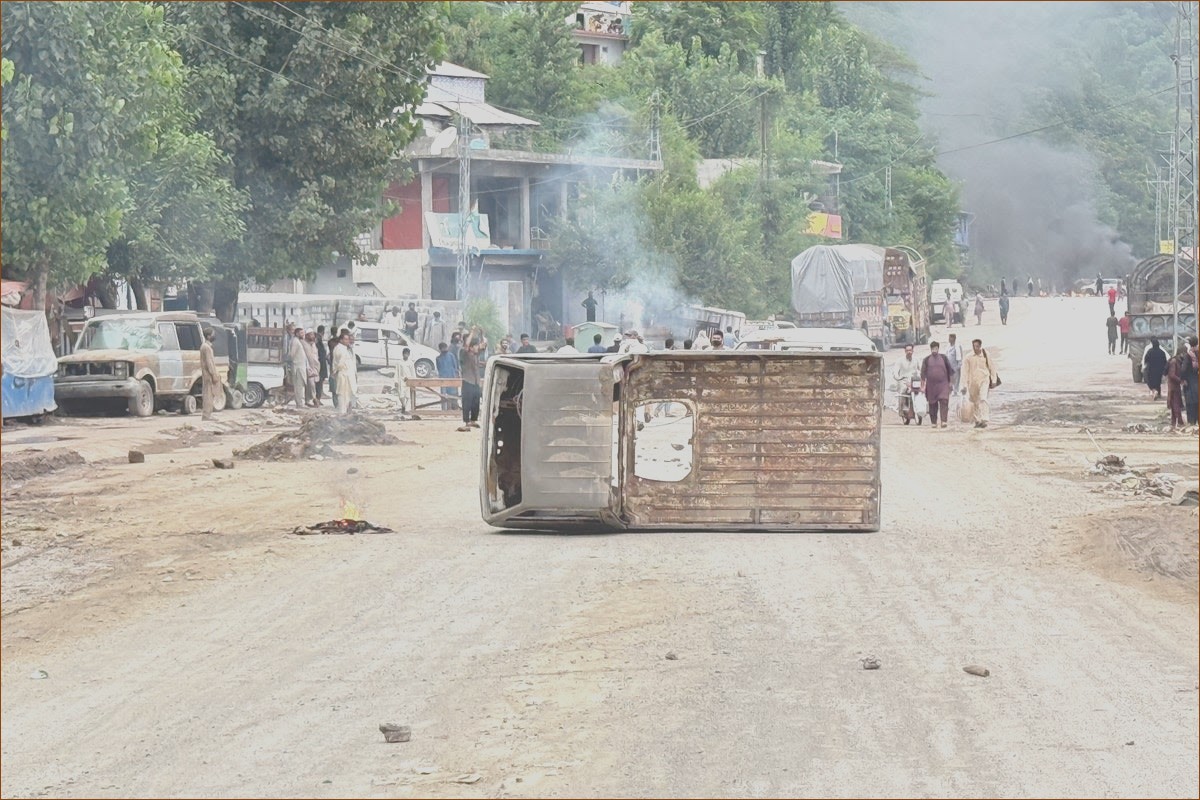
The region is experiencing significant political turmoil, with violence, an ongoing internet blackout, and claims of police brutality overshadowing elections. What started as protests over rising electricity costs has transitioned into a broader demand for political reforms and better accountability from local authorities.
Since these protests began earlier this year, the Pakistani government has repeatedly asserted that the Awami Action Committee is linked to India, aiming to disrupt elections. In June, the organization was even banned under anti-terrorism laws.
Recently, Pakistan’s federal information minister, Attaullah Tarar, claimed that an investigation had revealed a digital misinformation network connected to India, which allegedly financed social media campaigns for the banned group.
Khan rejected these allegations, asserting that the JKJAAC is an indigenous movement focused on local issues concerning governance and resource management. He emphasized that the group seeks meaningful political representation and accountability.
In contrast, the Indian government described the recent elections in Pakistan-administered Kashmir as a “complete farce.” Yet, Khan argued that such statements do not prove a connection between India and the JKJAAC, urging the Pakistani government to present credible evidence of foreign financing.
There has been a prolonged internet blackout and restrictions on journalism in the area, complicating independent reporting and raising concerns over human rights violations by security forces. Authorities maintain that they acted lawfully against violent protesters, claiming that some officers were killed during the unrest.
Khan affirmed that the JKJAAC is committed to peaceful protests and rejected any depiction of the movement as armed. He also called for an independent review of the government’s claims.
Central to the unrest is the demand to eliminate 12 reserved legislative seats for refugees from India-administered Kashmir. The Awami Action Committee argues that those who do not reside in the region should not influence its governance. They contend that every citizen should have a voice in decision-making concerning their lives.
Khan clarified that the movement does not wish to disenfranchise refugees; rather, it seeks to address the imbalance in political representation to ensure fair governance for all.
Despite the casualties, with reports indicating at least 88 civilians killed by early August, Khan expressed sorrow for every loss, including those of police and paramilitary personnel, emphasizing the unjust nature of the violence.
He urged that individuals should be held accountable for any wrongful acts rather than holding the entire movement responsible for violent actions. Khan criticized the official narrative, asserting that the conflict should be viewed as a political and civil rights issue, not solely a security matter.
Looking to the future, Khan sees two potential paths: a continuation of the current violent tensions or a return to meaningful negotiations. He advocates for dialogue over escalation, hoping for a resolution that benefits the people of Kashmir.
