
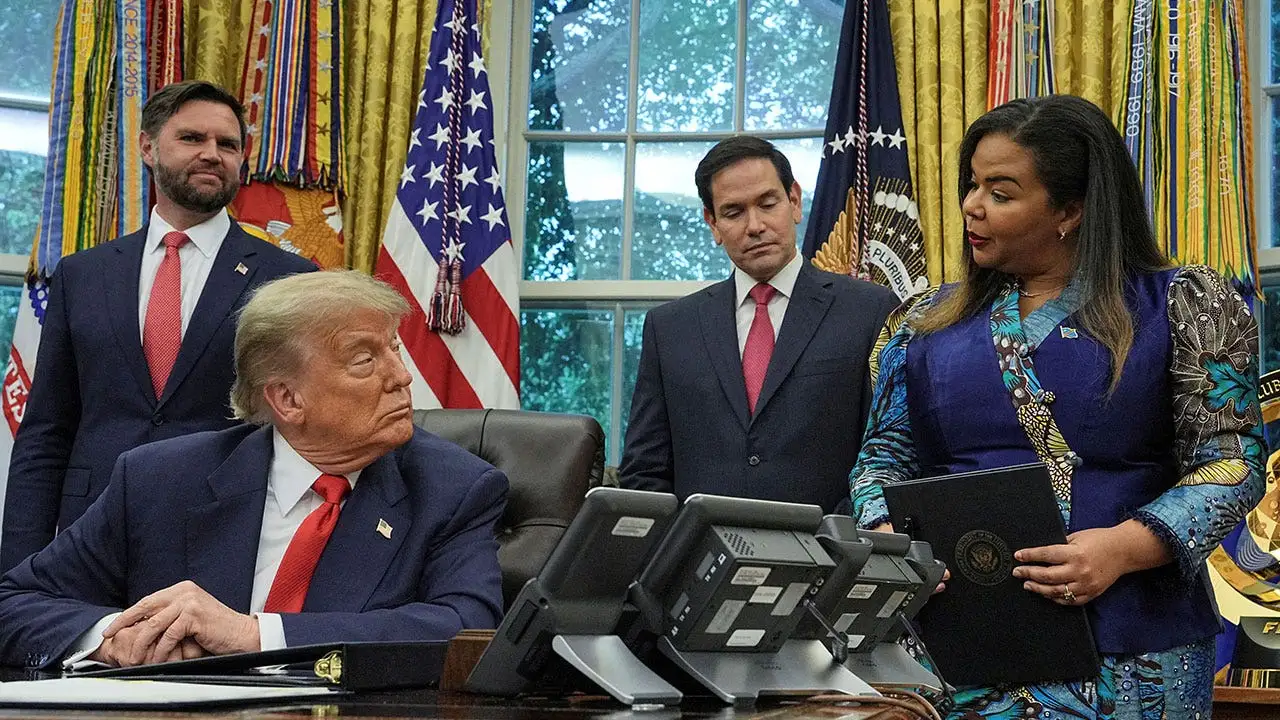
UNITED NATIONS — The Foreign Minister of the Democratic Republic of Congo (DRC) has expressed that the growing American engagement in the country’s mineral sector should not be viewed as a competition with China. Instead, Thérèse Kayikwamba Wagner emphasized the importance of having multiple partners to help harness the DRC’s rich natural resources for its people’s benefit.
In an interview at the United Nations, Kayikwamba Wagner stated, “I prefer to talk about complementarity rather than competition.” She highlighted that large nations like the USA, DRC, and China cannot develop with just one partner. They need diverse partnerships to address different needs and expertise.
Her comments come as the U.S. aims to enhance access to the DRC’s copper, cobalt, lithium, gold, and other vital resources while reducing dependence on Chinese mineral supply chains. A partnership agreement signed on December 4, 2025, between Washington and Kinshasa focuses on boosting economic cooperation, investment opportunities, and creating secure and transparent supply chains for critical minerals. This agreement is part of a larger initiative to promote economic integration while addressing long-standing conflicts in the region.
Moreover, a deal between DRC’s state mining company Gécamines and the commodities trader Mercuria could allow U.S. buyers priority access to some copper and cobalt supplies. The U.S. International Development Finance Corporation has also shown interest in investing in this partnership.
Kayikwamba Wagner noted that U.S.-DRC relations are becoming more defined based on shared economic interests. The DRC is eager for increased American involvement to help convert its mineral wealth into real improvements for Congolese citizens, while also benefiting American investors.
Speaking at a high-level U.N. meeting on critical minerals, she warned that the global shift toward clean energy should not switch one form of dependency for another, where raw materials are exported from Africa while processing and technology profits remain elsewhere. She argued for partnerships that support local processing, infrastructure, technology transfer, and access to financing.
The push for minerals is closely tied to the U.S.-mediated peace process between the DRC and Rwanda. An initial peace agreement was signed on June 27, 2025, which was reaffirmed with economic agreements on December 4. This framework aims to reduce conflict and attract investments to a mineral-rich region.
Although Kayikwamba Wagner acknowledged ongoing violence, she pointed out that the U.S. is committed to holding accountable those who violate the agreement. She commended the U.S. for sanctioning Rwandan officials allegedly supporting the M23 rebel group, which has been involved in seizing territory in the eastern DRC.
During her visit to New York, she also focused on the issues of natural resources and their ties to conflict and violence, especially the rise of sexual violence in areas controlled by M23 forces. She noted that victims often lack access to justice and healthcare, underscoring the importance of restoring state authority to protect survivors and ensure justice.
