
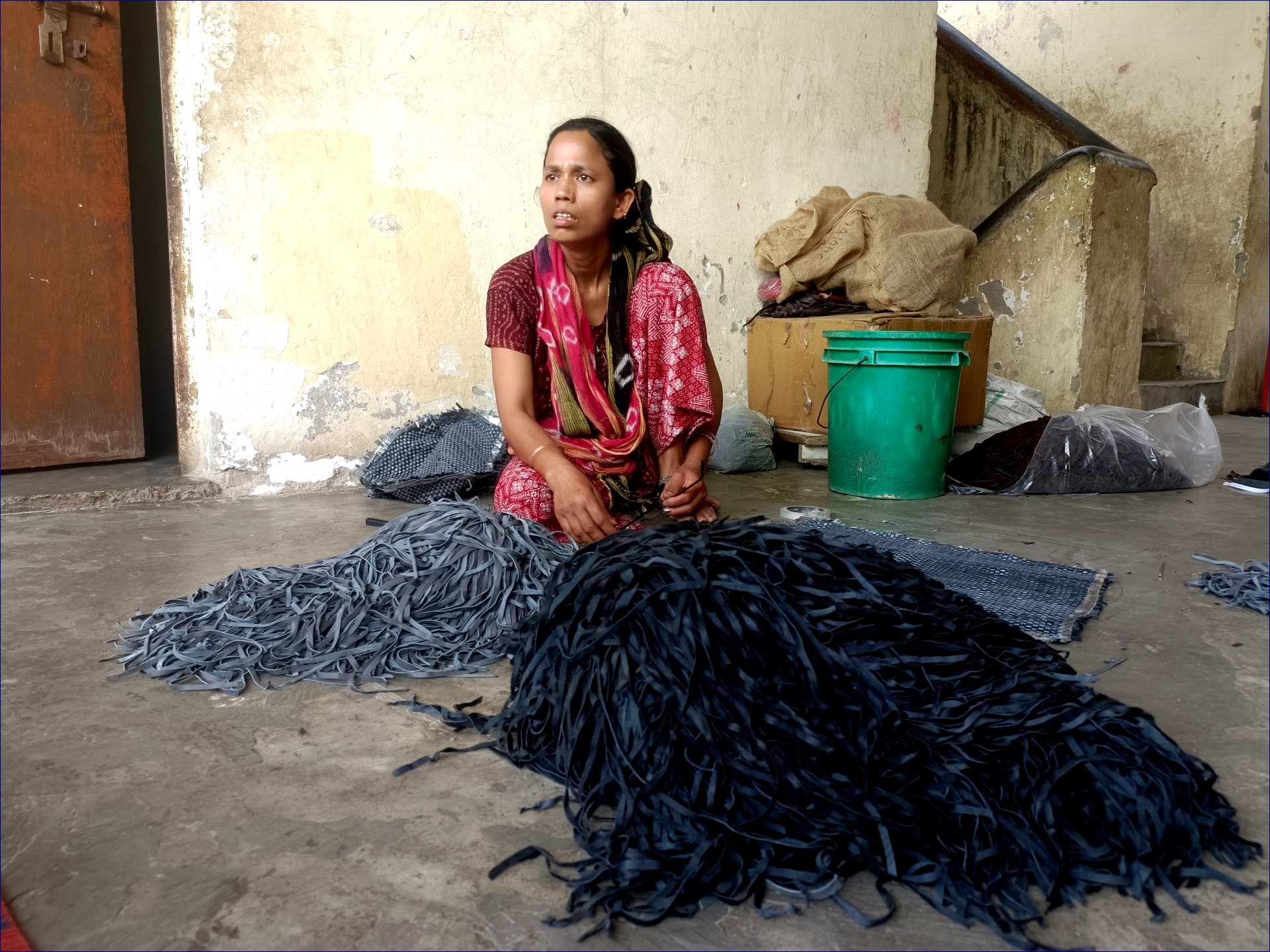
New Delhi, India – On a sweltering afternoon in a bustling working-class neighborhood of New Delhi, Shehnaz Bano sits on the worn floor of her small one-room home, skillfully crafting pieces for a leather jacket.
At 38 years old and a mother of two teenage boys, Bano dedicates countless hours to stitching each part of the jacket—a sleeve, a front or back panel—with only 100 rupees (around $1) as her reward for each piece.
“Just think if I worked in a factory instead of at home; I’d receive a fairer wage for the same work hours,” Bano shared, highlighting the disparity in pay. “Working from home shouldn’t mean I get less.”
Bano is one of approximately 260 million home-based workers (HBWs) worldwide, individuals tasked with producing goods or services from their homes. They largely exist within a global informal economy that offers low pay, no workers’ rights, and no social security or regulated work hours.
Women make up about 57% of this workforce, according to a 2024 estimate from Women in Informal Employment: Globalising and Organising (WIEGO), an organization that focuses on enhancing conditions for the working poor, especially women.
Thirty years ago, a significant but so far unfulfilled effort was made to change the status of HBWs. On June 20, 1996, the International Labour Organisation (ILO) adopted “Convention 177” in Geneva, which recognized HBWs as equal to traditional wage earners. This convention encouraged ILO member nations to implement policies promoting equality between HBWs and other workers.
Despite being officially enforced since April 22, 2000, only 13 countries have ratified it, with none from South Asia, where HBWs are numerous and integral to the fashion and manufacturing supply chains.
Renana Jhabvala, who was present at the ILO conference, recalls the excitement in the room as delegates voted for the Convention. “We spent 21 days in debate, not knowing what the outcome would be. The moment it passed was exhilarating,” she said.
However, many labor rights advocates point out that despite the passage of three decades since the convention, the lack of recognition for HBWs has worsened inequalities, particularly in developing nations like India. Experts note that these workers, especially women, often remain invisible to policymakers and endure unsafe working conditions with unreasonably low pay.
“Convention 177 has helped establish home work as legitimate labor,” stated Deepa Bharathi, an ILO gender and non-discrimination expert. “Yet in South Asia, the complexity of subcontracting complicates proper identification and regulation of employment relationships, which slows progress.”
For many women, their work is often seen merely as an extension of household duties, which devalues their labor. Bharathi emphasizes the need for visibility, fair pay, social protection, and safe working environments for women HBWs.
‘I Cannot Go Out and Work’
Bano’s home is situated in Kapashera, a settlement predominantly occupied by migrants from various regions. The name itself means “cotton settlement,” and the area is known for its cotton and leather garment units.
In her small room, Bano lives with her sons and her husband, who operates a lift in a mall outside the city. Her journey into home-based work started in her village as a beedi (hand-rolled cigarette) roller before she moved to the city after marriage and began stitching leather panels.
Despite her move to city life, Bano’s situation remains precarious, plagued by long hours, inconsistent work, and inadequate pay. She receives less than $1 for each piece she stitches, while a finished jacket can be sold for around $200. “Only those in need take this kind of work. We have expenses like rent and school fees,” she explained.
HBWs like Bano fall into two categories: those who work independently and those who are piece-rate workers employed by intermediaries. Bano is part of the latter group, which faces higher vulnerability due to unpredictable payments.
Nearby, Sangeeta Devi, 30, finalizes clothing pieces in a tiny, cramped space shared with her family. “I can’t go out to work because I have to care for my children,” she said, managing both her work and household responsibilities in her small room.
Sangeeta earns only a dollar for every 100 garment pieces she completes. “I wish there was a job I could do from home that pays well,” she expressed.
Her neighbor, Putul Devi, faces similar struggles and earns about $20 monthly. The constant strain of rising costs leaves her trying to balance work and household chores: “I’ve had to cook with firewood because fuel prices are so high.”
Shalini Sinha, a home-based work specialist, mentioned that even after three decades of recognition, female HBWs often remain unseen. “Home is still viewed as just a living space, not a workplace,” she explained, pointing to a broader issue where women’s economic contributions go unnoticed.
Government policies often overlook home-based work, with outdated statistics that fail to account for these workers. “There’s a significant need for better data and specific laws for home-based workers in India,” she emphasized.
While a social security code was introduced in India in 2020, clarifying benefits for unorganized workers including HBWs, many people remain unaware of how it will be implemented.
As Jhabvala reflects on the progress made since the recognition of HBWs, she sees the convention as a potential tool for change. “It’s not a measure of success or failure, but a way to fight for rights,” she concluded.
