
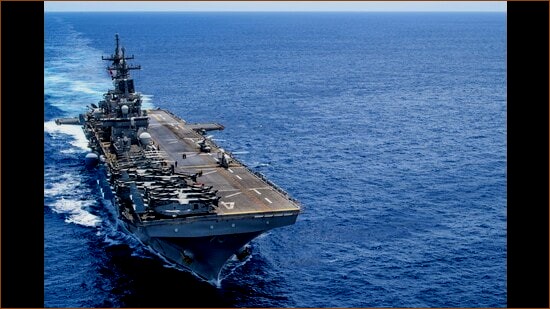
The recent decision by the US administration to rename its largest military command from Indo-Pacific Command back to Pacific Command has sparked discussions in New Delhi about America’s commitment to the Indo-Pacific strategy and the Quad coalition, which includes India.
On Wednesday, the US Department of Defense announced this name change to honor the command’s historical roots. However, the geographical scope—from the west coast of the US to India’s western borders—will stay the same.
This announcement came just hours before a planned meeting between Prime Minister Narendra Modi and US President Donald Trump during the G7 Summit in France. It follows a tragic incident where three Indian sailors lost their lives in a US Navy operation against a merchant vessel off Oman’s coast, causing concerns in India regarding US-India relations.
The change in name comes shortly after US Defense Secretary Pete Hegseth’s remarks at the Shangri-La Dialogue in Singapore, where he mentioned a “return to realism” in US Pacific policy, focusing on the realities of power and interests.
Former Indian Navy Chief Admiral Arun Prakash criticized the move, describing it as a reflection of how “unreliable and poorly thought out” US policies can be. He viewed this change as a sign of shifting interests, noting that when the command was initially renamed in 2018, it was seen as a significant step forward.
Prakash highlighted that the Indo-Pacific Command was intended to involve India in US plans, although Indian diplomats found the name too broad. The idea behind the command was to connect the Indian and Pacific oceans, aligning mutual interests.
This change comes precisely eight years after the command was renamed to Indo-Pacific Command by former US Defense Secretary James Mattis, who emphasized the growing connectivity in the region. Experts noted at the time that this shift was part of the US strategy to counter China’s influence in Asia, and the name change was seen as an acknowledgment of India’s increasing role in regional security.
Former ambassador Rajiv Bhatia pointed out three main implications of this recent move. First, he suggested that the concept of the Indo-Pacific has reduced in importance since the pandemic and has been further affected by conflicts in Ukraine and West Asia. Second, he noted that all of this is related to US policies on China, indicating clarity after Trump’s recent visit to Beijing. Lastly, he mentioned Trump’s limited engagement with the Quad, signaling a shift in US priorities regarding the Indo-Pacific strategy.
Bhatia concluded that this change was not unexpected and urged India to reconsider its stance based on this development.
Former Foreign Secretary Nirupama Menon Rao commented that while the “China factor” has brought India and the US closer, it may not be enough to keep the relationship strong over time. She described the Indo-Pacific concept as somewhat overhyped and called the recent name change a “healthy correction.” Rao stressed the need for a more realistic understanding of shared interests, acknowledging several factors that indicate a possible shift in the optimism of India-US relations.
