
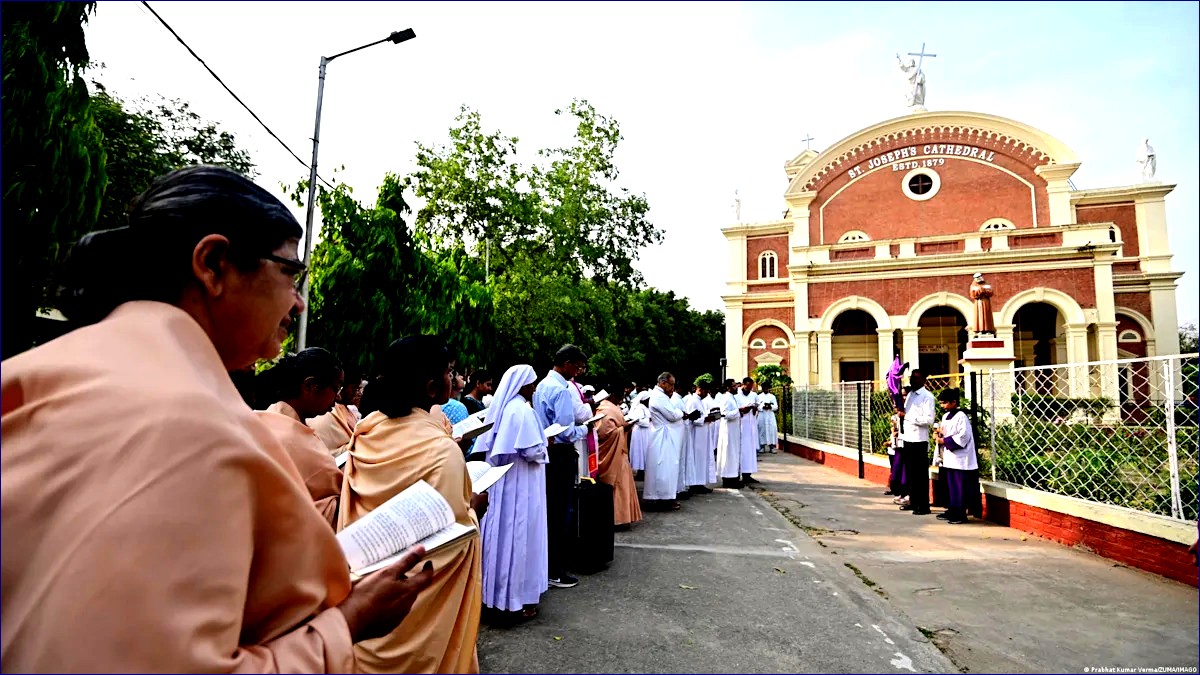
Rising Tensions for Christians in India
On a warm July afternoon in Uttar Pradesh, India, a peaceful Christian gathering faced an unexpected interruption. A group of around 50 to 60 individuals from a Hindu right-wing group stormed into Jaynendra’s (name changed) home, where he was leading a prayer session.
“Everything turned chaotic,” Jaynendra recounted. The group created havoc and shut down the prayer meeting, which was a typical event for Jaynendra and similar to many house churches frequented by Christians in the region. Such gatherings are common and usually quiet, but they have come under increasing scrutiny. In recent years, right-wing groups have accused these small communities of forcing people to convert to Christianity.
As per the 2011 census, Christians make up slightly over 2% of India’s population, while Hindus represent roughly 79%.
According to various rights organizations, there has been a significant surge in violence against Christians. In 2025 alone, nearly 900 incidents were documented, ranging from physical assaults to disruptions of church services, as reported by Christian Solidarity International.
Arrests Following Violent Attacks
Jaynendra’s experience is not unique. Often, prayers are interrupted by mobs alleging forced conversions, leading to police involvement. However, it’s usually the worshippers who face detainment instead of the aggressors. After the mob disrupted Jaynendra’s gathering, the police detained 10 to 11 individuals, including a 13-year-old girl.
“The police questioned them and found out there was no coercion involved in their attendance,” he explained, but they still held them for the entire day. Later, Jaynendra himself was arrested and spent over four months in jail due to charges under Uttar Pradesh’s controversial anti-conversion law. Critics argue that these laws are often misused to target minority groups.
“There was no evidence against me,” he shared, but noted the immense pressure he felt.
Similar Incidents Across Regions
Similar events have occurred in other regions of India. For example, in Madhya Pradesh’s Chhindwara district, Vinay Patil (name changed) recalled a recent attack on his church during a Sunday service. “Around 35 to 40 young men arrived, hurling insults and accusing us of forced conversions,” he said.
Some attackers were intoxicated and armed with sticks. “They began to beat everyone, regardless of age,” he reported. When the police eventually showed up, they detained the victims rather than pursuing the attackers, who had already fled.
Increase in Violence Under Current Leadership
Rights advocates assert that these incidents are becoming more frequent. Dr. Michael Williams from the United Christian Forum reported a drastic increase in anti-Christian violence since the Hindu nationalist Bharatiya Janata Party (BJP) came to power in 2014.
“The attackers no longer fear consequences,” he noted, as they continue their actions openly, even in daylight. This increasing boldness is tied to the political climate, which has seen a rise in anti-conversion laws that critics argue contribute to the violence.
The Consequences of Fear
For many in these communities, the consequences of such violence extend beyond immediate physical threats. Patil mentioned that his children are too frightened to attend school. “They haven’t gone for 15 days,” he said, reflecting the broader impact of fear on daily life.
Despite the risks, both Jaynendra and Patil remain committed to their faith and missions. “Our job is to spread the message,” Patil stated, emphasizing that it is up to the people to decide whether they want to listen.
Jaynendra expressed a similar sentiment, stating that while the atmosphere has dramatically shifted, he remains firm in his beliefs. “I’ve lived here my whole life; this is the first time I’ve experienced such turmoil.”
Conclusion
As tensions rise, the struggle for religious freedom continues for many Christian communities in India. With incidents of violence reported nearly every day, the resilience of these individuals shines through, even in the face of adversity. Government officials assert their commitment to protecting all religions, but critics argue that the laws in place have only served to increase hostility. The fight for a peaceful coexistence remains a challenging battle for many in this diverse and complex nation.
