
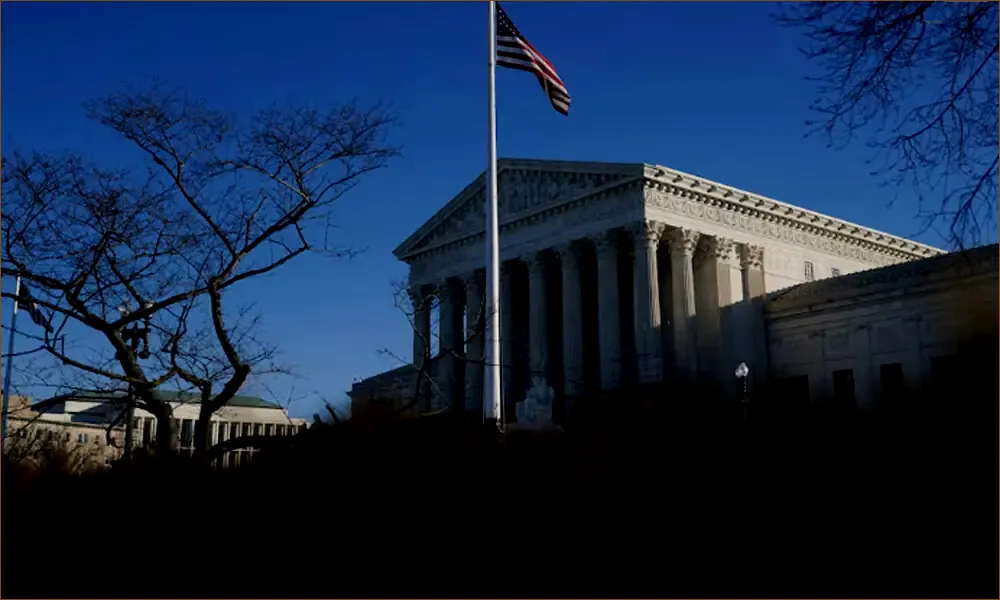
US Supreme Court Rejects Trump’s Tariffs in Major Ruling
In a significant ruling on Friday, the US Supreme Court dismissed former President Donald Trump’s extensive tariffs, which he had implemented using a law designated for national emergencies. This decision delivers a tough blow to Trump, potentially reshaping global trade dynamics.
The court’s verdict, decided by a 6-3 vote and led by Chief Justice John Roberts, supported a lower court’s finding that Trump’s interpretation of the 1977 International Emergency Economic Powers Act (IEEPA) overstepped his presidential powers. The justices clarified that the authority to manage imports granted to the president by IEEPA does not include the power to impose tariffs.
“Our job today is to determine if the president’s power to ‘regulate … importation’ includes imposing tariffs. The answer is no,” Roberts stated, emphasizing the statute’s wording that Trump had cited for his tariff actions.
While the White House did not immediately respond to the ruling, both Democrats and industry groups celebrated the outcome. The court’s majority opinion also noted that interpreting the IEEPA in this manner would infringe upon the powers of Congress, adhering to a legal principle known as the “major questions” doctrine, which requires significant government actions to be clearly authorized by Congress.
Roberts referenced a previous decision that stressed the need for “clear congressional authorization” to justify any significant assertion of power, implying that this was absent in Trump’s case.
Tariffs, which are taxes on imported goods, have been a cornerstone of Trump’s economic strategy and were key elements of a trade conflict begun during his second presidential term. This strategy has raised concerns and strained relationships with various trade partners, contributing to global economic uncertainty.
The Supreme Court made this determination in response to lawsuits from businesses impacted by the tariffs and a coalition of 12 states led by Democrats, challenging Trump’s extraordinary assertion of power to unilaterally levy these import taxes. Among the three dissenting justices were conservatives Clarence Thomas, Samuel Alito, and Brett Kavanaugh. They argued that the language and history of the IEEPA supported Trump’s position, with Kavanaugh stating, “Tariffs are a traditional means to regulate imports.”
Trump claimed that the tariffs were crucial for the security of the US economy, arguing they were necessary to protect American interests against countries like China, which he accused of taking unfair advantage over the years.
The Supreme Court ruling holds the potential to change trade practices, as tariffs imposed under the IEEPA are estimated to have generated substantial revenue— over $175 billion— and these funds may need to be refunded as a result of the ruling.
Under the US Constitution, Congress, not the president, holds the power to levy taxes and tariffs. Trump’s administration had turned to IEEPA in a bid to impose tariffs without Congressional approval. His approach has often stirred controversy, with critics pointing out that IEEPA was traditionally used for sanctions, not tariffs.
The ruling could have major implications for current trade agreements, and Treasury officials indicated they might explore other legal avenues to keep some of Trump’s tariffs in place. However, those alternatives may not replicate the broad authority that IEEPA provided.
Democratic leaders hailed the ruling as a victory for American consumers, suggesting the decision helped alleviate financial strain on families. However, concerns were raised by some lawmakers about the potential complexities and limitations in recovering funds already paid under the tariffs.
Overall, the Supreme Court’s decision not only affects Trump’s previous trade policies but also sets a precedent about the limits of presidential power in economic matters, potentially reshaping future interactions with global trade partners.
