
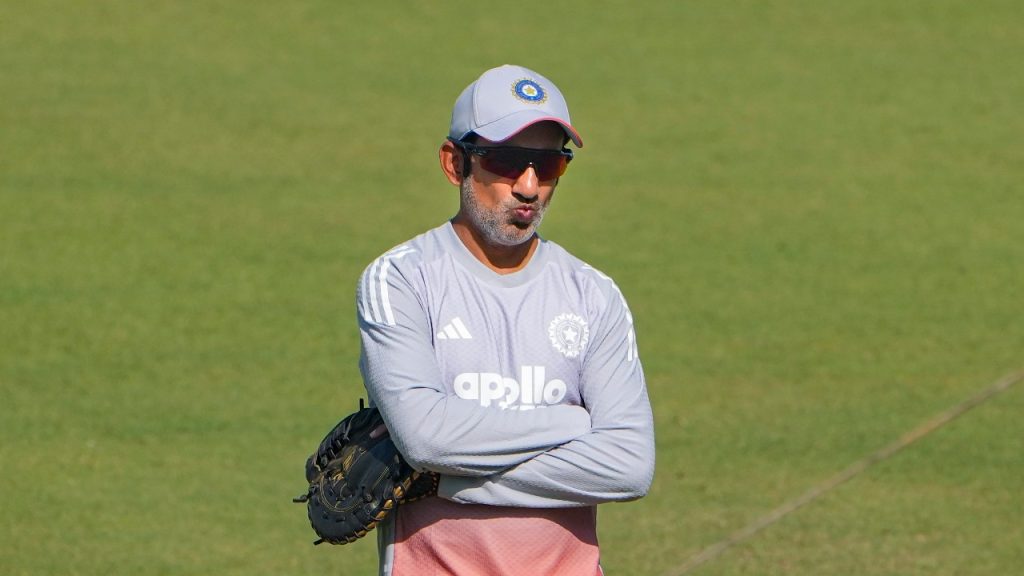
India’s attempt to create a spin-friendly pitch in Kolkata took a surprising turn when South Africa, the reigning Test champions, defeated them in the first match of the series. As a result, calls to remove coach Gautam Gambhir, which had quieted after the England tour, have once again gained traction. Many fans are expressing their frustrations online, and their anger is somewhat understandable. Coaches seldom remain in their positions after losing four home Tests in a single year. Under Gambhir’s leadership, India has won only two out of their last six home matches, which is a stark contrast to the three losses they had from 2013 to 2023. What was once India’s pride now appears to be quite fragile.
At times, Gambhir seems to be like a modern West Indies batsman—successful in white-ball formats but struggling to grasp the ins and outs of Test cricket. Since his appointment, he has excelled in ODIs and T20s, yet he seems to be lacking a clear winning strategy in Tests—the format he once excelled in as a player.
And it’s troubling that these losses are coming against teams that have historically struggled on Indian soil. New Zealand, which had never won a Test series in India, defeated India 3–0, and South Africa, which hadn’t won a Test in India for 15 years, managed to triumph in Kolkata. Matches that were once expected to be comfortable victories have turned into tense encounters exposing India’s weaknesses.
The most significant change is psychological: other teams now feel they can win in India. This is a stark contrast to the confidence seen during the Ravi Shastri-Virat Kohli era, when teams hesitated to challenge India on their home turf. Under Kohli, India won 24 out of 31 home Tests, losing only two. The last two years have revealed how hard-earned their dominance was.
Gambhir is known for his bold and often confrontational press conferences. But in Test cricket, that boldness must be backed by strong performances. His recent comments regarding the pitch, saying “this is what we wanted,” only fueled criticism, reinforcing the view that the team talks a big game but fails to deliver. While Gambhir speaks of clarity and courage, India’s performances often seem disorganized.
India’s ability to handle spin has noticeably declined. Even experienced players like Virat Kohli and Rohit Sharma looked vulnerable during the 0–3 loss to New Zealand. In the past, the team relied on roles and synergy, with players like Pujara absorbing pressure and Kohli setting the tempo. But under Gambhir, the batting order feels unsettled. Frequent changes and a mix of all-rounders have created an atmosphere where players seem more concerned about their positions than their performance.
Additionally, the over-reliance on spin-friendly pitches has become a liability. Yes, India has used home conditions to their advantage in the past, but now they seem to be preparing pitches that are more about luck than skill. Opponents, including New Zealand and South Africa, have adapted quickly and often outperformed India’s bowlers in these conditions. This marks a significant change from the home advantage India once had.
It’s disheartening that the lessons from the 0–3 loss to New Zealand appear to have gone unheeded. While the West Indies showed resilience against India on a good batting pitch in Delhi last month, it doesn’t justify returning to pitches that seem more like a gamble.
ARE THE BATTERS TO BLAME?
Simply blaming the batters can be unfair. As Sunil Gavaskar noted, India should have chased down the 124 runs in Kolkata. But how can we expect players to perform when they haven’t had adequate time to prepare? Many had just arrived from a white-ball series in Australia, and a few regulars had only participated in a warm-up match against South Africa A on a flat pitch. Though the BCCI encourages Test hopefuls to play domestic cricket, that becomes challenging when players are constantly switching formats without sufficient rest.
Meanwhile, some strong performers in domestic cricket have been overlooked. The frustration lies mainly with Gambhir’s selection choices. There seems to be an over-reliance on all-rounders, sacrificing batting depth in favor of a misguided sense of balance. The Kolkata XI, which featured multiple all-rounders and a makeshift No. 3, seemed overly complicated.
LACK OF SUPPORT?
Transitions can be tough, especially after the retirements of Kohli, Rohit, and Pujara. This is exactly when a Test side needs stability and long-term vision instead of constant changes. Gambhir has publicly stated that he won’t drop players lightly and that any adjustments would be to put together the best team possible. However, since he took charge, India has used 24 players in Tests in just one year, a stark contrast to the 41 players used during Kohli’s seven-year captaincy.
It raises questions about supporting players like Sai Sudharsan, who was promoted to No. 3 only to be dropped before an important home series. Why was Karun Nair, a red-ball specialist, recalled just to be dropped after a few tough games? Where is Sarfaraz Khan, who has proven himself as a strong player against spin, especially when others have struggled? If he is seen as too weak against pace, why not utilize him where he thrives—on home pitches?
Former player Mohammad Kaif has suggested that the players seem to be “playing afraid” under Gambhir, hinting at a lack of comfort within the team’s environment.
To be fair, Gambhir has inherited a team in transition, with aging stars and a need to incorporate younger talent. His success in white-ball formats shows he is not lacking in skill. His observation that the team lacked the “temperament to handle pressure” in Kolkata holds truth.
Yet the key question remains: is the current approach effective?
Gambhir’s situation feels reminiscent of Greg Chappell’s tenure with India—ambitious plans and bold ideas overshadowed by instability and underperformance. Currently, India seems to be at a similar crossroads: a coach full of energy and fresh ideas but lacking in results.
As India undergoes transition, they cannot afford to lose their way. The stronghold that once defined Indian cricket is beginning to show cracks. If they aim to regain dominance at home and remain competitive in the World Test Championship, concerns about their direction become increasingly difficult to overlook.
A team facing generational change requires thoughtful strategy, not just confidence; clarity, not confusion. Gambhir now has the task to demonstrate that his innovative ideas can build a consistent approach that will restore India’s strength at home.
Test cricket doesn’t forgive uncertainty. The longer the drift continues, the more significant the cracks will become. India must not end up reflecting: ambitious strategies, no outcomes.
