
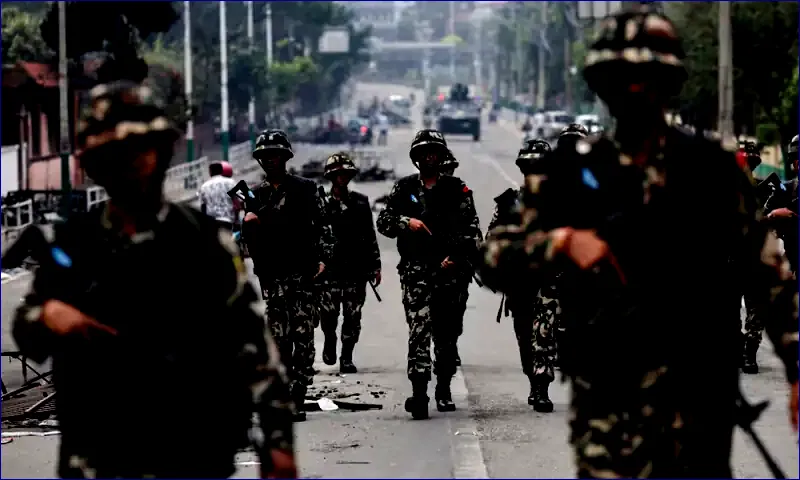
KATHMANDU: Armed soldiers were seen guarding Nepal’s parliament on Wednesday, as the streets of Kathmandu remained empty after an indefinite curfew was imposed. This decision came in the wake of two days of deadly protests against corruption, which led to the resignation of Prime Minister K.P. Sharma Oli.
The unrest marks one of the most significant upheavals in the nation’s recent history, sparked by a social media ban introduced last week and later revoked. The situation escalated after 19 people lost their lives on Monday when police used tear gas and rubber bullets against demonstrators.
Around the parliament, burnt vehicles and debris were scattered as army firefighters battled a fire in the main hall that protesters had set ablaze on Tuesday. “Our priority is to restore normalcy,” army spokesperson Raja Ram Basnet stated, emphasizing their commitment to safeguarding public safety.
Armored vehicles patrolled the eerily quiet streets, where only a few people were seen walking. Shops and markets were closed, and several government buildings, including the Supreme Court and the private residence of Oli, were also torched during the protests, which calmed only after his resignation.
Airport operations faced disruptions, with Kathmandu’s main airport closed until 6 p.m. (1215 GMT), according to an airport official.
Efforts to Resolve the Crisis
In a statement on X, the army announced that the curfew would remain in place until Thursday morning. They also mentioned that relevant groups were working together to address the unrest and seek resolution. Reports suggested that preparations were underway for talks between authorities and protest leaders, although further details were not available.
Former Supreme Court judge Balaram K.C. urged protesters to form a negotiation team, with the army assisting in maintaining order, and called for fresh elections. “Parliament should be dissolved, and new elections should be held,” he said.
The protests were largely driven by the youth, expressing dissatisfaction over the government’s approach to tackling corruption and providing economic opportunities. For many years, a lack of job prospects has compelled millions to seek work abroad in countries like Malaysia, the Middle East, and South Korea, mainly in construction, to support their families back home.
Situated between India and China, Nepal has faced ongoing political and economic challenges since the monarchy was abolished in 2008 amid protests.
India’s security cabinet convened late Tuesday to discuss the situation in Nepal. Prime Minister Narendra Modi later expressed in a post on X, “Nepal’s stability, peace, and prosperity are of utmost importance. I urge my brothers and sisters in Nepal to maintain peace and order.”
