
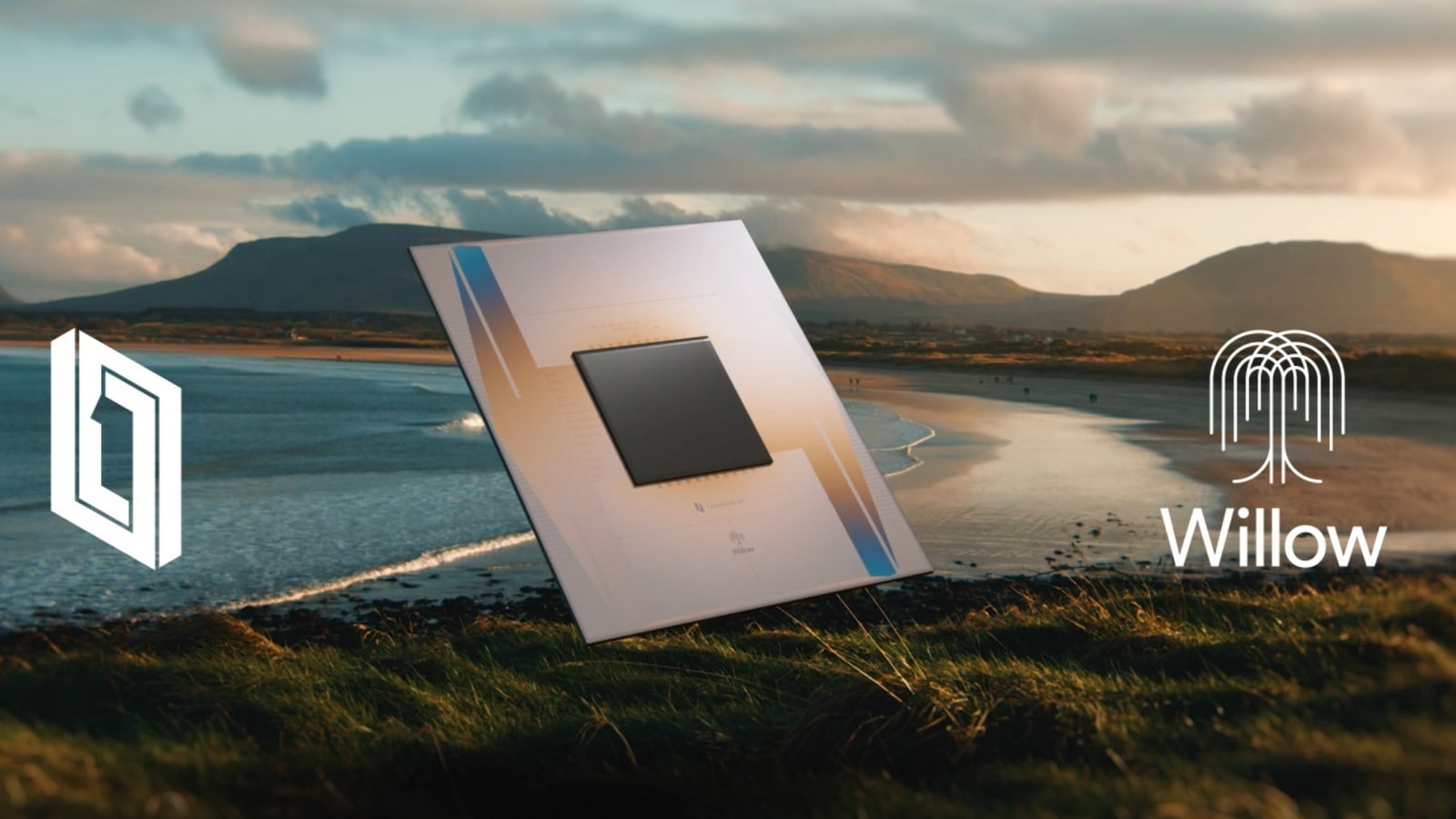
On December 9, 2024, Google made a significant advancement in technology by launching its newest quantum chip named Willow. This innovative chip has the incredible ability to execute a standard benchmark task, known as random circuit sampling, in just under five minutes—something that would take even the fastest traditional computers about 10^25 years to complete. To put that number into perspective, it is far greater than the estimated age of the universe.
Many people find quantum physics to be complex and challenging to understand. It can be likened to the famous Indian head nod—it’s unclear if it signifies a ‘yes’, a ‘no’, or something else entirely. In quantum mechanics, particles called qubits can exist in multiple states at once, a concept known as superposition. Imagine flipping a coin in the air. Until it lands, it can be thought of as being both heads and tails simultaneously. While the universe operates on these quantum principles, our everyday experiences are different, making the topic tough to grasp. Notably, physicist Richard Feynman once quipped, “If you think you understand quantum mechanics, you don’t understand quantum mechanics.”
The potential of quantum computers lies not only in their speed but also in their resemblance to natural processes. This could lead to breakthroughs in various fields, including weather forecasting, climate science, and nuclear fusion. Additionally, quantum technology holds promise for advancements in pharmaceuticals, material science, and energy storage.
Google first announced its progress in quantum computing in 2019 when it revealed its quantum chip that achieved what’s known as quantum supremacy. This milestone indicated that the quantum computer could solve a problem that was impractically lengthy for classical computers.
There are concerns about how quantum computers could impact current security systems, such as those used in Bitcoin and blockchain technology. However, Google is proactively addressing these challenges by working on post-quantum cryptography and encryption measures.
A significant hurdle in quantum computing has been the issue of noise, where qubits often lose their signal because of external interactions, leading to a higher error rate compared to classical computers. John Preskill, a prominent figure in the field, has noted that this presents a competitive landscape among quantum computers, classical computers, and noise interference.
With the launch of Willow, Google has demonstrated a remarkable achievement in quantum error correction. As they expand the size of their qubit array, they have been able to keep the qubits stable for longer periods, significantly reducing errors. This development raises more questions about when quantum computers will become commonplace rather than if they will ever arrive.
While commercial applications of this technology are still in the future, Google is already conducting simulations of quantum systems. These simulations can also be performed on classical computers, but Google’s aim is to develop quantum algorithms that can solve problems beyond the reach of traditional technology.
It’s important to note that Google is not the only player in the field of quantum computing. Other companies like IBM, QuEra, and Xanadu are working on their own quantum systems. For instance, IBM introduced a quantum computer with 433 qubits in 2022 and has plans for a machine with over 1,000 qubits by 2026. Google’s Willow currently has 105 qubits.
This groundbreaking announcement comes as Google has faced scrutiny regarding its innovation speed and relevance, especially with competitors like OpenAI gaining recognition. Google’s CEO, Sundar Pichai, shared the news on Twitter, earning praise from influential figures including Elon Musk and Greg Brockman, co-founder of OpenAI.
India is also making strides in quantum technology, having approved its National Quantum Mission in April 2023. This initiative aims for ambitious goals from 2023 to 2031, with institutions like the Tata Institute of Fundamental Research (TIFR), the Defense Research and Development Organisation (DRDO), and Tata Consultancy Services (TCS) leading the charge. In September 2024, they successfully tested a 6-bit quantum processor based on superconducting technology, further advancing the country’s capabilities in this cutting-edge field.
