
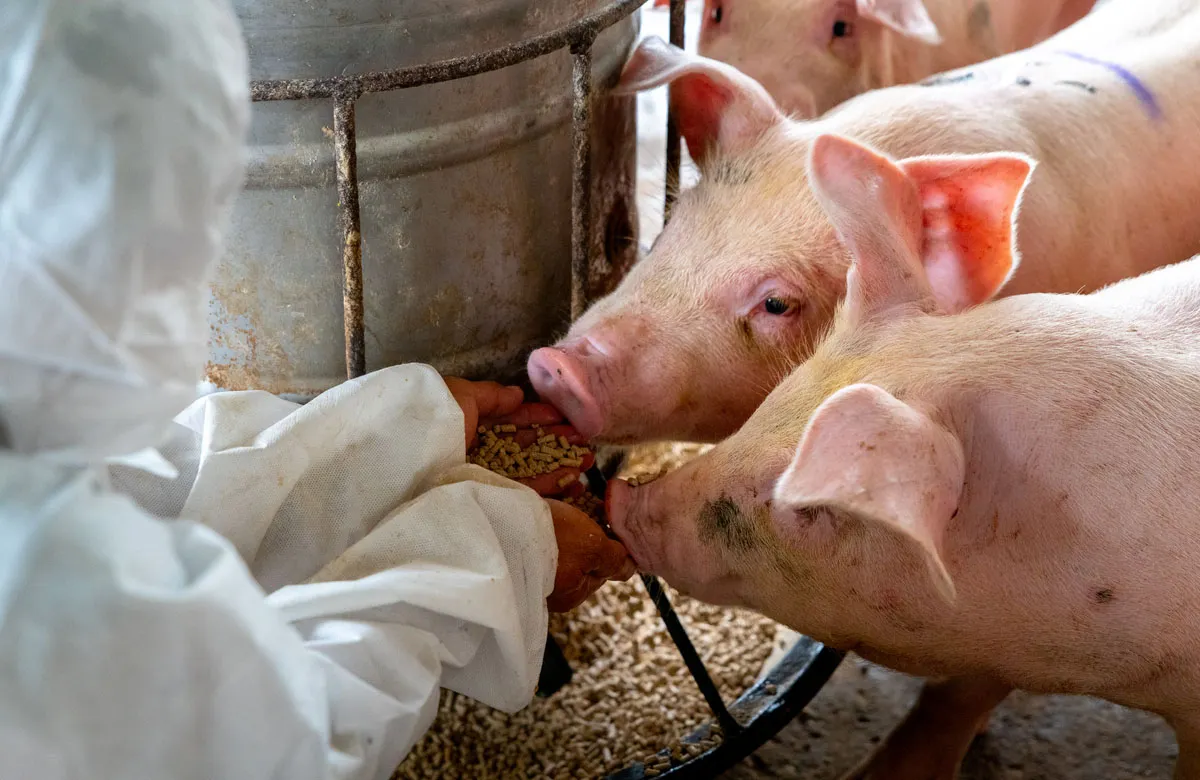
In a startling revelation, a pig residing in Oregon has been confirmed to have the H5N1 avian influenza, as per an announcement released on Wednesday by the U.S. Department of Agriculture (USDA). This unsettling news marks a critical juncture, being the inaugural finding of H5N1 in swine in the United States.
The infected swine hails from a backyard farming locale, described in the USDA’s press release as a setting with a potpourri of poultry and livestock. Here, the livestock and birds were sharing vital resources—water, housing, and equipment—creating a fertile ground for cross-species transmission, a risk that has been noted in other states.
Importantly, this particular pig exhibited no signs of illness, though it was tested alongside a cohort of four others as a precautionary measure after some farm animals showed positive results. Out of these five swine, two returned negative tests, while results for the remaining two are still pending.
“The integrity of the nation’s pork supply remains uncompromised by this incident,” the USDA assured, adding that this farm is a non-commercial entity, meaning these animals were not meant for the mainstream food market. Consequently, the farm has been placed under quarantine to curb any potential spread of the virus, with close monitoring of the other animals.
Dr. Marc Siegel, a clinical professor of medicine at NYU Langone Health and a senior medical analyst, remarked on the situation’s complexity. He pointed out that cattle have now effectively become a reservoir for H5N1. “The isolated case of a single pig isn’t alarming in itself—but the underlying questions loom large: What other undetected cases exist, and how will the fluid dynamics of influenza within swine play out?” he pondered.
Dr. Siegel warned of the inherent risk that pigs pose as “mixing vessels” for various influenza strains, where genetic exchanges can lead to new, unpredictable strains. He evoked memories of the 2009 H1N1 pandemic, which, while mild compared to prior pandemics, did originate from swine.
Echoing these concerns, Dr. Benjamin Anderson, an assistant professor in the Department of Environmental and Global Health at the University of Florida, noted that while the current situation appears isolated, vigilance is crucial. He highlighted that swine’s unique physiological makeup allows them to be susceptible to both avian and human influenza viruses, exacerbating the risk of cross-species infections.
“If the H5N1 virus were to develop regular transmission among pigs, the confluence of genetic material from various circulating strains could lead to a new progeny virus, one potentially more adept at infecting humans,” Anderson cautioned. The asymptomatic nature of the infected pigs raises alarm bells regarding surveillance efficacy—is the virus lurking in subclinical or asymptomatic animals, unnoticed and unchecked?
Samuel Scarpino, an expert in health sciences and director of AI and life sciences at Northeastern University, offered a glimmer of reassurance. He identified two mitigating factors: firstly, the origin of the H5N1 strain likely traces back to infected birds rather than a dairy farm spillover. Secondly, the relatively small size of the operation minimizes opportunities for viral transmission and subsequent evolution.
However, he warned against complacency. “Even with these protective factors, the emergence of H5N1 among pigs demands stringent safety protocols for farm workers to mitigate any risk of viral transmission to humans. The U.S. faces a significant and enduring H5N1 challenge, compounded by the onset of the seasonal flu period, complicating our ability to detect uncommon H5N1 infections,” Scarpino emphasized.
Calls have been made for enhanced resource allocation towards influenza surveillance from the CDC and local public health entities, including both clinical testing and wastewater analysis, as the battle against H5N1 intensifies. The landscape of avian influenza continues to evolve, and the surveillance posture must adapt accordingly to safeguard public health.
