
After wrapping up an intensive three-day engagement in the United States, Prime Minister Narendra Modi embarked on his return journey to India this Monday, as confirmed by the Ministry of External Affairs.
“PM @narendramodi has boarded his flight to New Delhi, marking the conclusion of a momentous and impactful visit to the USA,” the ministry announced via a post on X.
During his whirlwind tour, the Prime Minister participated in the esteemed Quad Leaders’ Summit in Wilmington, made a heartfelt address to a vast assembly of the Indian American community in Long Island, and delivered a pivotal speech at the UN’s Summit of the Future.
Throughout this diplomatic excursion, Modi held bilateral dialogues with global leaders and hosted a roundtable with executives from leading US tech firms, forging pathways for collaboration. Below, we delve into the key moments of his US itinerary:
Day 1: The Quad Summit
On the inaugural day of his visit, Prime Minister Modi stepped into the Quad Summit convened by President Joe Biden in Wilmington, Delaware—a gathering graced by the presence of Australian Prime Minister Anthony Albanese and Japanese Prime Minister Fumio Kishida.
In his discourse, Modi acknowledged the Quad leaders convening amidst rising global tensions, asserting the profound necessity of their partnership for the collective well-being of humanity. “We are not against anyone,” he emphasized, highlighting their commitment to a rules-based international framework, sovereignty, and the peaceful resolution of conflicts—a clear nod to China’s assertiveness in the Indo-Pacific arena.
Caught on a hot mic, President Biden expressed unease regarding China’s maneuvers, suggesting it was "testing" the Quad while seeking to "buy diplomatic space." The conclusive declaration from the summit conveyed more robust language concerning the South China Sea than previous reports.
This summit also set the stage for a significant bilateral encounter between Modi and Biden, where the latter proclaimed that the India-US alliance has reached unprecedented levels of strength and dynamism. They celebrated a groundbreaking agreement to establish a new semiconductor manufacturing facility in India, buoyed by the India Semiconductor Mission alongside strategic partnerships involving Bharat Semi, 3rdiTech, and the US Space Force.
Moreover, the Quad leaders unveiled the "Quad Cancer Moonshot," an initiative aimed initially at combating cervical cancer in the Indo-Pacific, with aspirations to tackle various other forms of cancer moving forward.
Additionally, Modi and Albanese reaffirmed their resolve to deepen bilateral relations, with the Indian Prime Minister voicing his gratitude for the robust camaraderie between their nations. Modi later described his dialogue with Prime Minister Kishida as "very constructive," centering on collaboration in critical areas such as infrastructure and green energy.
As a poignant gesture during his visit, Modi was presented with 297 antiquities, illicitly taken from India, further reflecting the depth of diplomatic relations encapsulated in his discussions with Biden, where matters concerning Bangladesh were also broached.
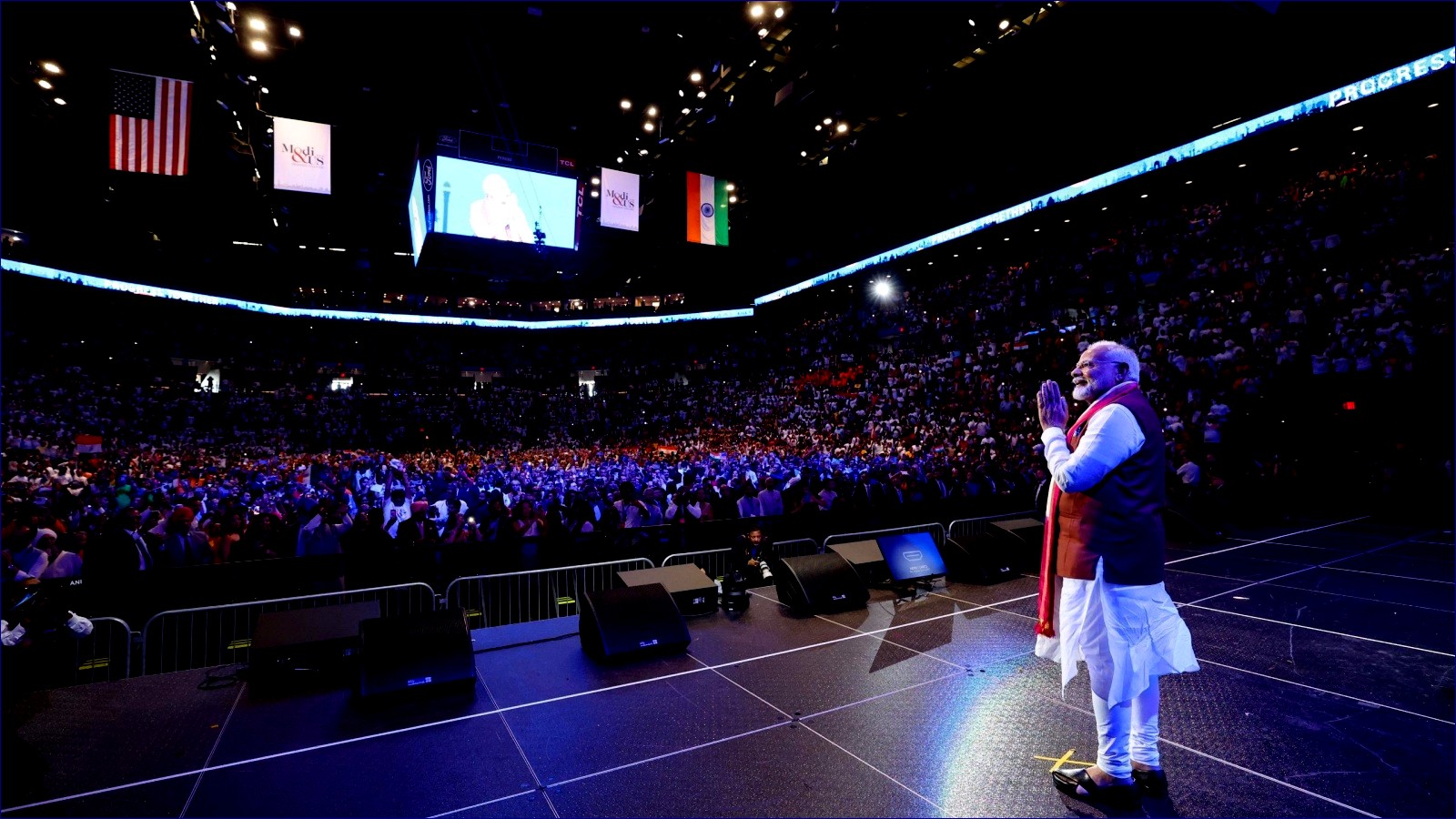
Day 2: The ‘Modi & US’ Mega Community Event
On the second day, PM Modi electrified an assembly of over 13,000 Indian Americans at Nassau Coliseum in Long Island, a congregation that drew attendees from the New York–New Jersey corridor and beyond—to the tune of individuals traveling from 40 states in a fleet of sixty chartered buses.
Promoting India as a “land of opportunities,” he laid out his ambitious vision for the nation during his current tenure, declaring the opening of two new consulates in Boston and Los Angeles—a response to the persistent demands of the burgeoning Indian American populace.
“Every Indian stands confident in India and its accomplishments. Today, India is not merely awaiting opportunities; it is actively fabricating them,” he proclaimed, heralding the uplifting of an astounding 250 million people from poverty within the last decade.
The Prime Minister underscored India’s foreign policy approach—seeking to cultivate equitable relationships with all nations rather than merely maintaining neutral distances.
Recognizing the pivotal role played by Indian Americans, he articulated their significance as brand ambassadors, reinforcing the transnational ties that bind India and the United States.
Day 3: UN Summit of the Future
On the concluding day of his American journey, Modi addressed the UN’s Summit of the Future in New York, opening with a respectful namaskar that encapsulated his role as a voice for 1.4 billion Indians, representing a substantial fraction of global humanity.
“The success of humanity hinges on our collective strength, not on the battlefield,” he underscored, reinforcing the urgent imperative for global cooperation amid the tumult of conflicts in regions like Israel-Gaza and Ukraine.
He posited that the reform of global institutions is vital for preserving their relevance, spotlighting the historic inclusion of the African Union as a permanent G20 member during India’s presidency as a monumental step forward.
Modi expressly addressed the persistent specter of terrorism that endangers global peace and highlighted the emergence of new conflict arenas—spanning cyberspace, maritime zones, and outer space.
Amidst this backdrop, Modi engaged with Palestinian President Mahmoud Abbas, articulating his “deep concern” for the humanitarian challenges in Gaza while reiterating India’s commitment to facilitating peace in the region. He also conferred with Ukrainian President Volodymyr Zelenskyy, reaffirming India’s advocacy for a swift resolution to the conflict involving Russia—a meeting that marked their third encounter in recent months.
Firm in his stance, Modi emphasized “India’s clear, consistent and constructive approach towards advocating for a peaceful settlement through diplomacy and dialogue.”
His tour also included interactions with various leaders, including Armenia’s Prime Minister Nikol Pashinyan and Vietnam’s President To Lam, focusing on bolstering connections in trade, culture, and energy sectors.
As his visit drew to a close, Modi connected with members of the Sikh community, fostering important dialogue, and celebrated the contributions he has made towards advancing Sikh interests.
Finally, the Prime Minister participated in a high-impact roundtable discussion with tech industry giants, including Google’s Sundar Pichai, urging them to harness India’s burgeoning growth narrative as a springboard for innovation in vital frontier areas, such as artificial intelligence and biotechnology.
With the conclusion of his meaningful journey, Modi’s visit stands as a testament to the intricate tapestry of diplomacy, cooperation, and global engagement that characterized India’s mission during this pivotal moment on the world stage.
