
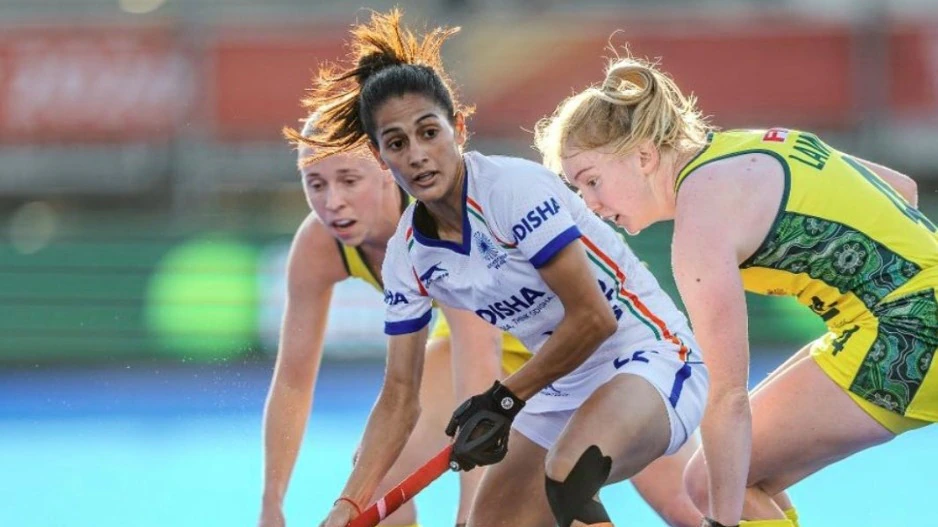
India’s women’s hockey team faced a tough setback at the Hockey World Cup, getting knocked out after a goalless draw against Australia in Amstelveen on Sunday. Despite the result, Australia advanced to the semi-finals based on their superior goal record.
The Indian team had previously experienced a remarkable victory over Australia during the Tokyo 2020 Olympics, where they defeated the Hockeyroos 1-0, securing their first-ever Olympic semi-final spot. However, this time the script didn’t play out the same way.
As the final whistle blew, it marked a heartbreaking end to India’s campaign. Goalkeeper Savita Punia was in tears on the sidelines, while teammate Bichu Devi shared her distress, realizing their journey in the tournament was over. After fighting valiantly throughout the competition, it was painful for the team to see their dreams dashed by such a narrow margin.
India entered the match knowing they needed a win to move forward, while Australia only required a draw. Earlier in the day, the Netherlands beat China 4-1, keeping India’s hopes alive as China was eliminated. However, neither team managed to score in a tense matchup.
Both teams finished with two points and identical goal differences of -2. However, Australia’s three goals in the tournament compared to India’s two allowed them to advance.
The wait for a World Cup semi-final continues for India. The team accomplished a fourth-place finish at the very first Women’s World Cup in 1974, but they have not made it to the final four since then.
### Australia’s Early Dominance and India’s Resilience
The opening quarter of the match was tense, with Australia controlling the ball while India focused on strong defense. The most significant moment came early when Australia seemed to score, but after a referral, the umpire ruled it out for dangerous play.
Though India was briefly down to ten players due to a green card given to Baljeet, Australia couldn’t capitalize on the advantage. Savita made a crucial save against Abigail Wilson, while India attempted to create offense through Ishika and Navneet, but a few misplaced passes hurt their momentum.
As the second quarter progressed, Australia maintained pressure. Bichu Devi, stepping in as goalkeeper, made an important save from a powerful shot. Although Australia earned a penalty corner, India managed to evade danger when the injection went awry.
Injury concerns plagued India, with Ishika Chaudhary leaving the match after an unfortunate hit to the head and Lalremsiami taking a painful blow to her knee. India had a chance to score late in the half but couldn’t convert it, and Nikki missed a big opportunity just before the break.
### A Stronger Second Half but No Goals
After halftime, India improved, responding to coach Sjoerd Marijne’s call for better ball control and more attacks. They started to look more threatening in the offensive zone, yet Australia remained dangerous on the counter.
Australia thought they had finally broken through with a goal from a penalty corner, but again, India successfully referred the decision, leading to the goal being overturned due to dangerous play. This was the second time a potential goal by Australia was negated after a referral.
India had their chances too, but Deepika couldn’t find the right touch after a promising collaboration with Navneet and Baljeet. With the score still tied at 0-0 entering the final quarter, India had just 15 minutes left to keep their World Cup hopes alive.
### Final Push Falls Short
In the last quarter, India put everything on the line, pushing forward for the much-needed goal. Navneet and Lalremsiami found themselves in a prime scoring position, but a lack of decisiveness allowed Australia to regroup.
With only five minutes left, India took a risk by replacing Bichu Devi with an extra outfield player, pushing for the goal they so desperately needed. Meanwhile, Australia earned late penalty corners, threatening to take advantage of India’s gamble.
India’s defense held strong, with Salima Tete making an impressive tackle to thwart Australia. The team even managed to defend a penalty corner without a designated goalkeeper. However, mere survival was not enough.
The final whistle confirmed a frustrating 0-0 draw, leading to India’s exit from the tournament. Australia advanced due to their better goal-scoring record, edging past India by the narrowest of margins.
Although they did not repeat their Olympic success in this tournament, India showcased their potential to compete with top teams. Under Marijne’s guidance, there’s a renewed sense of belief in the squad. The next step will be translating that belief into goals to win crucial matches.
