
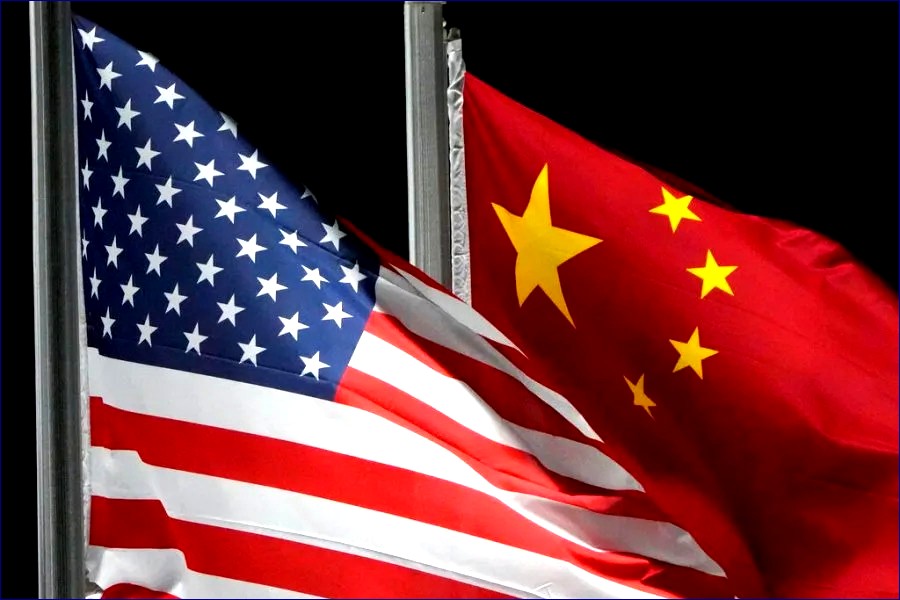
China Unveils Fastest Supercomputer, Sparking Tech Race Concerns
China has recently announced a significant achievement in the global technology race by revealing what it claims is the fastest supercomputer ever, named LineShine. This development marks a competitive shift as the honor previously belonged to the U.S. with its El Capitan machine, located in California.
While China’s victory may seem largely symbolic, it raises important questions regarding how the country has reached this milestone despite stringent U.S. export restrictions aimed at curbing its tech advances. The U.S. has long placed strict limitations on technology exports to China, particularly concerning graphics processing units which are vital for supercomputers. These units provide the necessary processing power for advanced computing tasks.
Interestingly, the LineShine supercomputer does not rely on graphics processing units at all. Instead, it has managed to bypass these American trade barriers by utilizing a vast network of standard microprocessors. This raises a significant point for the U.S.: while the government aims to restrain China’s tech industry, China has shown it can adapt cleverly to overcome these limitations.
This adaptability was evident earlier this year when U.S. policymakers reevaluated whether Nvidia could send its H20 chips to China for use in advanced AI projects. The Trump administration acknowledged that if China was going to develop AI, using American chips might be beneficial. However, China declined the offer, having already created its own alternatives in light of the restrictions on H20 imports.
China’s strategy focuses on strengthening its domestic technology sector, aiming for independence and global leadership in areas where the U.S. has imposed restrictions. This proactive approach serves as a model for the U.S.
While there are valid concerns regarding national security in the tech race, relying solely on export restrictions may not be the best path for the U.S. If the administration continues to classify more technologies as restricted exports, it risks losing the competition it seeks to win.
Congress should carefully consider proposals like the Remote Access Security Act, which not only limits technology flow to China but also restricts U.S. providers from serving companies hiring Chinese nationals, regardless of their tech’s impact. Such measures may shrink the reach of American technology instead of enhancing it, making U.S. platforms less appealing to global customers.
Customers won’t stop using AI due to restricted access to American services; they’ll simply look for alternatives elsewhere. Each customer lost to American providers is a potential gain for Chinese companies. Instead of controlling China’s influence, the U.S. may unintentionally help it grow.
The ultimate goal should not be merely obstructing Chinese advancements but ensuring that the rest of the world continues to adopt American technology over Chinese options. Winning the AI race isn’t just about restricting access—it’s about establishing dominance in global usage.
As China bolsters its domestic tech manufacturing, the U.S. needs to do the same. Fortunately, the U.S. has a solid foundation to build on. Although there’s concern over the shift of semiconductor production to East Asia, recent initiatives like the CHIPS Act are changing that narrative, reinvesting in American manufacturing.
A Taiwanese firm is even developing a $165 billion semiconductor manufacturing facility in Arizona, underscoring the potential for domestic growth. The U.S. holds significant advantages, such as attracting talent and a strong venture capital base. The tech industry’s privatized nature allows for ideas to flourish quickly, which can be harnessed for greater benefits.
Owning the fastest supercomputer won’t determine the outcome of the AI race. Instead, being the platform the world relies on will. The focus should be less on building barriers around American innovation and more on ensuring that the global community continues to choose American technology over Chinese alternatives.
