
Japan and India Strengthen Ties with New Agreements
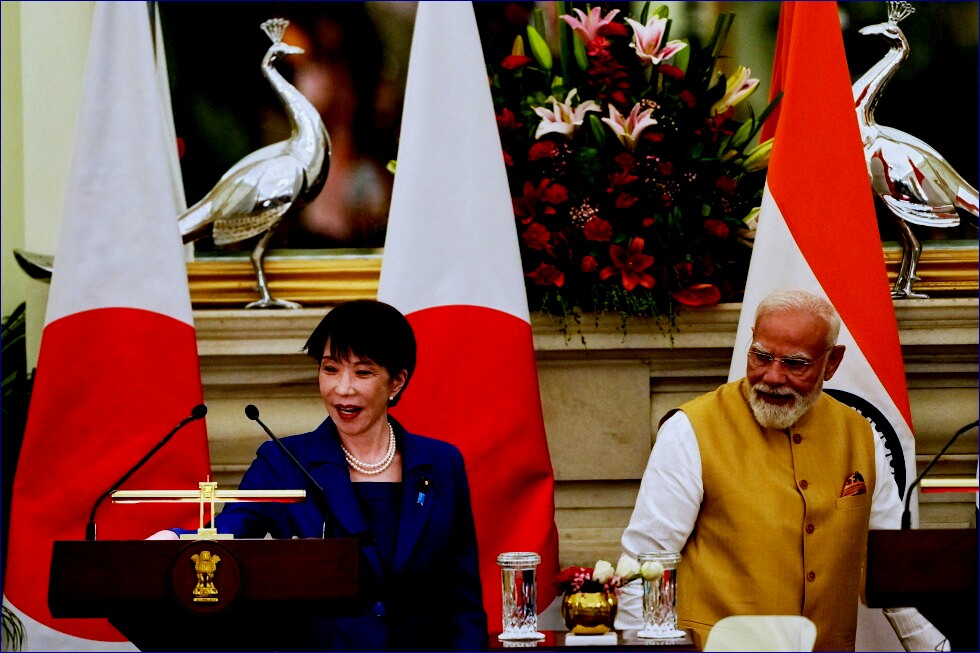
New Delhi – In a significant step towards enhancing their partnership, India and Japan announced several agreements on Thursday aimed at bolstering cooperation in defense, economic matters, and maritime security. This announcement came after discussions between Indian Prime Minister Narendra Modi and Japanese Minister Sanae Takaichi.
During their meeting, Modi expressed that both countries will work together on advanced naval radio antenna systems, alongside launching a joint roadmap to ensure economic security. They also emphasized the importance of collaboration in areas like artificial intelligence, shipbuilding, biogas, semiconductors, and other crucial technologies. “India and Japan see economic security as a shared interest,” Modi stated.
Japan is one of the largest foreign investors in India, backing key infrastructure projects, including the high-speed rail line between Mumbai and Ahmedabad. Currently, about 1,400 Japanese companies are active in India, with nearly half focused on manufacturing. In the fiscal year 2025-26, the two nations saw their trade reach $27.5 billion, with Japanese investments hitting $3.2 billion from April to December 2025, according to government sources.
Takaichi’s visit to New Delhi, part of the 16th annual India-Japan summit, aims to deepen ties in the Indo-Pacific region. This follows Modi’s trip to Tokyo last year, during which Japan committed to increasing its investment in India to over $61 billion in the upcoming decade.
Both India and Japan, along with the United States and Australia, are integral members of the Quad group, which focuses on regional security cooperation and maritime issues, especially to address China’s growing presence in the Indo-Pacific.
At the summit, Takaichi reiterated both nations’ commitment to Japan’s vision of a free and open Indo-Pacific, which emphasizes the importance of navigation freedom and adherence to international laws. “Expanding our maritime security cooperation is vital for peace and stability in the region,” she commented.
In response to this initiative, a spokesperson for China’s Foreign Ministry remarked that while some countries promote “freedom and openness,” they simultaneously pursue “confrontation and division.” He emphasized the need for stability in the Asia-Pacific region over chaos, urging a focus on cooperation rather than division.
