
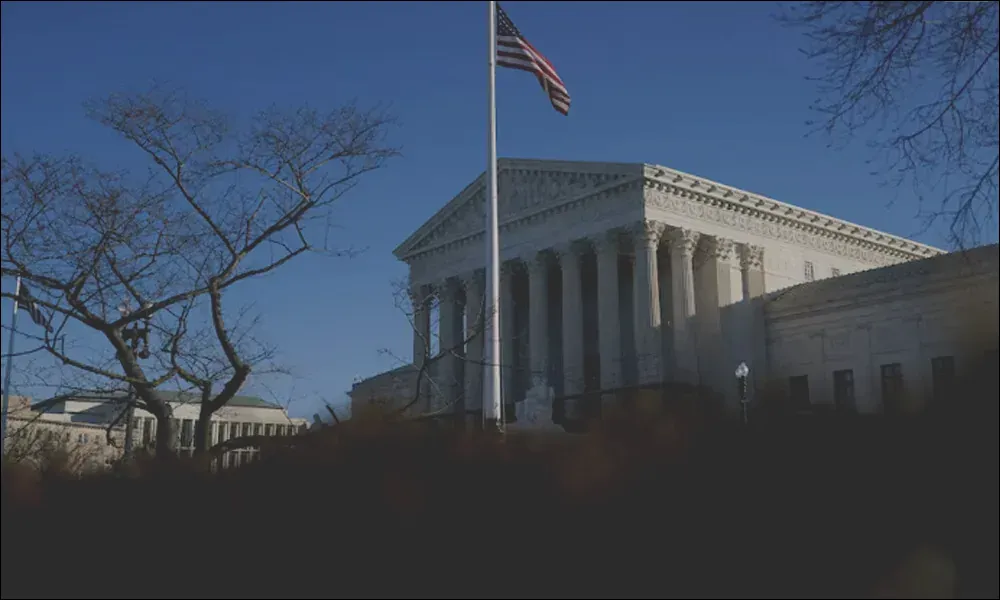
U.S. Supreme Court Rejects Trump’s Attempt to Limit Birthright Citizenship
WASHINGTON: In a significant ruling on Tuesday, the U.S. Supreme Court dealt a major blow to President Donald Trump by rejecting his efforts to limit birthright citizenship in the country. This ruling reinforces a long-standing principle of American law that guarantees citizenship to anyone born on U.S. soil, marking a setback for Trump’s immigration policies.
The court, in a 6-3 decision, upheld a lower court’s ruling that blocked Trump’s executive order, which aimed to deny citizenship to children born in the U.S. if their parents were not citizens or legal residents.
Critics of Trump’s order argued that it violates the 14th Amendment of the U.S. Constitution, which clearly states that anyone born in the U.S. is a citizen. This ruling draws on an important 1898 Supreme Court case, United States v. Wong Kim Ark, which confirmed that the 14th Amendment grants citizenship to all individuals born in the country.
Chief Justice John Roberts, who wrote the opinion for the majority, emphasized that the ruling from 1898 remains valid today. He noted, “We see no reason to depart from that view.”
Roberts pointed out that the Trump administration’s arguments were not supported by adequate evidence. He stressed that the language of the 14th Amendment does not suggest that citizenship should be limited to children of people who are residents of the U.S.
The implications of Trump’s directive were vast, potentially affecting around 250,000 newborns each year, while also putting millions of families in a position where they would need to prove the citizenship of their newborns.
The legal challenge began with a class-action lawsuit from families in New Hampshire affected by Trump’s directive. The 14th Amendment has traditionally been interpreted to guarantee citizenship for all children born in the United States with very few exceptions, such as children of foreign diplomats.
During arguments, U.S. Solicitor General D. John Sauer, representing the Trump administration, brought up the idea of “birth tourism,” claiming that many foreigners come to the U.S. to give birth in order to secure citizenship for their children. However, he acknowledged that the extent of this issue is unclear and largely based on media reports.
The 14th Amendment was ratified in 1868 following the Civil War to grant citizenship to former slaves and their descendants, making it an enduring part of American law.
Trump had consistently pushed for limitations on who qualifies for citizenship at birth, claiming that the current situation allows individuals to exploit the system.
In related cases, the Supreme Court has often sided with Trump on immigration issues, although this ruling does not apply to all of his policies. Earlier this year, the court ruled against Trump on other significant initiatives, including his expansive global tariffs.
As the court concluded its term, this latest ruling stands as a testament to the ongoing debates about citizenship, immigration, and presidential authority in the United States.
