
Mixed Market Sentiments as Key Talks Delay
BANGKOK — Global stock markets showed varied results on Friday, with U.S. futures taking a hit. Optimism regarding a potential peace deal between the U.S. and Iran faded as critical discussions on Iran’s nuclear program were postponed. The U.S. will also observe a market closure for Juneteenth.
Scheduled talks in Switzerland aimed at reaching a lasting peace between Iran and the U.S. have been delayed. Meanwhile, Israel confirmed that its military conducted strikes on targets in southern Lebanon, where fighting with Hezbollah intensified overnight.
“Both sides are making efforts to build trust,” commented Bas van Geffen from RaboResearch. “However, beneath the surface, the situation remains unstable, and the agreement is fragile on several levels.”
In Europe, Germany’s DAX index rose by 0.2%, closing at 25,079.30. The French CAC 40 remained mostly unchanged at 8,467.75, while the UK’s FTSE 100 dropped by 0.2% to 10,376.64. U.S. futures for the S&P 500 and Dow Jones slipped 0.2%.
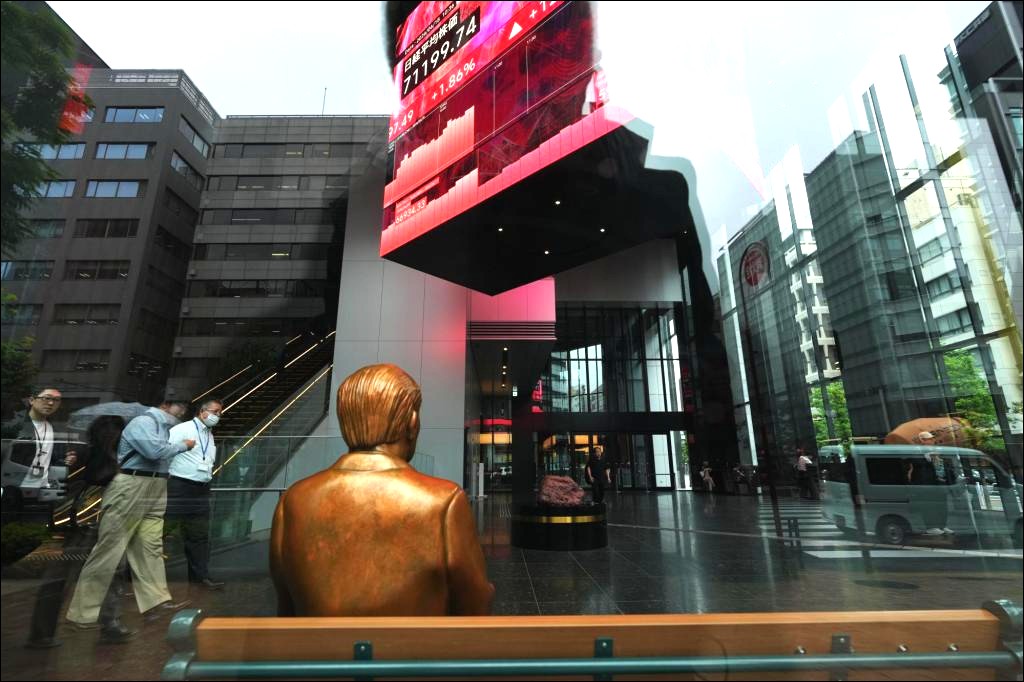
In Asia, Japan’s Nikkei 225 bounced around but ended 0.3% higher at a record of 71,250.06. Although consumer prices, except for volatile fresh foods, held steady, experts believe they will rise in the coming months, driven by increasing fuel costs. This inflation trend influenced Japan’s central bank to increase its benchmark interest rate to 1%, the highest in 30 years, as it adjusts its policies after years of low rates.
South Korea’s Kospi index edged down by 0.1% to 9,052.42, just short of its previous record. Australia’s S&P/ASX 200 fell by 0.9% to 8,828.70, and India’s Sensex dropped 0.8%. Markets in Hong Kong, Shanghai, and Taiwan were closed for the Dragon Boat festival.
On Wall Street the previous day, stocks rebounded, regaining most losses thanks to strong performances from major tech companies. The S&P 500 rose by 1.1%, while the Dow gained 0.1%. The Nasdaq saw a notable increase of 1.9%.
Technology stocks played a significant role in the uplift. Intel surged 10.6% following President Trump’s announcement that it would produce chips for Apple in the U.S. Other semiconductor firms, including Nvidia and Micron Technology, also recorded gains.
Conversely, SpaceX saw a continued decline, falling 3.6% after experiencing a loss of 4.9% the day before.
Oil prices fluctuated post-agreement on reopening the Strait of Hormuz for oil transport. Brent crude temporarily fell but ended the day 0.4% higher at $79.85 a barrel. U.S. benchmark crude decreased slightly to $75.85 a barrel. Early Friday, Brent crude dipped to $79.50.
Despite the recent turmoil, crude oil prices remain above $70 per barrel from before the conflict but are significantly lower than the more than $100 prices seen weeks ago. Rising energy costs are putting additional strain on inflation, with U.S. gasoline prices now averaging below $4 a gallon, although that’s still a 25% increase from last year. The cost of shipping has also gone up, affecting various goods.
The Federal Reserve kept its key interest rate steady this week, but increasing inflation suggests that rate hikes are likely by the year’s end. Lower rates generally foster growth by making borrowing easier, but they can also drive inflation.
In foreign exchange markets early Friday, the U.S. dollar fell slightly against the Japanese yen, trading at 161.31. The euro remained stable at $1.1458.
