
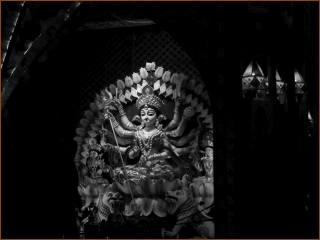
In the summer of 2022, I found myself in a situation that made me question my beliefs. Tired and anxious, my husband and I visited the Mahalaxmi temple in South Mumbai. I dressed casually, sporting denim jeans, a black t-shirt, and a traditional mangalsutra, all while trying to appear composed. Deep down, I was hoping to catch the attention of Goddess Mahalaxmi that evening.
As newly-weds, there are many things a couple might pray for, but that night, our prayers were focused on my visa to the United States. My husband, a believer, needed to leave for San Francisco soon, and the waiting time for my visa was overwhelming—our agent informed us that it could take anywhere from 18 to 22 months due to post-COVID delays. Faced with this daunting news, I found myself standing in line at one of the busiest temples in the city, participating in a tradition that seemed so foreign to my rational mind.
The atmosphere was overwhelming. Packed closely in the hot, humid air, I found myself surrounded by devoted worshippers all eager to connect with the divine. The sounds of temple bells, chants, and prayers created a chaotic but sacred environment. As I struggled with my thoughts, I noticed tension rising within me, and I attempted to escape the crowd to find some space.
At that moment, the noise faded, and a special worship session began. Amid the silence, a woman in the adjacent line stole my attention. She appeared to be in a trance, her body moving rhythmically while she emitted haunting sounds. It was as if she had been transported into another world, fully immersing herself in devotion while her friends urged her on.
Onlookers were captivated; they approached her, touched her, and shared their deepest wishes as if she had become a temporary embodiment of the goddess herself. This behavior is often seen in spiritual contexts across India, where a connection to the divine can manifest unexpectedly in the most ordinary of situations.
As I watched this astonishing scene, I realized that for a brief moment, societal norms slipped away. This woman, who probably faced judgment in her everyday life, was free to express herself openly, embraced by the energy of the crowd. I couldn’t help but question the fine line between devotion and madness.
Just as abruptly as it began, her performance ended. She returned to her normal self, straightening up and gathering her belongings. The crowd slowly stepped back, returning to their own thoughts.
Before I could reflect on what I had witnessed, my husband found me. He held my hand and led me closer to the idol of Mahalaxmi. As I took in the scene around me, my gaze drifted back to the woman. I spotted her, now quite ordinary, focused on her phone and chewing something nonchalantly. Our eyes met for a moment, and I felt an unspoken understanding pass between us. Despite the chaos and my skepticism, there was a shared acknowledgment of the human experience.
We left the temple that day, filled with questions but also a deeper connection to something beyond ourselves. A few days later, my husband flew to America while I waited back home. In just four months, my visa was approved.
This experience reminded me that sometimes, seeking help from unexpected places—even in our most desperate moments—can lead to surprising insights.
