
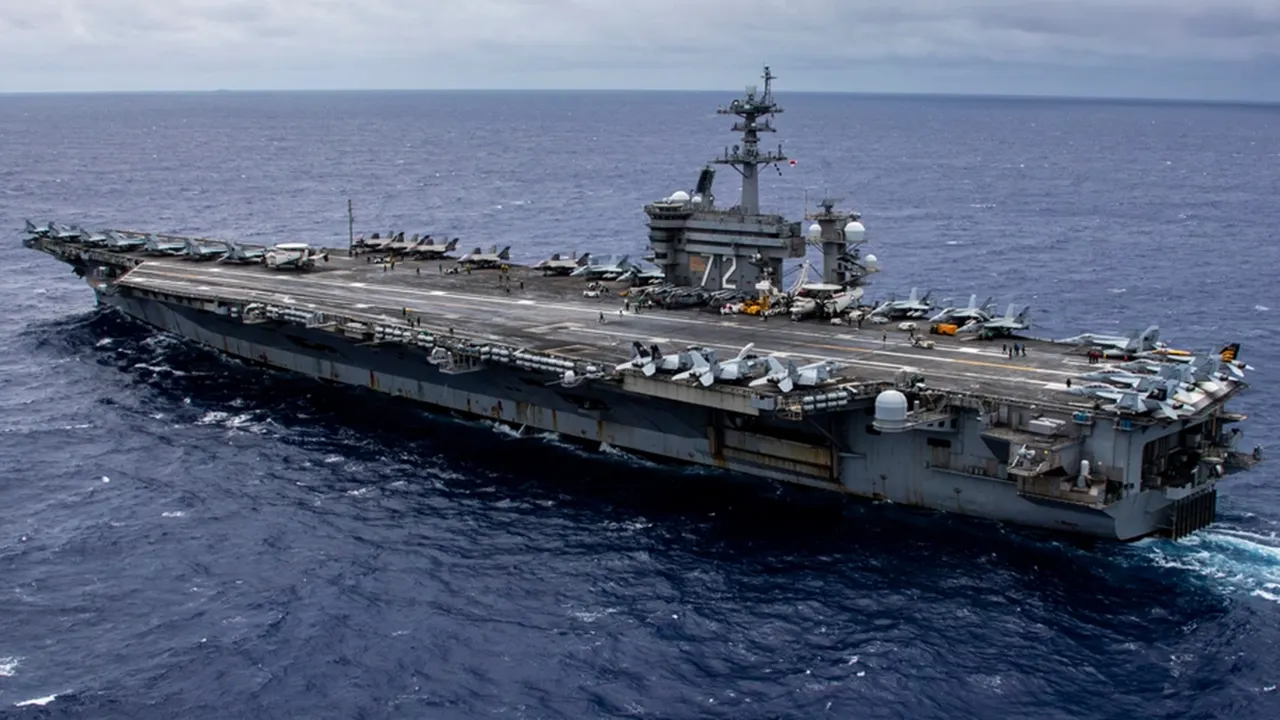
USS Abraham Lincoln Deploys to Indian Ocean Amid Iran Tensions
The USS Abraham Lincoln aircraft carrier has entered the Central Command (CENTCOM) waters of the Indian Ocean, as tensions with Iran continue to rise, a top U.S. official reported on Monday.
There are growing concerns that Iran’s Supreme Leader, Ayatollah Ali Khamenei, has gone into hiding, hinting that the country might be gearing up for military action. A prominent drone expert indicated that Iran’s drone swarms represent a significant threat to the Lincoln and its accompanying fleet.
While U.S. officials confirmed the Lincoln is in position, they stated it is still not fully prepared for any potential offensive actions against Iran.
Cameron Chell, CEO of Draganfly, elaborated on Iran’s capabilities, describing their drone operations as an “effective asymmetric threat.” He noted that Iran combines low-cost warheads with inexpensive drones, making them formidable against sophisticated military assets.
Reports suggest Iran’s leader has claimed that they are ready to deliver an “even bigger blow” to the U.S, while former President Trump mentioned he has no urgency for negotiations.
Chell warned that Iran’s strategy involves launching large numbers of relatively simple drones at naval vessels, which can lead to attacks that traditional defense systems may struggle to counter. He pointed out that if hundreds of drones are deployed simultaneously, some are likely to breach defenses.
He emphasized that U.S. Navy vessels near Iran are prime targets, as modern defense systems were not originally designed to handle such “saturation attacks.”
In response to the rising instability within Iran, U.S. officials are reinforcing their military presence, deploying more troops and equipment by air, land, and sea. A squadron of F-15 fighter jets has been sent to the region, alongside C-17 aircraft transporting heavy equipment.
Chell acknowledged that while U.S. and allied forces are improving their defenses, there remains uncertainty about how the USS Abraham Lincoln’s carrier group will manage multiple Iranian drones flying in formation.
He underscored that Iran’s drone fleet poses a credible threat to U.S. assets, which are often large, slow, and easily detected on radar. This makes them vulnerable to potential attacks. Chell concluded that Iran’s strength lies in these low-cost, abundant drone systems, particularly those designed for one-way strikes against targets.
