
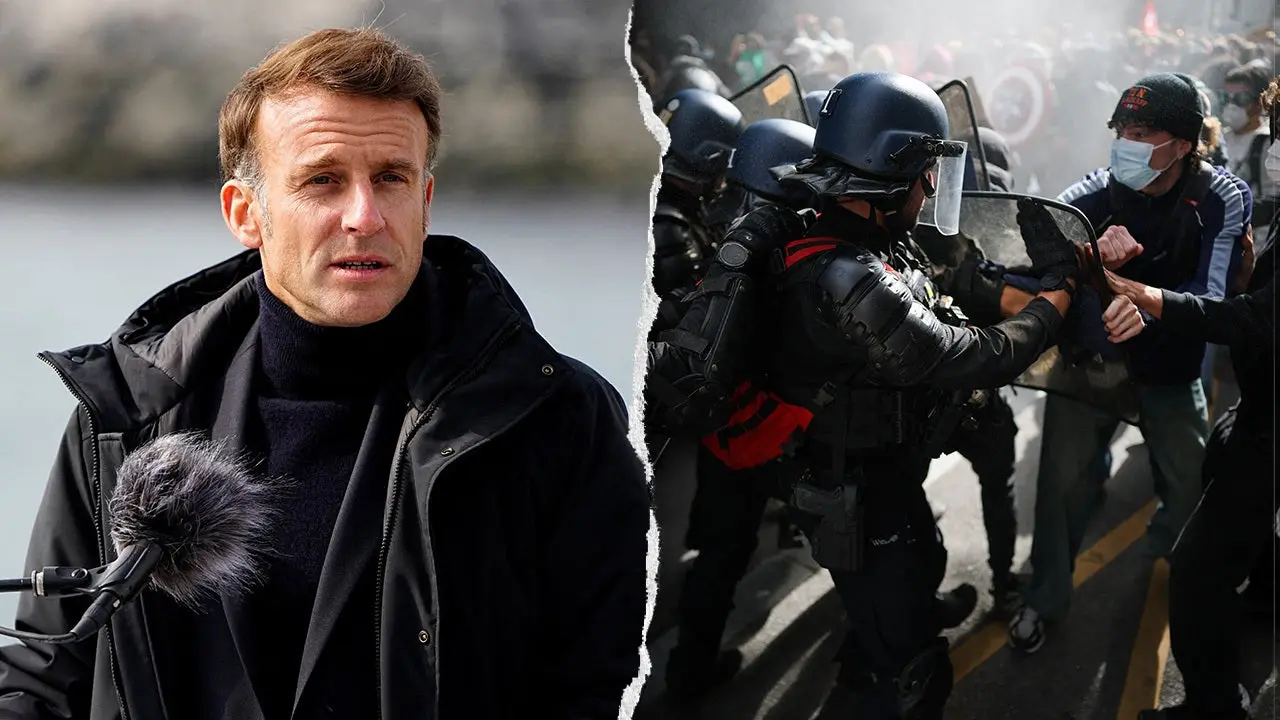
Student Protests in France Spark Widespread Unrest
Recent student protests in France, ignited by concerns over deteriorating school conditions, are now revealing deeper issues within the country. Experts suggest that factors like worsening financial circumstances, a weak political landscape, and rising radical movements are transforming the educational complaints into a broader crisis.
Simone Rodan-Benzaquen, a senior envoy for the Foundation for Defense of Democracies, noted in a Paris interview that what started as valid concerns regarding school infrastructure has become a tool for political factions looking to challenge the government. “While the frustration is genuine, the violence seems to be organized,” she explained, emphasizing that vandalizing schools will not solve the problems in the education system.
Major Unrest Over Education
Protests erupted in September, initially focusing on poor school conditions, such as overcrowded classrooms and outdated facilities. Currently, about 72% of the education budget is allocated to salaries and pensions, leaving only a small portion for investments in infrastructure, according to the French Education Ministry’s 2026 report.
Harvey Feigenbaum, a political science expert, highlighted that France’s mounting government debt and sluggish economic growth are significant contributors to the education crisis. He stated, “The country’s finances are under pressure, and people are escalating their demands amid years of neglected school facilities.”
The financial scale is alarming: France’s public debt reached 117.6% of its GDP in early 2026, ranking among the highest in the European Union. Moreover, rising borrowing costs are hindering the government’s ability to address the current unrest through increased funding, a method used to quell past protests.
Struggles in Politics and Governance
Amid this unrest, Macron’s political approach has come under scrutiny. When he became president in 2017, he aimed to create a centrist coalition, merging ideas from various political sides. However, this has weakened moderate parties without establishing a strong replacement.
Feigenbaum remarked, “Macron attracted moderate voters but, in doing so, dismantled those parties.” The absence of a stable political center has led to increased polarization and opportunities for radical groups to gain traction.
Previous reforms, like changes to pension laws, faced significant backlash, further complicating governance. Prime Minister Sébastien Lecornu now finds himself managing immediate unrest while Macron faces serious questions about the political system’s stability.
Ongoing Demands for Education Reform
The issues prompting the protests started with complaints about classroom overcrowding and unaddressed teacher absences. Rodan-Benzaquen points out that these protests also reflect young people’s anxieties about their futures, intensified by issues like climate change and economic insecurity.
Significantly, despite spending nearly $16,674 per student—much higher than the OECD average—resources for schools seem inadequate. Teachers cite persistent shortages and complaints about the hiring of qualified staff reinforce the demand for urgent reform.
The government’s announcement of an emergency plan to deploy 3,000 educators to crisis-hit schools shows a step toward addressing the issues, but protests continue as student unions demand more substantial reforms.
A Complex Landscape of Influences
Amid the unrest, concerns arise around the influence of radical political groups, including Jean-Luc Mélenchon’s far-left La France Insoumise party. While some reports suggest these groups may be stoking the unrest, others argue that many participants are motivated by genuine educational concerns and societal frustrations.
Rodan-Benzaquen indicated that various political movements are trying to harness student unrest. She noted a notable alliance is forming among diverse groups around shared causes, which is changing the landscape of the protests further than just educational disputes.
As protests evolve, many questions remain, particularly regarding the role of Islamist groups and how they intertwine with the broader political discourse.
Conclusion: A Nation at a Crossroads
While the government has made certain concessions, the protests continue, underscoring systemic issues in France’s educational system and the political landscape. As students demand changes, the challenge remains for the French government to balance public expectations against financial realities.
Rodan-Benzaquen warns of a growing divide within society exacerbated by social media, where individuals are exposed to vastly different narratives. This polarizing environment complicates dialogue and potential resolutions.
As the situation unfolds, France grapples with whether it can reconcile its ambitious commitments with financial constraints before the divides affecting its educational landscape deepen further.
