
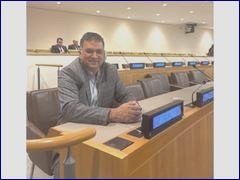
New York: Highlighting the Right to Development
On September 26, Shri Binod Anand, the Secretary General of the Confederation of NGOs of Rural India (CNRI) and the Founder of the World Cooperative Economic Forum (WCOOPEF), participated in discussions at the United Nations General Assembly. He addressed the crucial topic of the Right to Development and held important meetings concerning global politics and economics with leaders from UN DESA.
During these discussions, Anand shared India’s approach, termed “Sahkar Se Samriddhi” or “Prosperity through Cooperation.” He emphasized that this method offers a people-focused solution to major global issues like food, fertilizer, fuel, and finance. He pointed out how ongoing geopolitical conflicts disrupt supply chains, increase costs, and limit credit opportunities for countries in the Global South. In this context, cooperatives become vital as they are community-driven models that ensure the control of value, information, and decision-making remains with local producers.
The backbone of Anand’s arguments was the Cooperative Economic Framework (CEF) developed by CNRI. This framework considers cooperatives not merely as support entities but as crucial components of economic strategy. It promotes fair local markets, member-owned financial systems, and farmer-led supply chains that enhance economic independence and reduce the risk of exploitation and financial misconduct. His discussions spanned various aspects of the economy, connecting farming, dairy, fisheries, access to fertilizer, rural credit, cooperative insurance, and green energy innovations.
“The crises we face in food, fertilizer, fuel, and finance are interconnected,” Anand stated. “Control over this chain impacts countless small producers’ lives. Our Cooperative Economic Framework presents a solution: when farmers manage the entire chain—from seed to credit to clean energy—supply shocks become challenges we face together, rather than opportunities for individual profit. Development should be a right that everyone can exercise.”
With the anniversary of the Declaration on the Right to Development approaching, Anand noted, “The question for the United Nations isn’t about whether the Global South needs growth, but who will possess that growth.” He believes “Sahkar Se Samriddhi” empowers people, transforming them from passive recipients into active participants in their economic future. This cooperative approach is vital in safeguarding against market domination and financial exclusion.
In his discussions with UN DESA, Anand proposed a strategic partnership aimed at leveraging cooperatives to foster inclusive, sustainable digital development. This initiative includes plans for a Global South Cooperative Policy Lab, development toolkits, dialogues, and a digital literacy initiative focused on cooperatives with a proposed 12-month pilot project.
CNRI enjoys Special Consultative Status with the UN Economic and Social Council (ECOSOC) and has been affiliated with the OECD’s International Network on Financial Education (OECD/INFE) since 2011. WCOOPEF serves as a global, nonprofit platform promoting cooperative economics around the world.
Overall, the initiatives discussed by Anand and CNRI reflect a commitment to enhancing the livelihoods of rural communities and ensuring that economic growth benefits all stakeholders involved.
