
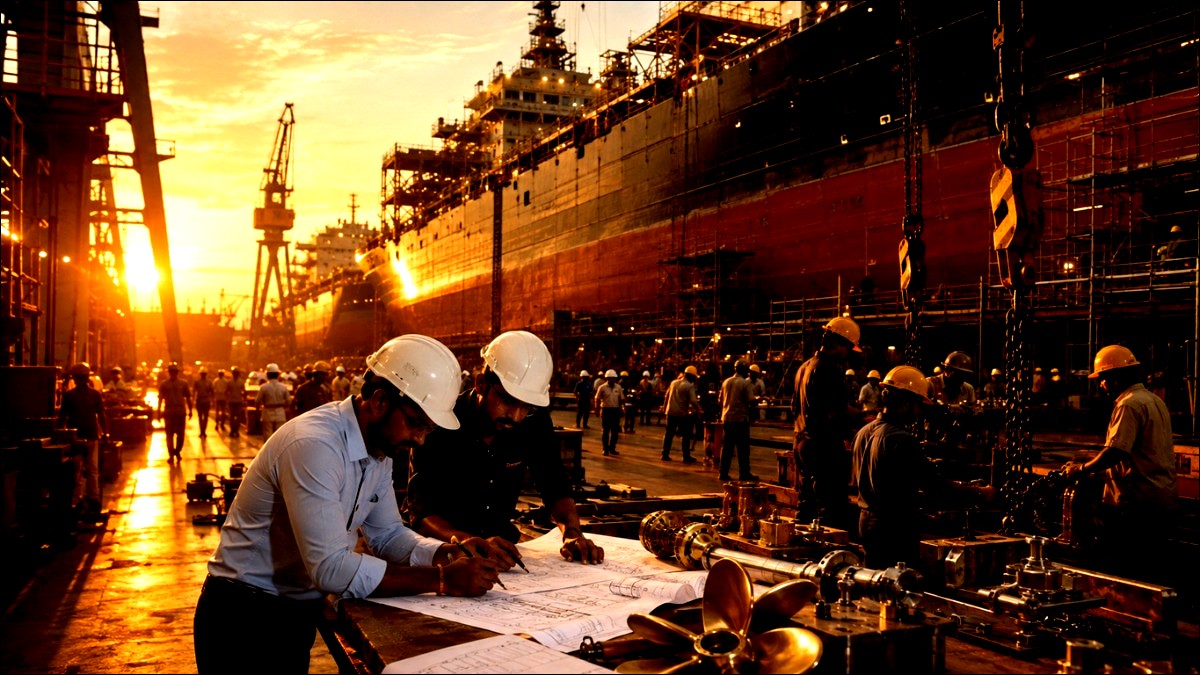
India’s Aspiration in Shipbuilding: A Journey Towards Global Competitiveness
India’s maritime industry carries a rich history, dating back to the Indus Valley Civilization, which boasted the world’s oldest dockyard in Lothal, Gujarat. Today, traditional maritime practices are echoed in celebrations like Boita Bandhna in Odisha, a festival that commemorates ancient sea voyages to Southeast Asia. Despite this illustrious past, India’s current contribution to global shipbuilding is minimal, accounting for less than 1% of the world’s capacity. In contrast, China, South Korea, and Japan dominate the industry, holding a staggering 98.5% share.
Setting Ambitious Goals
Recognizing the need for growth, the Indian government has initiated a substantial investment of Rs 69,725 crore to elevate the country into the top 10 shipbuilding nations by 2030, and into the top five by 2047. Currently, Indian shipyards mainly serve the Navy, focusing predominantly on domestic needs. However, there is a push towards expanding their reach and improving exports. This involves transitioning from producing small ships and patrol vessels to manufacturing larger frigates and modular warships for markets in Southeast Asia, Latin America, and Africa.
Facing the Competition
To compete with established giants, Indian shipbuilders have some advantages. Their experience in crafting vessels for the Indian Navy stands out, along with supportive government policies aimed at reducing capital costs and promoting local sourcing. Pricing is another strategic advantage, as Indian vessels are generally cheaper—30-40% lower in cost compared to European ships. However, India still faces challenges, including higher material and financing costs compared to East Asian competitors.
India is banking on modular construction techniques and strong diplomatic ties under initiatives like the Security and Growth for All in the Region (SAGAR) to strengthen its position in the global market. With a government plan to order over 400 vessels, shipyards can expect a steady stream of work.
The Importance of Shipbuilding
Shipbuilding is deemed a strategic industry for India, linking closely to sectors like steel, logistics, and defense. According to government estimates, it boasts impressive economic multipliers—6.4 times for employment and 1.82 for investment. As international trade expands, India’s cargo traffic is anticipated to grow to nearly 5.7 billion tonnes by 2047, a significant jump from the current 1.2 billion tonnes. Most of this freight currently depends on foreign-owned vessels, highlighting a critical opportunity for Indian-built ships to take a larger share of the transportation market.
The Maritime Focus
Unlike China, which blends civil and military shipbuilding, India’s focus remains largely on naval vessels. Captain (Retd) K.K. Agnihotri observes that while naval shipbuilding is a key strength, commercial ship construction has struggled to keep pace. Currently, only about 7% of India-owned commercial vessels are built domestically.
As the Navy prepares to introduce 19 new domestically built warships by 2026, there is a pressing need for Indian shipbuilders to innovate and scale up their operations. Past delays in orders, such as the gap faced by Mazagon Dockyard Ltd (MDL) in submarine production, underscore the importance of sustained government support to keep shipyards operational.
Strategic Collaborations and Future Outlook
The Navy and Indian shipyards have been working collaboratively since the 1970s, continuously developing their capabilities. There is optimism about future prospects, as efforts to handle orders among a few shipyards have proven effective.
Furthermore, there are exciting developments from major companies like Larsen & Toubro, which are expanding their shipbuilding facilities to tap into the burgeoning demand for naval vessels. The Tata Group is also making strides in the industry with a new shipyard in Kerala.
Embracing Modern Techniques
One significant hurdle for Indian shipyards is limited capacity to handle large-scale orders. With a gross tonnage capacity of only 0.072 million GT, Indian yards lag behind their South Korean and Japanese counterparts. To address this, the government plans to create new mega shipbuilding clusters across various states, facilitating the development of large vessels through shared infrastructure.
The Growing Potential of Ship Repair
The global ship repair market is projected to be worth $32-41 billion by 2026, growing to $55-60 billion by the 2030s. Although India currently captures less than 2% of this market, its strategic location and cost-effectiveness position it as a potential hub for ship maintenance and repairs.
Recent acquisitions, such as MDL’s controlling stake in Sri Lanka’s Colombo Dockyard, highlight India’s ambitions in the maritime sector. This facility’s proximity to busy shipping routes can elevate India’s role on the global maritime stage.
Conclusion
India’s shipbuilding sector stands at a crucial juncture. Government initiatives like Sagarmala, Make in India, and the Shipbuilding Financial Assistance Policy offer hope for establishing India as a dominant player in shipping. With continued effort and strategic investments, Indian shipyards can look forward to significant growth and competitiveness in the global market.
