
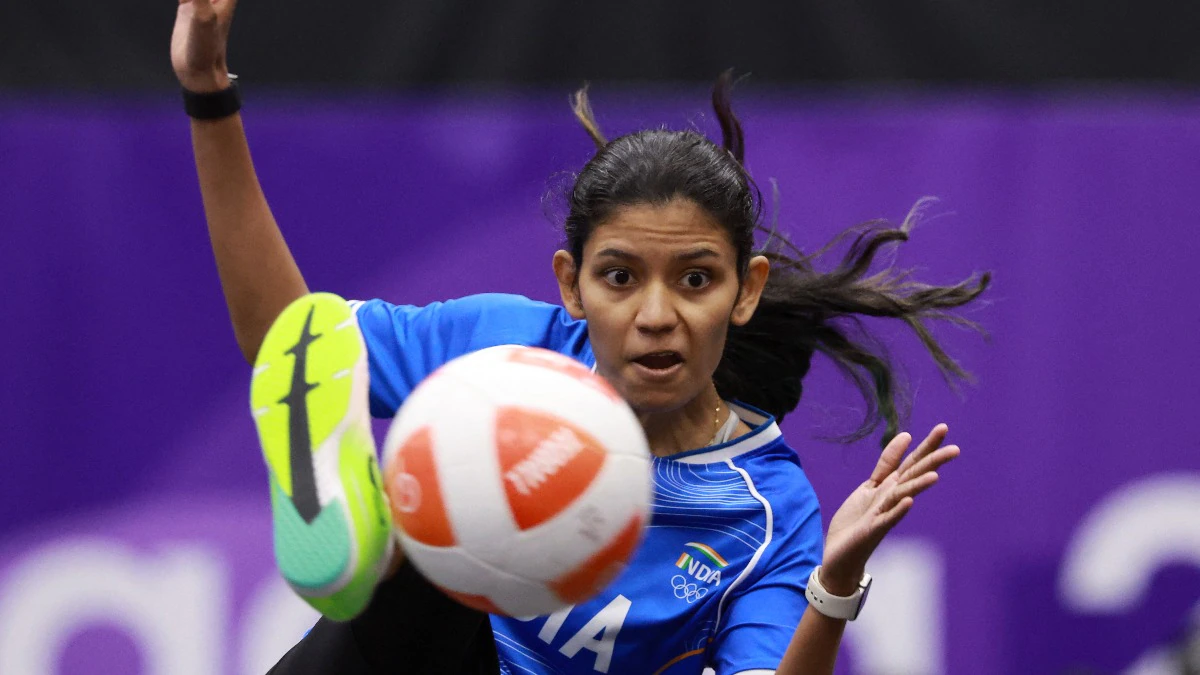
India faced disappointment in teqball at the Asian Games on Sunday morning, September 20. The country came close to winning two bronze medals—one in women’s singles and another in mixed doubles—but ultimately finished fourth in both events.
Quimcy Dsouza’s day started off with a tough loss that was hard to accept. Competing in the women’s singles bronze medal match against Japan’s World No. 7, Yuina Sakamoto, Quimcy came back strong after a weak start, but unfortunately fell short. The match ended with scores of 12-11 and 12-11 in favor of Sakamoto, but the excitement of the game couldn’t be summed up by the score alone, especially with the lively crowd at the Nagoya City Higashi Sports Center.
Initially, Quimcy struggled as Sakamoto took a commanding 5-1 lead early on. However, Quimcy began to find her rhythm, delivering clever shots that forced Sakamoto to stretch and struggle for control. Quimcy fought hard and managed to tie the game at 11-11, but Sakamoto quickly regained her composure to take the first set.
Feeling uplifted after her comeback, Quimcy started the second set strongly, even taking a 10-9 lead. But once again, Sakamoto responded with precise plays and tightened her defense. Quimcy, who had been in control, found herself in a new battle. Sakamoto fought back, ultimately winning the second set 12-11, leaving Quimcy visibly shaken and almost in tears after coming so close to a medal.
With no time to linger on her loss, Quimcy quickly prepared for another chance at a bronze, this time in mixed doubles. Teaming up with Mohammed Anas Beg, they faced Vietnam’s Tan Nguyen and Gia Trinh. From the get-go, it was clear they were in for a tough match, and Quimcy’s back pain worsened. After losing the first set 12-9, she received treatment, hoping to continue.
Unfortunately, her struggle grew evident as she had difficulty moving. Beg was also feeling the pressure, making mistakes when it mattered most. Despite calling for a time-out and receiving help from the physio, Quimcy could barely stand by the time they returned to play. The duo fought on, but ultimately lost the second set 12-6, sealing their fourth-place finish and the heartbreak of missing out on medals.
This was India’s first outing in teqball at the Asian Games, and although the medals eluded them, Quimcy Dsouza gave the sport a memorable representation in Nagoya. Her resilience and determination shone through, showing the potential for growth in this lesser-known sport.
Quimcy Dsouza, a 24-year-old from Mumbai, has quickly become a prominent figure in teqball. Although her journey in sports began with athletics and football, she found her passion for teqball in 2022. Since then, she has become a seven-time national champion and has played a big role in promoting the sport in India, even establishing the Teqball Club of Bangalore.
Besides her athletic career, Quimcy works as a test engineer at Decathlon in Bengaluru. On an international level, she has reached her highest world ranking at No. 24 and placed ninth in the 2026 World Championships in Romania. Her journey continues to inspire as teqball gains popularity both in India and globally, making Quimcy one of its key representatives.
