
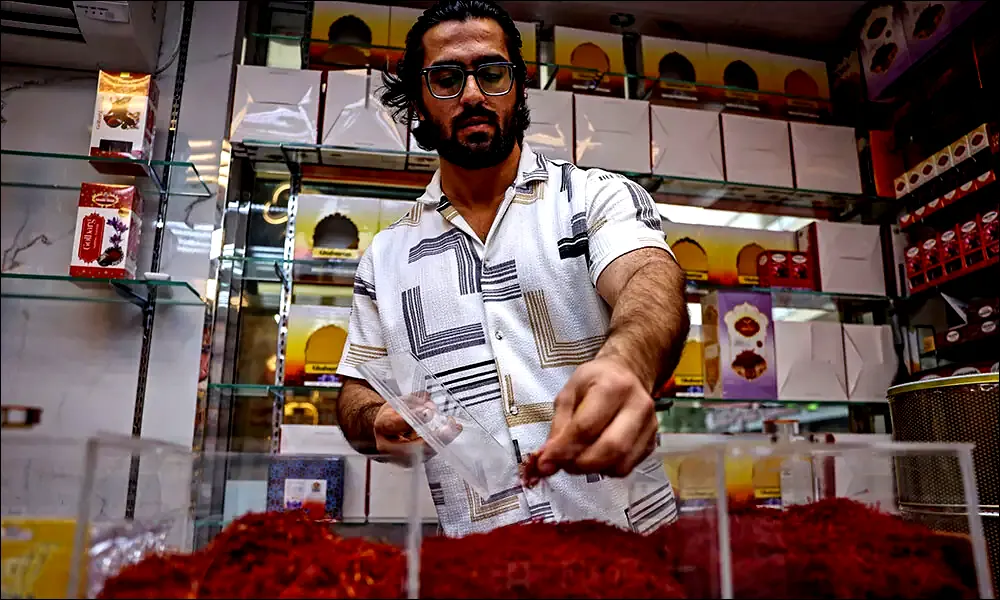
DUBAI: Old Dubai Markets Continue to Thrive Amid Tensions with Iran
In the vibrant markets of old Dubai, shelves are filled with familiar goods like saffron, cumin, pistachios, and almonds from Iran. Despite the tensions and conflicts that have arisen across the Gulf, these regions remain closely connected through trade.
Recently, the United Arab Emirates decided to suspend trade and financial transactions with Iran. In response, Tehran has taken aggressive actions against the UAE, particularly around the strategically vital Strait of Hormuz. However, many Iranian traders in Dubai remain optimistic about the enduring ties established over the years between the UAE and southern Iran.
Morteza Asaadi, who has operated a grocery store in the city since 1963, shared that while some Iranian products have become harder to find and others more expensive, many traditional items, including nuts and zereshk (small red berries used in Persian cooking), continue to be available. “It’s just coming. How? I don’t know, but it’s coming,” he remarked, expressing his faith in the resilience of trade.
Wholesalers, who wished to remain anonymous, confirmed that they are still able to get goods from Iran via Omani ports, despite the tighter restrictions. “We can’t export from the Emirates anymore, but we can still bring in certain goods,” one wholesaler explained.
In Yasser’s saffron shop, the prized spice is flown in from Mashhad, in northeastern Iran, thanks to resumed air connections after a brief pause.
The Role of the Iranian Community in Dubai
Dubai is home to a sizable Iranian community that numbers in the hundreds of thousands. This community has played a crucial role in the emirate’s commercial growth, even during times of tension with Tehran. Following the intensification of U.S. sanctions against Iran in 2012, the Iranian business community in Dubai successfully argued for continued trade, emphasizing its importance to the UAE economy, according to Mehran Haghirian of the Bourse & Bazaar Foundation.
In 2024, the UAE emerged as Iran’s main gateway for goods, making up over 30% of Iran’s imports worth around $21 billion. It also ranked as Iran’s third-largest market for exports, absorbing nearly 12% of its exports valued at over $7 billion, according to the World Trade Organization.
Dubai remains a vital financial center for Iranian businesses, and while the U.S. has accused the emirate of being a crucial hub for evading sanctions, banks like Iran’s Bank Melli continue to function in the region.
“We’ve been under sanctions for years,” said an employee at one of two Bank Melli branches in Dubai.
Future of UAE-Iran Relations
Haghirian believes that the UAE’s recent decision to suspend relations with Iran is a strategic move aimed at encouraging Tehran to return to the negotiating table and signifying solidarity with the U.S. However, he noted that such political maneuvers might not disrupt informal trade flows between private entities, which are well-established on both sides of the Gulf.
A significant detachment from these economic ties could potentially harm Dubai’s economy in the long term. “It’s difficult to just suddenly cut it off and not have an impact. That chunk cannot easily be replaced,” he cautioned.
Nonetheless, Nasser al-Shaikh, an Emirati businessman and former senior official, downplayed these issues at a conference, stating that Iran’s importance to the UAE economy has diminished over the years. While he acknowledged that the relationship was once mutually beneficial, he emphasized that national security must take precedence during times of conflict.
Back in his shop in Bur Dubai, Asaadi remains hopeful about the future of trade. He pointed towards the Gulf, saying, “You see the water there? Water can break a mountain,” suggesting that no matter the challenges, connections will endure.
