
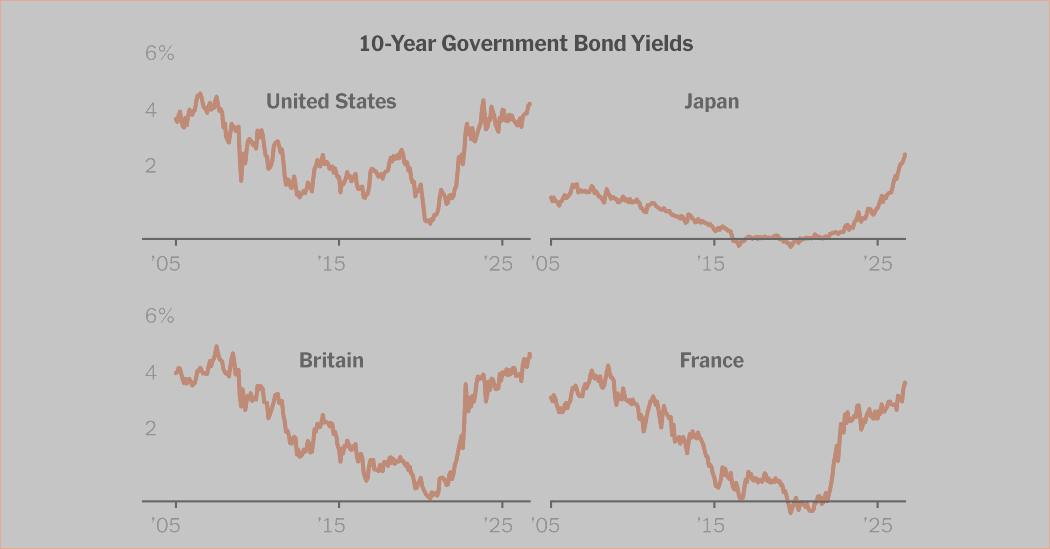
Global Bond Market Turmoil: Borrowing Costs Surge to Decades-high Levels
On Tuesday, a significant sell-off in government bonds across the globe reached a new peak, resulting in higher borrowing costs for some of the world’s largest economies. This increase threatens to impact a variety of debts, from business loans to mortgages, just as many consumers are already feeling the pinch.
Several factors are driving investors to seek greater returns on government debt. These include increased borrowing by wealthier nations, rising budget deficits, ongoing inflation, and a distinct lack of action from countries towards improving the situation.
In the United States, the yield on 10-year Treasury notes, a key indicator of interest rates globally, briefly hit 4.8 percent—its highest since January 2025. The yield on 30-year bonds also remains near a two-decade high, indicating that rising yields are correlating with falling prices.
The increasing borrowing costs in the U.S. have sparked conflict between Treasury Secretary Scott Bessent and market investors. However, the issues affecting U.S. bond yields are equally relevant to other major economies.
“It’s a global story,” noted Peter Schaffrik, a strategist at RBC Capital Markets in London.
The rise in oil prices, especially since the start of the conflict in Iran, has added to concerns about persistent inflation. As U.S. foreign policy continues to shake the global economy, Secretary Bessent, attending a G20 meeting in Asheville, N.C., tried to reassure the markets by stating, “I don’t think we’re in any kind of dire situation.”
This week also saw Japan’s bond yields surpass 3 percent for the first time since 1996, while yields in Britain reached their highest level since mid-2007, and Germany’s bond yields climbed to the highest levels since 2011.
Moreover, tech companies’ aggressive borrowing to develop artificial intelligence systems has flooded the market with bonds, diverting investors away from government debt. These so-called hyperscalers are increasingly issuing euro-denominated bonds as well.
“It’s becoming harder to unravel” the factors affecting the bond markets, remarked Ed Al-Hussainy, a portfolio manager at Columbia Threadneedle. “What we can clearly see is a unified direction towards higher rates, and it’s happening worldwide.”
The turmoil has also impacted stock markets, with declines seen in the S&P 500, Japan’s Nikkei index, and the Stoxx Europe 600.
One of the significant catalysts for this bond market instability is the ongoing conflict in Iran. The resurgence of attacks has led to climbing oil and natural gas prices. Brent crude oil surpassed $95 a barrel, up 30 percent from pre-war prices, nervously igniting inflation fears.
In Europe, consumer prices surged by 3.3 percent in August, marking the fastest inflation rate in nearly three years. This situation is prompting expectations that the European Central Bank may raise interest rates during its upcoming meeting, marking the second hike since the conflict in Iran began.
Traders are also speculating that the U.S. Federal Reserve will increase interest rates soon. Fed Chairman Kevin M. Warsh emphasized the challenges posed by ongoing inflation pressures, stating that the central bank has “work to do.”
The prospect of higher interest rates is coming at a time when government debt levels have ballooned. America’s national debt recently surpassed $40 trillion, while France’s public debt crossed 3.5 trillion euros (around $4 trillion). Japan faces a similar challenge, with debt levels exceeding twice its economic size.
Despite this alarming growth in debt, many investors feel that politicians aren’t giving enough attention to the issue. Without credible plans to tackle these deficits, investors are pushing for more generous returns on government bonds.
Geoffrey Yu, a strategist at BNY, noted that the relationship between bond markets and policymakers is becoming one of attrition, fueled by concerns over inflation, fiscal policy, and energy prices.
In Europe, skepticism about France’s financial plans looms large, especially with a presidential election around the corner. Investors are wary, and France’s status as a safe financial haven is diminishing, as evidence grows that it might be more concerning than traditionally troubled economies like Italy or Greece.
Some analysts believe that the current bond market conditions reflect a resilient economy, which might keep yield pressures up but also pave the way for appealing long-term investments.
As markets continue to adjust, Columbia Threadneedle’s Al-Hussainy mentioned that the current economic climate appears capable of managing these increased yields without disruption, although trading volumes are still lower than usual.
Ultimately, the bond market’s fluctuations could compel political leaders to take firmer action regarding debt management, a necessary response as growing pressures demand more attention.
